

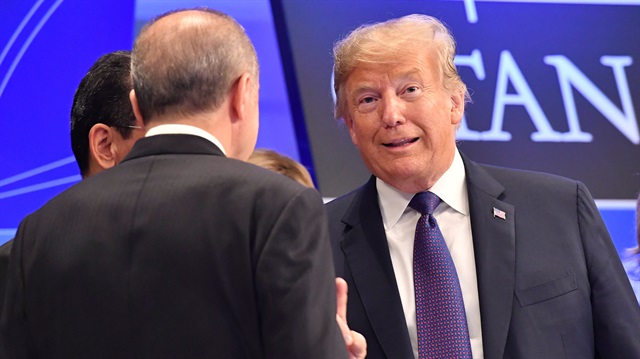
U.S. President Donald Trump talks to Turkish President Recep Tayyip Erdogan as they arrive for a dinner at the Art and History Museum at the Parc du Cinquantenaire during the NATO Summit in Brussels, Belgium July 11, 2018.
U.S. President Donald Trump hailed a personal victory at a NATO summit on Thursday, saying allies had sharply increased defence spending commitments after he provoked a crisis session with a tirade at European leaders.
"I told people that I would be very unhappy if they didn't up their commitments," an ebullient president told reporters after the second day of the Brussels meeting, when NATO leaders huddled with Trump to try to defuse a crisis.
"I let them know that I was extremely unhappy," he said, but added that the talks had ended on the best of terms: "It all came together at the end. It was a little tough for a little while."
Officials at the meeting said Trump had shocked many present and broke with diplomatic protocol by addressing German Chancellor Merkel by her first name, telling her: "Angela, you need to do something about this". Most officials and the invited leaders of non-NATO Afghanistan and Georgia were ushered out.
U.S. President Donald Trump launched a fresh attack on NATO allies' failure to raise defence spending on Thursday, prompting leaders to huddle in a special session excluding other summit participants, sources told Reuters.At one point, in a break with diplomatic protocol, a source said Trump addressed German Chancellor Merkel by her first name and told her: "Angela, you need to do something about this."As Trump amps up trade war, China plays nice with foreign investorsInvited leaders from non-NATO countries Afghanistan and Georgia were asked to leave along with most NATO leaders' retinues of officials, as the heads of state and government of the Western alliance sought to deal with the man whose nation commands much of the budget and forces for Europe's defence.Trump had opened the first day of talks in Brussels on Wednesday with a public diatribe against Germany, the second biggest state in the Western defence alliance, before the mood appeared to have calmed as the summit went into its second day, focusing on operations beyond Europe.But, several sources said, Trump instead reopened in strong terms his demand that other countries greatly speed up their progress toward a NATO target of spending at least two percent of their GDP on defence, which now has a deadline of 2024 with get-out terms available that can stretch it to 2030.After Trump's spending demands, NATO summit turns to Afghanistan"The language was much tougher today," one source told Reuters. "His harshest words were directed at Germany, including by calling her Angela --'You, Angela.'"As well as Merkel, Spanish Prime Minister Pedro Sanchez and Charles Michel, the prime minister of Belgium, were also singled out by Trump for undershooting on their spending targets when U.S. taxpayers, funding a defence budget worth about 3.6 percent of their national income, foot much of NATO's bills.Breaking from a carefully scripted session that was to focus on Ukraine and Georgia, one source said Trump "forcibly restated his position on wanting NATO members to reach 2 percent spending target to a short a deadline".Trump keeps up spending demands at NATO but turns on charmTwo NATO sources said, however, that Trump had not issued a threat to pull the United States out of the alliance that it helped found to keep the peace in Europe after World War Two.TWITTER DEMANDLeaders had gone into the second day, set to focus mainly on ending the long war in Afghanistan, with low expectations, showing the extent of European frustration with Trump's "America first" policies among the other 28 members of the alliance.Trump took to Twitter to say publicly what he told NATO leaders privately on Wednesday, calling on all allies to meet a commitment agreed in 2014 to spend 2 percent of economic output on defence to counter threats ranging from Russia's military modernisation to militant attacks on European cities.He also renewed a demand that they even double that -- though many question what they could usefully spend it on.US experts raise concern over FETÖ threat in America"All NATO Nations must meet their 2% commitment, and that must ultimately go to 4%!" Trump tweeted an hour before the second day of the summit got under way.Despite the first day's haranguing of allies for failing to meet spending targets and accusing Germany of being a prisoner to Russian energy, Trump was mild-mannered at a private dinner on Wednesday and avoided any outbursts that many NATO diplomats had feared."He was in a good mood, he said Europe was a continent he appreciated," Luxembourg's Prime Minister Xavier Bettel told reporters."We didn't know what to expect, it was a positive outcome," he said of the dinner in a Brussels park, where leaders were treated to an acrobatic display and saxophone music.French President Emmanuel Macron said the summit atmosphere was "much calmer than everyone had said" and he saw a will to maintain the unity of the alliance, while Croatian President Kolinda Grabar-Kitarovic said Trump was "constructive".
Trump tirade sends NATO leaders into crisis session
Others in the room, including the Lithuanian president whose country is among the most nervous of Russian ambitions, denied a suggestion that Trump had threatened to quit the alliance.
When asked about that, Trump said he believed he could do that without Congressional approval but it was "not necessary".
Instead, he said, the other 28 allies had agreed to increase their defence spending more quickly to meet a NATO target of two percent of their national income within a few years. The current commitment is to reach two percent by 2024 but with get-out terms that would allow some to stretch it out to 2030.
Trump stressed that NATO's budget had been unfair to the United States but now he was sure it would be fair. Allies would be increasing spending by $33 billion or more, he added.
He also said he thought spending of 4 percent on defence -- similar to the U.S. level -- would be the right level.
U.S. President Donald Trump on Thursday pressed home a new demand that allies more than double defence spending, but his European counterparts sought to avoid more tension at a NATO summit, saying the president was friendlier than expected.Leaders' low expectations showed the extent of European frustration with Trump's "America first" policies as they headed into a second day of talks with the 29 members of the Western military alliance, set to focus mainly on ending the long war in Afghanistan.Trump took to Twitter to say publicly what he told NATO leaders privately on Wednesday, calling on all allies to meet a commitment agreed in 2014 to spend 2 percent of economic output on defence to counter threats ranging from Russia's military modernisation to militant attacks on European cities."All NATO Nations must meet their 2% commitment, and that must ultimately go to 4%!" Trump tweeted an hour before the second day of the summit got underway.After Trump's spending demands, NATO summit turns to AfghanistanDespite the first day's haranguing of allies for failing to meet spending targets and accusing Germany of being a prisoner to Russian energy, Trump was mild-mannered at a private dinner on Wednesday and avoided any outbursts that many NATO diplomats had feared."He was in a good mood, he said Europe was a continent he appreciated," Luxembourg's Prime Minister Xavier Bettel told reporters."We didn't know what to expect, it was a positive outcome," he said of the dinner in a Brussels park, where leaders were treated to an acrobatic display and saxophone music.French President Emmanuel Macron said the summit atmosphere was "much calmer than everyone had said" and he saw a will to maintain the unity of the alliance, while Croatian President Kolinda Grabar-Kitarovic said Trump was "constructive".Canada to command new NATO mission in IraqFrom abandoning the Iran nuclear deal to putting higher tariffs on European Union steel imports and threatening more on cars, Trump has undermined European priorities in the Middle East, on free trade and on combating climate change.While Germany, Europe's biggest economy, has been in Trump's sights, Britain was keen to make the most of its status as one of the few NATO nations that meet the spending target and sided with Washington's position that allies should spend more."We think President Trump is basically right, that the foundation of a successful alliance is fair contributions by all parties," said Britain's new foreign minister Jeremy Hunt.US former top diplomat blasts Trump's NATO remarksHELSINKI RISKAt the NATO summit, normally a ceremonial affair to cement an alliance that dates back almost seven decades, officials had hoped to limit discussions to strictly military business, especially as deterring Russia is a rare unifying factor after Moscow's 2014 annexation of Ukraine's Crimea.Ukraine's Petro Poroshenko met NATO Secretary-General Jens Stoltenberg and spoke at the decision-making North Atlantic Council session with leaders, although his hopes of joining the alliance are, for the time being, thwarted by Russia's incursion into eastern Ukraine and its support for rebels there.Under NATO rules, countries with armed conflicts on their territory cannot join the Western alliance.The U.S. president will travel to Britain later on Thursday and then to Helsinki to see Russia's Vladimir Putin on Monday, a meeting that NATO diplomats say will be the true test of Trump's commitment to the Western alliance.Any deal with Putin to call off U.S. exercises in the Baltics or withdraw U.S. troops from the region would be a severe blow to the West's policy towards Moscow, although diplomats, officials and analysts stressed such outcomes were only a worst-case scenario not based on any official position.Still, three senior U.S. officials told Reuters that no one in the Pentagon, including Secretary of Defence Jim Mattis, knows what Trump might say in Helsinki."The president came out of Singapore saying he'd ended the nuclear threat from North Korea," said one U.S. official, referring to Trump's meeting with North Korean leader Kim Jong Un."Who's to say he won't come out of Helsinki saying he and Putin agreed that Russia no longer poses a threat to the rest of Europe?"
Trump keeps up spending demands at NATO but turns on charm
"TOTAL CREDIT TO ME"
"We have a very powerful, very strong NATO, much stronger than it was two days ago," he said. Citing the alliance's Secretary-General Jens Stoltenberg, he said: "Secretary Stoltenberg gives us total credit, meaning me, I guess, in this case, total credit. Because I said it was unfair."
"The numbers have gone up like a rocket ship ... and they're going to be going up further," he said. "Everybody in that room got along and they agreed to pay more and they agreed to pay it more quickly."
Merkel said: "We had a very intense summit."
Trump had opened the first day of talks in Brussels on Wednesday with a public diatribe against Germany, the second biggest state in the Western defence alliance, criticising its reliance on Russian gas imports and failure to spend more on defence.
NATO leaders will try on Thursday to move beyond Donald Trump's demands for higher defence spending, and focus on ending the long war in Afghanistan, in the second day of a summit in Brussels underscored by transatlantic tensions.On a trip that will also take the U.S. president to Britain and to Helsinki to meet Russia's Vladimir Putin, Trump spent the first day of the NATO summit lambasting allies for failing to spend the targeted 2 percent of GDP on defence and accused Germany of being a prisoner to Russian energy.Erdoğan meets Merkel on sidelines of NATO SummitOn day two, leaders will welcome non-NATO partners including Afghan President Ashraf Ghani and Ukraine's Petro Poroshenko to the alliance's new glass-and-steel headquarters as they seek to focus on policy rather than politics.Britain's Prime Minister Theresa May tried to set the tone on Wednesday by announcing more troops for NATO's Afghan training mission."We will be deploying an additional 440 personnel to NATO's Resolute Support mission in Afghanistan and I think that shows when NATO calls, the UK is one of the first to step up," May told reporters.German FM: ‘We are not captives’ of Russia or USNATO to ‘monitor’ ballistic missile threat to TurkeyNATO's chief Jens Stoltenberg wants leaders to agree to fund Afghan security forces until 2024, despite public fatigue in Western countries about their involvement in the conflict.Funding has averaged at about $1 billion annually and Stoltenberg has said he expected that level to be met.Leaders will be keen to hear more about Trump's military approach to Afghanistan, which he revamped last August to include a surge in air strikes to force Taliban militants to the negotiating table.U.S. officials have told Reuters Washington is preparing another review of strategy, a year after Trump begrudgingly agreed to extend involvement in the 17-year-old war.Trump was opposed to remaining in America's longest war, but his advisers convinced him to give it more time. He authorized the deployment an additional 3,000 troops, bringing the total to around 15,000.At the summit, leaders will discuss ties with Georgia and Ukraine, two NATO membership hopefuls who contribute to troop levels in Afghanistan but have seen their chances of joining the alliance hampered by Russian incursions into their territory.Under NATO rules, countries with territorial conflicts cannot join the Western alliance and neither country is expected to progress in membership talks.Macedonia, however, which was formally invited to start accession talks on Wednesday, will be part of a special ceremony on Thursday as the alliance sets the stage for expanding to its 30th member state.
After Trump's spending demands, NATO summit turns to Afghanistan
The mood had appeared to have calmed as the summit went into its second day, focusing on operations beyond Europe. But, several sources said, Trump instead reopened in strong terms his demand that other countries spend more immediately.
"The language was much tougher today," one source told Reuters. "His harshest words were directed at Germany, including by calling her Angela --'You, Angela.'"
As well as Merkel, Spanish Prime Minister Pedro Sanchez and Charles Michel, the prime minister of Belgium, were singled out by Trump for undershooting on their spending targets when U.S. taxpayers, funding a defence budget worth about 3.6 percent of their national income, foot much of NATO's bills.
U.S. President Donald Trump said on Thursday that "no more nuclear weapons anywhere in the world" would be the ultimate goal of his meeting with Russian counterpart Vladimir Putin next week.
Trump says 'no more nuclear weapons' would be ultimate goal of Putin meeting
President Donald Trump on Thursday said the best agreement he could have with Russian President Vladimir Putin would be one where there would be no nuclear weapons in the world.
Asked what would be the best possible result from his meeting with Putin, Trump said: "What would be the ultimate? Let's see. No more nuclear weapons anywhere in the world, no more wars, no more problems, no more conflicts. ... That would be my ultimate."
Trump is due to meet with Putin on Monday in Helsinki.
The United States and the United Arab Emirates have broken up a network funnelling illicit funds to Iran as Washington steps up a drive to restrict Iranian trade and access to hard currency in the region, a senior U.S. official said on Thursday."We jointly disrupted a currency exchange network that was transferring millions of dollars to Iran's Islamic Revolutionary Guards Corps' Quds Force," said Sigal Mandelker, Under Secretary for Terrorism and Financial Intelligence at the U.S. Treasury.She said the network was dismantled in May. Currency exchanges had used the UAE financial system to transfer cash out of Iran and convert it into U.S. dollars for use by Iranian-supported proxy groups in the region, she said.The network, directed by senior officials of Iran's central bank, forged documents and disguised its dealings behind front and shell companies, Mandelker told reporters.She did not give further details of the operation. In early June, the UAE central bank announced it had restricted the operations of seven currency exchange houses for unspecified violations of anti-money laundering and other regulations.Iran has denounced the U.S. campaign to hurt its economy as unjustified interference in its affairs.The UAE central bank and the UAE government media office did not immediately respond to questions on Thursday on the crackdown described by Mandelker and on whether the seven exchange houses sanctioned by the central bank were involved.Mandelker was visiting the UAE after making similar trips to Saudi Arabia and Kuwait to win support for the U.S. effort to squeeze Iran, which comes after President Donald Trump decided to pull out of an international deal on Iran's nuclear programme and reimpose sanctions on Tehran. She said governments and financial institutions in the Gulf were cooperating closely with the United States because they agreed on Tehran's malign influence in the region.Mandelker said Washington was trying to constrict Iran's trade in general, not just its oil and gas sales, which provide for over half of its export receipts.But Washington may struggle to achieve a sharp reduction of Iranian business with the UAE. Dubai has traditionally served as a hub for exports to Iran and received Iranian investment in its businesses and real estate market.UAE exports to Iran totalled $19.9 billion in 2017, or about 5 percent of the UAE's gross domestic product, according to International Monetary Fund data.Asked about this, Mandelker said Washington had an "excellent partnership" with the UAE. "There's no question in my mind that working together, we can take significant action (against Iran) to disrupt their ability to fund themselves," she said. 
US says disrupts Iran finance operation in UAE to squeeze Tehran
Iran treating U.S. with more respect
U.S. President Donald Trump said he expected Iran to call him one day with an offer to allay U.S. security concerns, saying Tehran was treating Washington with much more respect after he pulled the U.S. out of a nuclear deal.
"They're treating us with much more respect right now than they did in the past," Trump told reporters after a summit of NATO leaders in Brussels.
"I know they're having a lot of problems and their economy is collapsing. But I will tell you this: at a certain point they're going to call me they're going to say 'Let's make a deal'. They're feeling a lot of pain right now."
The European Commission cut on Thursday its forecasts for the euro zone's economic growth this year, saying the main causes for the revision were trade tensions with the United States and rising oil prices which are pushing the bloc's inflation higher.The slowdown of the euro zone economy is set to affect all major economies of the bloc, but is expected to hit Italy harder, as the country will record the lowest growth rate in Europe, matched only by Britain among all EU countries.The EU executive estimated the 19-country euro zone will grow by 2.1 percent this year, lower than the 2.3 percent gross domestic product (GDP) increase it had forecast in its previous estimates released in May. Next year the bloc's growth should further slow to 2.0 percent, unchanged from the previous forecast.Brexit blueprint should reassure EU over strategy: UK minister"The downward revision of GDP growth since May shows that an unfavourable external environment, such as growing trade tensions with the U.S., can dampen confidence and take a toll on economic expansion," EU commission's vice-president Valdis Dombrovskis said.Rising oil prices have also contributed to the slowdown, the EU economics commissioner Pierre Moscovici said, and are expected to push euro zone's inflation up to 1.7 percent this year and next, from the previously estimated 1.5 percent in 2018 and 1.6 percent in 2019.Germany and France, the two largest economies of the euro zone, are expected to lose steam this year and next.Germany's GDP expansion will slow to 1.9 percent this year and in 2019 from the previously estimated 2.3 percent in 2018 and 2.1 percent in 2019.France's economy will grow 1.7 percent this year and next, less than the 2.0 percent the Commission had earlier forecast for this year and also slower than the 1.8 percent growth previously forecast for 2019.The slowest-growing economy of the bloc will remain Italy which is expected to grow only 1.3 percent this year, less than the 1.5 percent estimated in May.One of the causes cited by the Commission for the revision were "re-emerging concerns or uncertainty about economic policies", as Italy's new eurosceptic government has launched ambiguous messages on its future spending plans.Only Britain is expected to match Italy's sluggish growth among all the 28 states of the European Union. It will grow 1.3 percent this year, according to the Commission, less than the previously estimated 1.5 percent growth.Britain's inflation is also forecast to go up further to 2.6 percent this year, from a previous estimate of 2.5 percent.
EU Commission cuts euro zone growth forecasts, blames trade wars
U.S. will hit EU cars if no good faith in trade talks
U.S. President Donald Trump warned the European Union on Thursday that the United States would act to restrict entry for European cars if the bloc failed to treat his country fairly on trade.
Trump, who is set to host European Commission President Jean-Claude Juncker in Washington this month, repeated his line that the EU was treating the United States unfairly on trade, shutting out U.S. farmers.
"That'll change also and I think we'll see that because on the 25th of July they're coming in to start negotiations with me. We'll see," he told a news conference at the end of a meeting of NATO leaders.
"And if they don't negotiate in good faith we'll do something having to do with all the millions of cars that are coming into our country and being taxed at a virtually zero level, at a very low level... I think it's been a very effective way of negotiating, but I'm not negotiating, I just want fairness for the United States," he said.