

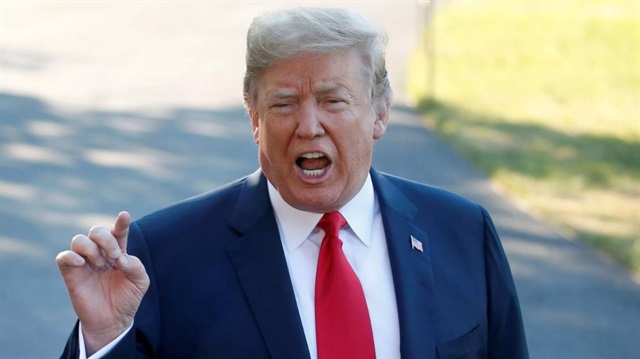
U.S. President Donald Trump
U.S. President Donald Trump on Thursday pressed home a new demand that allies more than double defence spending, but his European counterparts sought to avoid more tension at a NATO summit, saying the president was friendlier than expected.
Leaders' low expectations showed the extent of European frustration with Trump's "America first" policies as they headed into a second day of talks with the 29 members of the Western military alliance, set to focus mainly on ending the long war in Afghanistan.
Trump took to Twitter to say publicly what he told NATO leaders privately on Wednesday, calling on all allies to meet a commitment agreed in 2014 to spend 2 percent of economic output on defence to counter threats ranging from Russia's military modernisation to militant attacks on European cities.
"All NATO Nations must meet their 2% commitment, and that must ultimately go to 4%!" Trump tweeted an hour before the second day of the summit got underway.
NATO leaders will try on Thursday to move beyond Donald Trump's demands for higher defence spending, and focus on ending the long war in Afghanistan, in the second day of a summit in Brussels underscored by transatlantic tensions.On a trip that will also take the U.S. president to Britain and to Helsinki to meet Russia's Vladimir Putin, Trump spent the first day of the NATO summit lambasting allies for failing to spend the targeted 2 percent of GDP on defence and accused Germany of being a prisoner to Russian energy.Erdoğan meets Merkel on sidelines of NATO SummitOn day two, leaders will welcome non-NATO partners including Afghan President Ashraf Ghani and Ukraine's Petro Poroshenko to the alliance's new glass-and-steel headquarters as they seek to focus on policy rather than politics.Britain's Prime Minister Theresa May tried to set the tone on Wednesday by announcing more troops for NATO's Afghan training mission."We will be deploying an additional 440 personnel to NATO's Resolute Support mission in Afghanistan and I think that shows when NATO calls, the UK is one of the first to step up," May told reporters.German FM: ‘We are not captives’ of Russia or USNATO to ‘monitor’ ballistic missile threat to TurkeyNATO's chief Jens Stoltenberg wants leaders to agree to fund Afghan security forces until 2024, despite public fatigue in Western countries about their involvement in the conflict.Funding has averaged at about $1 billion annually and Stoltenberg has said he expected that level to be met.Leaders will be keen to hear more about Trump's military approach to Afghanistan, which he revamped last August to include a surge in air strikes to force Taliban militants to the negotiating table.U.S. officials have told Reuters Washington is preparing another review of strategy, a year after Trump begrudgingly agreed to extend involvement in the 17-year-old war.Trump was opposed to remaining in America's longest war, but his advisers convinced him to give it more time. He authorized the deployment an additional 3,000 troops, bringing the total to around 15,000.At the summit, leaders will discuss ties with Georgia and Ukraine, two NATO membership hopefuls who contribute to troop levels in Afghanistan but have seen their chances of joining the alliance hampered by Russian incursions into their territory.Under NATO rules, countries with territorial conflicts cannot join the Western alliance and neither country is expected to progress in membership talks.Macedonia, however, which was formally invited to start accession talks on Wednesday, will be part of a special ceremony on Thursday as the alliance sets the stage for expanding to its 30th member state.
After Trump's spending demands, NATO summit turns to Afghanistan
Despite the first day's haranguing of allies for failing to meet spending targets and accusing Germany of being a prisoner to Russian energy, Trump was mild-mannered at a private dinner on Wednesday and avoided any outbursts that many NATO diplomats had feared.
"He was in a good mood, he said Europe was a continent he appreciated," Luxembourg's Prime Minister Xavier Bettel told reporters.
"We didn't know what to expect, it was a positive outcome," he said of the dinner in a Brussels park, where leaders were treated to an acrobatic display and saxophone music.
French President Emmanuel Macron said the summit atmosphere was "much calmer than everyone had said" and he saw a will to maintain the unity of the alliance, while Croatian President Kolinda Grabar-Kitarovic said Trump was "constructive".
Canada will take command of a new training mission in Iraq designed to counter the threat of a Daesh re-emergence, Prime Minister Justin Trudeau announced Wednesday at the NATO Summit in Brussels.Canada will send up to 250 personnel and four Griffin helicopters and make up the bulk of the force for the NATO Western military alliance, beginning this fall.The main job of the Canadians will be to provide protection for hundreds of other personnel from NATO countries who will train local forces in counter-terrorism tactics.US former top diplomat blasts Trump's NATO remarksNow that Daesh has been defeated in Iraq, Trudeau said the task is to keep the terrorists from regaining a foothold and to rebuild democracy in Iraq and “strengthen it.”“Since NATO’s creation in 1949, Canada has played a strong and active role in missions to advance people and security for our citizens and people around the world,” Trudeau said in a statement. “We are proud to take a leadership role in Iraq and work with our Allies and the Government of Iraq to help this region in the Middle East transition to long-lasting peace and stability.”But the Canadian initiative may also be a move to stifle U.S. President Donald Trump’s assertion that his country is carrying too much of the load of NATO and he wants the other 28 members to contribute more.NATO to ‘monitor’ ballistic missile threat to TurkeyWhen asked if Trump would give Canada credit for heading the Iraq mission, Canadian Foreign Affairs Minister Chrystia Freeland ducked the question.“Our first – and really our only consideration – was what served the Canadian national interest, what served Canadians, what was appropriate to do for Canada given our role in the world and the very great interest we, as Canadians, have in a functioning, rules-based international order,” Freeland said.
Canada to command new NATO mission in Iraq
From abandoning the Iran nuclear deal to putting higher tariffs on European Union steel imports and threatening more on cars, Trump has undermined European priorities in the Middle East, on free trade and on combating climate change.
While Germany, Europe's biggest economy, has been in Trump's sights, Britain was keen to make the most of its status as one of the few NATO nations that meet the spending target and sided with Washington's position that allies should spend more.
"We think President Trump is basically right, that the foundation of a successful alliance is fair contributions by all parties," said Britain's new foreign minister Jeremy Hunt.
Former Secretary of State John Kerry ripped America's sitting chief executive Wednesday, calling President Donald Trump's criticisms of NATO and Germany "strange" and "counterproductive.""It was disgraceful, destructive, and flies in the face of the actual interests of the United States of America," Kerry said in a statement released shortly after Trump's haranguing of the transatlantic alliance and singling out of Germany during a summit in Brussels.During the meeting of the 29-member alliance Trump suggested Germany is "totally controlled" and "captive to Russia," pointing to its use of Moscow's fossil fuels."I think it's very sad when Germany makes a massive oil and gas deal with Russia, where you're supposed to be guarding against Russia, and Germany goes out and pays billions and billions of dollars a year to Russia," Trump said. "Why are countries in NATO, namely Germany, having a large percentage of their energy needs paid to Russia and taken care of by Russia?"NATO to ‘monitor’ ballistic missile threat to TurkeyHe later reiterated his criticism on Twitter.Trump also took aim at "delinquent" NATO members’ defense spending, calling on allies to not only meet the minimum goal of spending 2 percent of GDP on defense, but urging them to double that to a total of 4 percent.Only five NATO members have met the 2 percent benchmark to date, including the U.S. NATO expects the number of countries that are meeting the guideline to rise to eight this year, and expects the number to rise to 15 by 2024.Trump, however, sent a tweet from the summit insisting members "must" meet the goal, set in 2014, "IMMEDIATELY."In repeatedly sending such pointed barbs at NATO and Germany, Kerry said Trump "is steadily destroying our reputation in the world. He is undermining our interests. He diminishes alliances we built to safeguard an economic and strategic force that has allowed millions of people to live in freedom."There's a time, place, and manner for raising issues with allies, and trashing them on camera in a way that calls into question the alliance itself isn't it," the former top diplomat said. "Enough. This isn't good for the United States and there are people across the aisle -- as the Senate vote yesterday clearly showed -- who know it and need to say it.Kerry was referring to Tuesday's Senate vote that overwhelming saw the chamber voice its support for NATO amid Trump's continued criticisms.He was not alone in questioning Trump's treatment of America's closest allies.While refraining from directly criticizing the president, House Speaker Paul Ryan, the chamber's top ranking Republican, told ABC News "NATO is indispensable."The House of Representatives later Wednesday approved by voice vote a bipartisan resolution expressing support for NATO.Democratic Representative Steve Cohen, who sponsored the resolution, said its passage sends "a strong message that, no matter what the President says during the NATO Summit in Brussels, Congress strongly supports our treaty allies."“Members of Congress understand, as our President clearly does not, the value of stability and certainty in our diplomatic relations and the threat of continued Russian aggression. I’m pleased the House has taken the step of formally stating its support for the alliance at this time,” Cohen said.Trump is slated to meet Russian President Vladimir Putin in Helsinki, Norway July 16 in what Trump said "may be the easiest" meeting on his four-nation trip.Asked if he sees Putin as a friend or foe, Trump said the Russian leader is a "competitor"
US former top diplomat blasts Trump's NATO remarks
HELSINKI RISK
At the NATO summit, normally a ceremonial affair to cement an alliance that dates back almost seven decades, officials had hoped to limit discussions to strictly military business, especially as deterring Russia is a rare unifying factor after Moscow's 2014 annexation of Ukraine's Crimea.
Ukraine's Petro Poroshenko met NATO Secretary-General Jens Stoltenberg and spoke at the decision-making North Atlantic Council session with leaders, although his hopes of joining the alliance are, for the time being, thwarted by Russia's incursion into eastern Ukraine and its support for rebels there.
Under NATO rules, countries with armed conflicts on their territory cannot join the Western alliance.
The U.S. president will travel to Britain later on Thursday and then to Helsinki to see Russia's Vladimir Putin on Monday, a meeting that NATO diplomats say will be the true test of Trump's commitment to the Western alliance.
Any deal with Putin to call off U.S. exercises in the Baltics or withdraw U.S. troops from the region would be a severe blow to the West's policy towards Moscow, although diplomats, officials and analysts stressed such outcomes were only a worst-case scenario not based on any official position.
Still, three senior U.S. officials told Reuters that no one in the Pentagon, including Secretary of Defence Jim Mattis, knows what Trump might say in Helsinki.
"The president came out of Singapore saying he'd ended the nuclear threat from North Korea," said one U.S. official, referring to Trump's meeting with North Korean leader Kim Jong Un.
"Who's to say he won't come out of Helsinki saying he and Putin agreed that Russia no longer poses a threat to the rest of Europe?"