

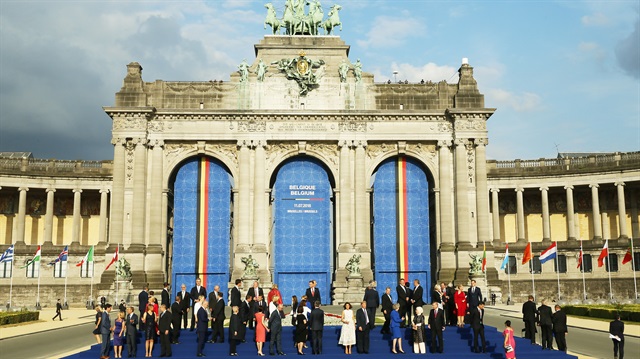
2018 NATO Summit in Brussels
NATO leaders will try on Thursday to move beyond Donald Trump's demands for higher defence spending, and focus on ending the long war in Afghanistan, in the second day of a summit in Brussels underscored by transatlantic tensions.
On a trip that will also take the U.S. president to Britain and to Helsinki to meet Russia's Vladimir Putin, Trump spent the first day of the NATO summit lambasting allies for failing to spend the targeted 2 percent of GDP on defence and accused Germany of being a prisoner to Russian energy.
Turkish President Recep Tayyip Erdoğan on Wednesday held talks with German Chancellor Angela Merkel on the sidelines of the two-day NATO summit in Brussels.Before the closed-door meeting that lasted around 40 minutes, Merkel congratulated Erdoğan over his June 24 presidential election victory.Video: Erdoğan meets Merkel on sidelines of NATO SummitErdoğan was accompanied by National Defense Minister Hulusi Akar, Foreign Minister Mevlut Cavusoglu and Presidential Spokesman Ibrahim Kalin.The two-day NATO summit started with the attendance of 29 NATO heads of state and government to make important decisions on the future of the alliance.Canada to command new NATO mission in IraqUS former top diplomat blasts Trump's NATO remarksNATO to ‘monitor’ ballistic missile threat to Turkey
Erdoğan meets Merkel on sidelines of NATO Summit
On day two, leaders will welcome non-NATO partners including Afghan President Ashraf Ghani and Ukraine's Petro Poroshenko to the alliance's new glass-and-steel headquarters as they seek to focus on policy rather than politics.
Britain's Prime Minister Theresa May tried to set the tone on Wednesday by announcing more troops for NATO's Afghan training mission.
"We will be deploying an additional 440 personnel to NATO's Resolute Support mission in Afghanistan and I think that shows when NATO calls, the UK is one of the first to step up," May told reporters.
German foreign minister lashed out at the U.S. President Donald Trump's criticism over Russia's sale of liquefied natural gas to Berlin, saying “we are not captives” of Russia or the U.S.”Heiko Maas's remarks on his Twitter account came after Trump said at the NATO summit in Brussels on Wednesday that Germany is “totally controlled by Russia, because they are getting 60 to 70 percent of their energy from Russia and a new pipeline.""So we're supposed to protect you against Russia but they're paying billions of dollars to Russia," Trump said describing it as "inappropriate."“If you look at it, Germany is a captive of Russia. They got rid of their coal plants, they got rid of their nuclear, they’re getting so much of their oil and gas from Russia. I think it is something NATO has to look at. It is very inappropriate.”In response to Trump, Maas said: "We are not captives, neither of Russia nor the U.S. We are one of the guarantors of the free world and that will stay that way.”Trump lashes Germany over gas pipeline deal, calls it Russia's 'captive'
German FM: ‘We are not captives’ of Russia or US
NATO will continue to monitor and assess ballistic missile threats to Turkey from Syria, according to a declaration issued Wednesday, after the first day of the NATO summit in Brussels."We remain concerned that Turkey has been hit three times in the last four years by missiles launched from Syria. We continue to monitor and assess the ballistic missile threat from Syria," it said.Pointing to Syria's inventory of short-range ballistic missiles, the declaration said the range of these missiles "covers part of NATO’s territory and some of our partners’ territories".Analysts: Turkey to play decisive role in Middle EastIt also drew attention to the Syrian regime’s use of these missiles extensively against its own population."The increasing threat posed by the proliferation of ballistic missiles in the vicinity of the south-east border of the Alliance has been and remains a driver in NATO’s development and deployment of a ballistic missile defense system, which is configured to counter threats from outside the Euro-Atlantic area," it added.The two-day NATO summit opened with the attendance of 29 NATO heads of state and governments who will make important decisions on the future of the alliance.NATO chief says despite differences, alliance 'stronger together'NATO also vowed to provide Turkey with “tailored assurance measures” aimed at guaranteeing the alliance’s security"Tailored assurance measures for Turkey to respond to the growing security challenges from the south contribute to the security of the Alliance as a whole, and will be fully implemented," the declaration said."We have increased the strength of the NATO Response Force, and the Very High Readiness Joint Task Force (VJTF) is ready to deploy on short notice," it added.Since 2014, NATO has implemented Assurance Measures (AM) which comprise a series of land, sea and air activities in, on and around the eastern part of Alliance territory.In late 2015, NATO allies agreed on a package of Tailored Assurance Measures for Turkey (TAMT) to respond to the increasing security challenges on Turkey’s borders.These measures include an additional AWACS (Airborne Warning and Control System) surveillance aircraft presence in the region; increased maritime activities in the Eastern Mediterranean; and Intelligence, Surveillance and Reconnaissance activities and information sharing.- North Korea and IranThe declaration welcomed the recent meetings and declarations between the leaders of the Republic of Korea and the Democratic People’s Republic of Korea (DPRK), and between the leaders of the United States and the DPRK as a contribution towards reaching the final fully verified denuclearization of the DPRK in a peaceful manner.Regarding Iran, the declaration said NATO is concerned by Iran's intensified missile tests."We are concerned by Iran’s intensified missile tests and the range and precision of its ballistic missiles and by Iran’s destabilizing activities in the wider Middle East region," the declaration said.The declaration condemned all financial support of terrorism, including Iran’s support to a variety of armed non-state actors.- Afghanistan and LibyaThe declaration also reaffirmed NATO's commitment to ensure long-term security and stability in Afghanistan. "We will continue our assistance by extending our financial sustainment of the Afghan forces through 2024," it said.The declaration encouraged Pakistan, Iran and Russia to contribute to regional stability by fully supporting an Afghan-led and Afghan-owned peace process.On the other hand, the declaration welcomed the commitment made by the Libyan parties to work constructively with the UN to hold inclusive, secure and credible elections, most recently at the May 29, 2018 Paris Conference.- Macedonia and BosniaThe declaration reaffirmed the commitment of NATO to the alliance’s open door policy and said NATO’s invitation to the former Yugoslav Republic of Macedonia is a tangible demonstration of this commitment."We welcome the historic agreement between Athens and Skopje on the solution of the name issue. In line with our policy, we have decided to invite the government in Skopje to begin accession talks to join our Alliance," the declaration stressed.It added that full implementation of all prescribed internal procedures with respect to the agreement on the solution of the name issue is a condition for a successful conclusion of the accession process.The declaration added that NATO fully supports Bosnia and Herzegovina’s NATO membership aspiration and it is committed to the territorial integrity and sovereignty of a stable and secure Bosnia and Herzegovina.It also said that non-EU NATO allies continue to make significant contributions to the EU's efforts to strengthen its capacities to address common security challenges."For the strategic partnership between NATO and the EU, non-EU Allies' fullest involvement in these efforts is essential," the declaration said.- Relations with RussiaThe declaration highlighted that Russia’s recent activities and policies reduced "stability and security, increased unpredictability and changed the security environment" and reaffirmed decisions towards Russia agreed at the Wales and Warsaw summits.The NATO leaders also condemned a nerve agent attack on Yulia Skripal, who was poisoned alongside her father, ex-Russian spy Sergei Skripal, in Salisbury in the United Kingdom in March."The UK assesses that it is highly likely that the Russian Federation was responsible for the attack and that there is no plausible alternative explanation. We stand in solidarity with the UK in its assessment," the declaration added.NATO leaders also condemned Russia's "illegal and illegitimate annexation of Crimea" and reiterated support for the territorial integrity and sovereignty of Ukraine, Georgia and the Republic of Moldova within their internationally recognized borders."The discrimination against the Crimean Tatars and members of other local communities must end. International monitoring structures must be allowed to carry out their essential work in view of the protection of human rights," the declaration added, calling for the full implementation of the Minsk Agreements by all sides and support for the efforts of the Normandy format and the Trilateral Contact Group.- NATO Readiness InitiativeThe declaration announced that allies "will offer an additional 30 major naval combatants, 30 heavy or medium manoeuvre battalions, and 30 kinetic air squadrons, with enabling forces, at 30 days’ readiness or less"."The NATO Readiness Initiative will further enhance the Alliance’s rapid response capability, either for reinforcement of Allies in support of deterrence or collective defense, including for high-intensity warfighting, or for rapid military crisis intervention, if required."In the declaration, NATO leaders vowed to strengthen the ability to deploy and sustain forces and their equipment throughout the Alliance and beyond and also to improve military mobility by land, air, or sea as soon as possible, but no later than 2024.- NATO's military backboneThe declaration announced that far-reaching decisions to adapt and strengthen the NATO Command Structure, the military backbone of the Alliance, were taken.The declaration further announced the establishment a Cyberspace Operations Centre in Belgium "to provide situational awareness and coordination of NATO operational activity within cyberspace"."A Joint Force Command Norfolk headquarters in the United States" was also decided to be established to focus on protecting the transatlantic lines of communication, including "a Joint Support and Enabling Command in Germany" to ensure freedom of operation and sustainment in the rear area in support of the rapid movement of troops and equipment into, across and from Europe.- Nuclear deterrenceNATO allies decided to take steps to ensure its nuclear deterrent capabilities remain safe, secure and effective following changes in the security environment."As long as nuclear weapons exist, NATO will remain a nuclear alliance," the declaration said, adding the fundamental purpose of NATO's nuclear capability is to preserve peace, prevent coercion and deter aggression.Underlining that the circumstances in which NATO might have to use nuclear weapons are extremely remote, NATO leaders also warned that any employment of nuclear weapons against NATO would fundamentally alter the nature of a conflict.
NATO to ‘monitor’ ballistic missile threat to Turkey
NATO's chief Jens Stoltenberg wants leaders to agree to fund Afghan security forces until 2024, despite public fatigue in Western countries about their involvement in the conflict.
Funding has averaged at about $1 billion annually and Stoltenberg has said he expected that level to be met.
Leaders will be keen to hear more about Trump's military approach to Afghanistan, which he revamped last August to include a surge in air strikes to force Taliban militants to the negotiating table.
U.S. officials have told Reuters Washington is preparing another review of strategy, a year after Trump begrudgingly agreed to extend involvement in the 17-year-old war.
Trump was opposed to remaining in America's longest war, but his advisers convinced him to give it more time. He authorized the deployment an additional 3,000 troops, bringing the total to around 15,000.
At the summit, leaders will discuss ties with Georgia and Ukraine, two NATO membership hopefuls who contribute to troop levels in Afghanistan but have seen their chances of joining the alliance hampered by Russian incursions into their territory.
Under NATO rules, countries with territorial conflicts cannot join the Western alliance and neither country is expected to progress in membership talks.
Macedonia, however, which was formally invited to start accession talks on Wednesday, will be part of a special ceremony on Thursday as the alliance sets the stage for expanding to its 30th member state.