

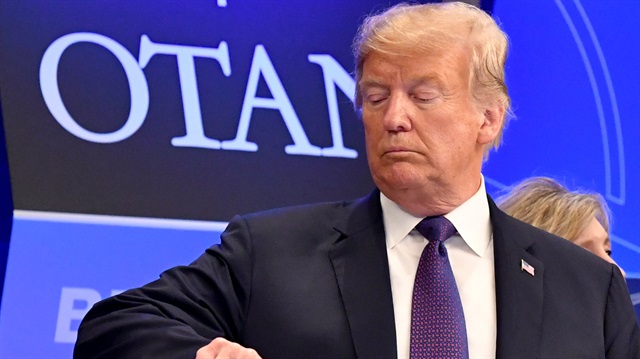
U.S. President Donald Trump checks time prior to a dinner at the Art and History Museum at the Parc du Cinquantenaire during the NATO Summit in Brussels, Belgium.
U.S. President Donald Trump launched a fresh attack on NATO allies' failure to raise defence spending on Thursday, prompting leaders to huddle in a special session excluding other summit participants, sources told Reuters.
At one point, in a break with diplomatic protocol, a source said Trump addressed German Chancellor Merkel by her first name and told her: "Angela, you need to do something about this."
Long accused of protectionist tactics that make it a difficult place for foreign firms to operate, China is trying to reverse that narrative amid an escalating trade war with the United States, green-lighting huge investments and portraying itself as a champion of openness.But critics argue that despite its attempt to claim the moral high ground as U.S. President Donald Trump threatens to apply more tariffs on Chinese imports, Beijing's recent moves to make it easier for foreign businesses to set up operations also effectively acknowledges that it has had discriminatory market barriers.China says has not been in touch with US about restarting trade talksThis week, China agreed to a $10 billion petrochemicals project by Germany's BASF that will be the first such plant in China that is wholly foreign-owned, not a joint venture.It also approved a huge new wholly-owned Shanghai factory for U.S. electric car maker Tesla Inc, and a $2.3 billion joint venture organic light-emitting diode (OLED) plant to be built by South Korea's LG Display Co Ltd.Responding to the Trump administration's latest plan to slap 10 percent tariffs on an extra $200 billion worth of Chinese imports, Assistant Commerce Minister Li Chenggang said on Wednesday that China would not close itself to U.S. business.China to increase influence in Middle East: Experts"I want to stress that the Chinese government's attitude to support business cooperation between the two countries will not change, its determination to push forward reforms and improve the business environment will not change, and its stance of opposing unilateralism and supporting multilateralism will not change," Li said at a business forum in Beijing on Wednesday.“They go low, we go high," he said, in an apparent jab at Trump as he borrowed a phrase used by former U.S. First Lady Michelle Obama in the 2016 U.S. election campaign.US firms doing business in China mostly oppose tariffs: surveyThe recent investment announcements came as Premier Li Keqiang this week visited Germany. The two countries signed commercial accords worth 20 billion euros ($23.5 billion), including the BASF agreement.Chinese state media framed such cooperation in the context of the increasingly bitter trade dispute with Washington."The trade war should push China and the EU to cherish mutual cooperation, because this increasingly scarce cooperation is becoming more valuable," China's nationalist tabloid, the Global Times, said in an editorial on Wednesday.'PROMISE FATIGUE'As the threats in the trade dispute have increased, so too have signals from Beijing that it means to follow through on reforms. Chinese officials insist there is no link, and that it will open up at its own pace. Rising costs are also frustrating to foreign manufacturers in China.Australia prepares to ban Huawei from 5G project over security fearsIn recent weeks, China has issued a shorter list of areas closed to foreign investment, and committed to easing or eliminating foreign equity caps in sectors that include banking, insurance, securities, the auto industry, as well as in shipbuilding and aerospace.But the string of announcements come at a time when there has been slowing foreign investment into China and more vociferous complaints about Beijing's market barriers and the difficulty of doing business in the world's second-largest economy.And Beijing is still holding up at least one major takeover involving foreign companies - U.S. chipmaker Qualcomm Inc's deal to buy Netherlands-based NXP Semiconductors NV . That has been waiting approval from China's antitrust regulator for months, leading to speculation among investors that the deal is being held hostage to the trade dispute with Washington.Years of lacklustre follow-through by China on its reform pledges has left what many in the foreign business community call "promise fatigue".Business leaders have been warning that if China didn't take real measures to address a lack of reciprocal market openness, it would sow retaliatory sentiment among its largest trading partners. And trade hardliners, particularly in the United States, had argued that Beijing would not make good on its pledges until other countries began imposing costs upon Beijing.European Union Chamber of Commerce in China President Mats Harborn on Tuesday called Trump's tariffs the "sledgehammer approach", but said the root cause of what China has termed the "largest-scale trade war" in economic history began in China."The reason we are where we are is because the Chinese leadership did not proceed as quickly as we wanted as a trade community," Harborn told a news briefing.Some in the U.S. business community, while rueing the damage caused by Trump's tariffs, privately say Beijing's recent emphasis on accelerating reforms may not be a coincidence."Tariffs are biting. The Chinese are less confident internally than externally. They have never been tested this way," a U.S. industry source told Reuters, asking to not be named given the sensitivity of the matter.Beijing has begun downplaying Made in China 2025, the state-backed industrial policy that has provoked alarm in the West and is core to Washington's complaints about the country's unfair trade practices.Propaganda authorities have also issued unusually strict rules limiting local media coverage of the trade war because of worries that unrestrained reporting could set off panic and roil its already jittery financial markets, sources within Chinese state media have said.Keep calm, don't inflame trade row with US: China to its state mediaAnd European officials have said Beijing is trying to woo the EU with market access in return for standing with China against Trump's trade measures, though the Europeans, who share U.S. criticism of China but disapprove of Trump's tariffs, have largely refrained from taking sides."By committing themselves to further openness. I think China hopes it can minimize the departure out of China of multinational firms," said Louis Kuijs, Hong Kong-based head of Asia Economics at Oxford Economics.
As Trump amps up trade war, China plays nice with foreign investors
Invited leaders from non-NATO countries Afghanistan and Georgia were asked to leave along with most NATO leaders' retinues of officials, as the heads of state and government of the Western alliance sought to deal with the man whose nation commands much of the budget and forces for Europe's defence.
Trump had opened the first day of talks in Brussels on Wednesday with a public diatribe against Germany, the second biggest state in the Western defence alliance, before the mood appeared to have calmed as the summit went into its second day, focusing on operations beyond Europe.
But, several sources said, Trump instead reopened in strong terms his demand that other countries greatly speed up their progress toward a NATO target of spending at least two percent of their GDP on defence, which now has a deadline of 2024 with get-out terms available that can stretch it to 2030.
NATO leaders will try on Thursday to move beyond Donald Trump's demands for higher defence spending, and focus on ending the long war in Afghanistan, in the second day of a summit in Brussels underscored by transatlantic tensions.On a trip that will also take the U.S. president to Britain and to Helsinki to meet Russia's Vladimir Putin, Trump spent the first day of the NATO summit lambasting allies for failing to spend the targeted 2 percent of GDP on defence and accused Germany of being a prisoner to Russian energy.Erdoğan meets Merkel on sidelines of NATO SummitOn day two, leaders will welcome non-NATO partners including Afghan President Ashraf Ghani and Ukraine's Petro Poroshenko to the alliance's new glass-and-steel headquarters as they seek to focus on policy rather than politics.Britain's Prime Minister Theresa May tried to set the tone on Wednesday by announcing more troops for NATO's Afghan training mission."We will be deploying an additional 440 personnel to NATO's Resolute Support mission in Afghanistan and I think that shows when NATO calls, the UK is one of the first to step up," May told reporters.German FM: ‘We are not captives’ of Russia or USNATO to ‘monitor’ ballistic missile threat to TurkeyNATO's chief Jens Stoltenberg wants leaders to agree to fund Afghan security forces until 2024, despite public fatigue in Western countries about their involvement in the conflict.Funding has averaged at about $1 billion annually and Stoltenberg has said he expected that level to be met.Leaders will be keen to hear more about Trump's military approach to Afghanistan, which he revamped last August to include a surge in air strikes to force Taliban militants to the negotiating table.U.S. officials have told Reuters Washington is preparing another review of strategy, a year after Trump begrudgingly agreed to extend involvement in the 17-year-old war.Trump was opposed to remaining in America's longest war, but his advisers convinced him to give it more time. He authorized the deployment an additional 3,000 troops, bringing the total to around 15,000.At the summit, leaders will discuss ties with Georgia and Ukraine, two NATO membership hopefuls who contribute to troop levels in Afghanistan but have seen their chances of joining the alliance hampered by Russian incursions into their territory.Under NATO rules, countries with territorial conflicts cannot join the Western alliance and neither country is expected to progress in membership talks.Macedonia, however, which was formally invited to start accession talks on Wednesday, will be part of a special ceremony on Thursday as the alliance sets the stage for expanding to its 30th member state.
After Trump's spending demands, NATO summit turns to Afghanistan
"The language was much tougher today," one source told Reuters. "His harshest words were directed at Germany, including by calling her Angela --'You, Angela.'"
As well as Merkel, Spanish Prime Minister Pedro Sanchez and Charles Michel, the prime minister of Belgium, were also singled out by Trump for undershooting on their spending targets when U.S. taxpayers, funding a defence budget worth about 3.6 percent of their national income, foot much of NATO's bills.
Breaking from a carefully scripted session that was to focus on Ukraine and Georgia, one source said Trump "forcibly restated his position on wanting NATO members to reach 2 percent spending target to a short a deadline".
U.S. President Donald Trump on Thursday pressed home a new demand that allies more than double defence spending, but his European counterparts sought to avoid more tension at a NATO summit, saying the president was friendlier than expected.Leaders' low expectations showed the extent of European frustration with Trump's "America first" policies as they headed into a second day of talks with the 29 members of the Western military alliance, set to focus mainly on ending the long war in Afghanistan.Trump took to Twitter to say publicly what he told NATO leaders privately on Wednesday, calling on all allies to meet a commitment agreed in 2014 to spend 2 percent of economic output on defence to counter threats ranging from Russia's military modernisation to militant attacks on European cities."All NATO Nations must meet their 2% commitment, and that must ultimately go to 4%!" Trump tweeted an hour before the second day of the summit got underway.After Trump's spending demands, NATO summit turns to AfghanistanDespite the first day's haranguing of allies for failing to meet spending targets and accusing Germany of being a prisoner to Russian energy, Trump was mild-mannered at a private dinner on Wednesday and avoided any outbursts that many NATO diplomats had feared."He was in a good mood, he said Europe was a continent he appreciated," Luxembourg's Prime Minister Xavier Bettel told reporters."We didn't know what to expect, it was a positive outcome," he said of the dinner in a Brussels park, where leaders were treated to an acrobatic display and saxophone music.French President Emmanuel Macron said the summit atmosphere was "much calmer than everyone had said" and he saw a will to maintain the unity of the alliance, while Croatian President Kolinda Grabar-Kitarovic said Trump was "constructive".Canada to command new NATO mission in IraqFrom abandoning the Iran nuclear deal to putting higher tariffs on European Union steel imports and threatening more on cars, Trump has undermined European priorities in the Middle East, on free trade and on combating climate change.While Germany, Europe's biggest economy, has been in Trump's sights, Britain was keen to make the most of its status as one of the few NATO nations that meet the spending target and sided with Washington's position that allies should spend more."We think President Trump is basically right, that the foundation of a successful alliance is fair contributions by all parties," said Britain's new foreign minister Jeremy Hunt.US former top diplomat blasts Trump's NATO remarksHELSINKI RISKAt the NATO summit, normally a ceremonial affair to cement an alliance that dates back almost seven decades, officials had hoped to limit discussions to strictly military business, especially as deterring Russia is a rare unifying factor after Moscow's 2014 annexation of Ukraine's Crimea.Ukraine's Petro Poroshenko met NATO Secretary-General Jens Stoltenberg and spoke at the decision-making North Atlantic Council session with leaders, although his hopes of joining the alliance are, for the time being, thwarted by Russia's incursion into eastern Ukraine and its support for rebels there.Under NATO rules, countries with armed conflicts on their territory cannot join the Western alliance.The U.S. president will travel to Britain later on Thursday and then to Helsinki to see Russia's Vladimir Putin on Monday, a meeting that NATO diplomats say will be the true test of Trump's commitment to the Western alliance.Any deal with Putin to call off U.S. exercises in the Baltics or withdraw U.S. troops from the region would be a severe blow to the West's policy towards Moscow, although diplomats, officials and analysts stressed such outcomes were only a worst-case scenario not based on any official position.Still, three senior U.S. officials told Reuters that no one in the Pentagon, including Secretary of Defence Jim Mattis, knows what Trump might say in Helsinki."The president came out of Singapore saying he'd ended the nuclear threat from North Korea," said one U.S. official, referring to Trump's meeting with North Korean leader Kim Jong Un."Who's to say he won't come out of Helsinki saying he and Putin agreed that Russia no longer poses a threat to the rest of Europe?"
Trump keeps up spending demands at NATO but turns on charm
Two NATO sources said, however, that Trump had not issued a threat to pull the United States out of the alliance that it helped found to keep the peace in Europe after World War Two.
TWITTER DEMAND
Leaders had gone into the second day, set to focus mainly on ending the long war in Afghanistan, with low expectations, showing the extent of European frustration with Trump's "America first" policies among the other 28 members of the alliance.
Trump took to Twitter to say publicly what he told NATO leaders privately on Wednesday, calling on all allies to meet a commitment agreed in 2014 to spend 2 percent of economic output on defence to counter threats ranging from Russia's military modernisation to militant attacks on European cities.
He also renewed a demand that they even double that -- though many question what they could usefully spend it on.
American experts on Wednesday warned of the threat posed by the Fetullah Terrorist Organization (FETÖ) in the country."I believe that the Gülen movement in the U.S. presents a unique and unusual security threat," said Mark Hall, producer, screenwriter and director of the documentary "Killing Ed", which probed the financial practices of FETO-linked charter schools in the U.S.Security measures stand out at FETÖ’s Pennsylvania campSpeaking at the panel "July 15 Coup attempt: Two Years Later" organized by the Global Policy Institute in Washington, D.C., Hall said FETÖ threatens the U.S. mainly by bringing in unqualified employees from other countries, especially from Turkey, as well as through money laundering and forgery of documents, deceiving local and federal authorities.He noted that the terror group has also been financing major public relations firms for ages to convince American society that they are compatible with democratic, moderate American values. But a closer investigation reveals exactly the opposite."The Gülen movement has financed over a 19-year period a huge PR movement to provide a story about who they are. But when you look more closely, it is not a group that is democratic or that has the U.S.’ best interests in mind," Hall said.FETÖ terror ringleader sends instructions to group membersAt least 16 FETÖ suspects arrested across TurkeyEmphasizing that FETÖ's U.S.-based leader Fetullah Gülen needs to be extradited to Turkey, he added that the U.S. government should also pay attention to the immigration issues related to FETÖ-linked charter schools."The schools should be removed from receiving tax dollars," he said. FETÖ and Gülen orchestrated the defeated coup of July 15, 2016 which left 250 people martyred and nearly 2,200 injured.Ankara also accuses FETÖ of being behind a long-running campaign to overthrow the state through the infiltration of Turkish institutions, particularly the military, police and judiciary.Hall, in a previous panel, said he heard about the July 15 defeated coup from TV news while he was in the process of filming a documentary, and "it was no surprise" to him to learn that FETÖ was behind the coup attempt.Another speaker at the panel, Abraham Wagner, who is a lecturer in national security law at Columbia Law School, said the corruption in taxes and immigration that FETÖ commits in the U.S. needs to be examined thoroughly.He also said that FETÖ is not known in America in detail."There is not a great deal of awareness in America among the public or the media about what the Gülen movement is," Wagner said. "It is unfortunate that it hasn’t gotten the media coverage or official law enforcement coverage that it needs."Mary Addi, who formerly taught at a Gülen movement school in the U.S., also spoke at the panel.Addi said she first learned that her Turkish husband, who also taught at the school, was part of the movement when she realized he was giving 40 percent of his salary back to the movement."I said to my husband, 'Do you get that this is not legal? They are extorting money from you,'” she said, describing it as "illegal and money laundering".Stating that FETÖ attempted to force her husband to divorce her because she was investigating its corruption, Addi said she worked with her husband to gather evidence of wrongdoing at the schools and submitted it to the relevant authorities.However, she said she has been told that the biggest problem the agencies investigating the movement are facing is tracking the money. Addi also said she has been giving interviews to foreign media outlets while American media outlets turn a blind eye to the issue.“Where are our government officials? Why is our own country not doing anything about these schools? "There is not a doubt in my mind as to whether they are insidious, dangerous and terrorists."
US experts raise concern over FETÖ threat in America
"All NATO Nations must meet their 2% commitment, and that must ultimately go to 4%!" Trump tweeted an hour before the second day of the summit got under way.
Despite the first day's haranguing of allies for failing to meet spending targets and accusing Germany of being a prisoner to Russian energy, Trump was mild-mannered at a private dinner on Wednesday and avoided any outbursts that many NATO diplomats had feared.
"He was in a good mood, he said Europe was a continent he appreciated," Luxembourg's Prime Minister Xavier Bettel told reporters.
"We didn't know what to expect, it was a positive outcome," he said of the dinner in a Brussels park, where leaders were treated to an acrobatic display and saxophone music.
French President Emmanuel Macron said the summit atmosphere was "much calmer than everyone had said" and he saw a will to maintain the unity of the alliance, while Croatian President Kolinda Grabar-Kitarovic said Trump was "constructive".