

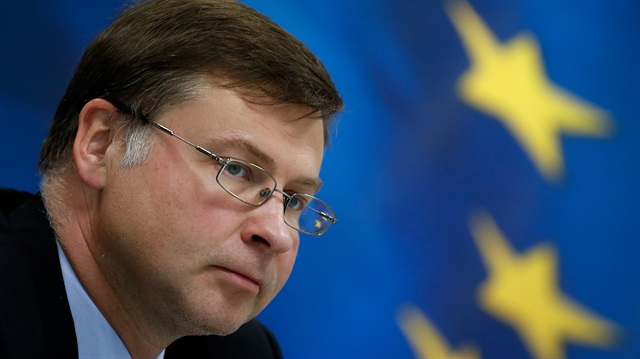
Valdis Dombrovskis
The European Commission cut on Thursday its forecasts for the euro zone's economic growth this year, saying the main causes for the revision were trade tensions with the United States and rising oil prices which are pushing the bloc's inflation higher.
The slowdown of the euro zone economy is set to affect all major economies of the bloc, but is expected to hit Italy harder, as the country will record the lowest growth rate in Europe, matched only by Britain among all EU countries.
The EU executive estimated the 19-country euro zone will grow by 2.1 percent this year, lower than the 2.3 percent gross domestic product (GDP) increase it had forecast in its previous estimates released in May. Next year the bloc's growth should further slow to 2.0 percent, unchanged from the previous forecast.
Britain's newly appointed Brexit minister said on Thursday he hoped that the government's soon-to-be-published policy on leaving the European Union will reassure those in the EU who are unclear as to how it will work.British Prime Minister Theresa May will set out a blueprint for Brexit on Thursday after agreeing a strategy with senior ministers last week that prompted the resignations of two senior ministers. The EU's top Brexit negotiator Michel Barnier said the proposals needed to be assessed to see if they were workable and realistic."What we've got in the White Paper is detailed proposals, which Michel Barnier hasn't seen yet, but I'm hoping will reassure all of those who have concerns about this," Dominic Raab, who was appointed on Monday after David Davis resigned in protest at Prime Minister Theresa May's Brexit Strategy, told BBC Radio.British PM May urges her party to back EU Brexit plan: spokesmanFrance warns Britain that time running out on BrexitUK must be able to diverge from EU on services after Brexit: minister
Brexit blueprint should reassure EU over strategy: UK minister
"The downward revision of GDP growth since May shows that an unfavourable external environment, such as growing trade tensions with the U.S., can dampen confidence and take a toll on economic expansion," EU commission's vice-president Valdis Dombrovskis said.
Rising oil prices have also contributed to the slowdown, the EU economics commissioner Pierre Moscovici said, and are expected to push euro zone's inflation up to 1.7 percent this year and next, from the previously estimated 1.5 percent in 2018 and 1.6 percent in 2019.
Germany and France, the two largest economies of the euro zone, are expected to lose steam this year and next.
Germany's GDP expansion will slow to 1.9 percent this year and in 2019 from the previously estimated 2.3 percent in 2018 and 2.1 percent in 2019.
France's economy will grow 1.7 percent this year and next, less than the 2.0 percent the Commission had earlier forecast for this year and also slower than the 1.8 percent growth previously forecast for 2019.
The slowest-growing economy of the bloc will remain Italy which is expected to grow only 1.3 percent this year, less than the 1.5 percent estimated in May.
One of the causes cited by the Commission for the revision were "re-emerging concerns or uncertainty about economic policies", as Italy's new eurosceptic government has launched ambiguous messages on its future spending plans.
Only Britain is expected to match Italy's sluggish growth among all the 28 states of the European Union. It will grow 1.3 percent this year, according to the Commission, less than the previously estimated 1.5 percent growth.
Britain's inflation is also forecast to go up further to 2.6 percent this year, from a previous estimate of 2.5 percent.