

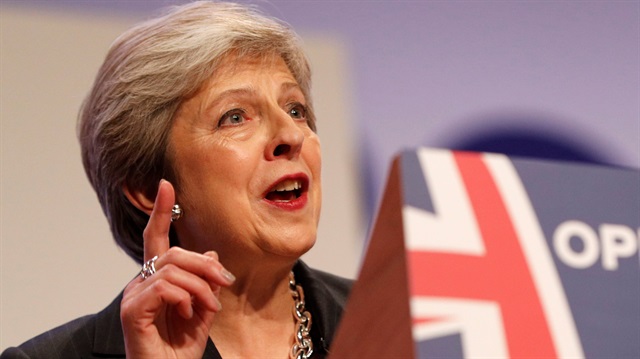
British Prime Minister Theresa May
Prime Minister Theresa May appealed to wavering British voters on Sunday ahead of a defining few months in which she hopes to secure a Brexit deal and face down opponents who say her EU exit plan is too hard, too soft, or just plain wrong.
May, tasked with delivering Britain's exit from the European Union after a 2016 referendum which continues to divide the country, must find a way through deadlocked talks in Brussels and then convince a sceptical parliament to back the outcome.
On Sunday she launched an unusual plea for the backing of centre-ground voters who had previously backed the Labour Party but felt alienated by a shift to the left under current Labour leader Jeremy Corbyn.
"I want voters who may previously have thought of themselves as Labour supporters to look at my government afresh. They will find a decent, moderate and patriotic programme that is worthy of their support," May wrote in an article for the Observer newspaper.
Hot off the heels of a speech at her annual conference which polls showed was well received, May sought to reinforce her message that the end of over eight years of austerity was in sight, and that she was capable of delivering reform beyond Brexit.
Britain signed a military cooperation agreement with Germany on Friday, emphasising London's commitment to helping shield Europe from future security threats at a time when negotiations over its exit from the EU are reaching a crunch.One of the British government's strongest cards in Brexit negotiations is the expectation that, as the EU country with the highest defence spending, it will continue to play a central role in European security after it leaves the bloc.Britain's military capabilities easily dwarf those of any other EU member state apart from France. It also has diplomatic and intelligence services that are among Europe's best resourced and most capable."We will further strengthen the European pillar in NATO, contribute to European security and improve Europe's resilience to security threats," Britain and Germany said in a document which did not mention Brexit.Germany accuses Russia of committing cyber-attacksBritish Defence Minister Gavin Williamson and his German counterpart Ursula von der Leyen signed the agreement at a British army barracks in the western German town of Sennelager."We are determined to deepen and strengthen our relationship in order to achieve our common defence and security goals," the agreement said. Naval, land and air forces would work closely together and there would be cooperation in defence procurement.Prime Minister Theresa May has vowed to maintain Britain's commitment to protecting Europe after Brexit. She has accused Russia of fomenting violence in eastern Ukraine, of repeatedly violating the national airspace of several European countries, and mounting a campaign of cyber attacks.Russia is also blamed for hacking attacks in several European countries, including the Danish defence ministry and the German parliament.The European Union and Britain are trying to finalise a deal setting out their relationship after March 29, when Britain is expected to leave the bloc. Sources told Reuters that the EU's Brexit negotiators told national diplomats in Brussels late on Thursday that a divorce deal with Britain was "very close".Merkel offers qualified support for 'Jewish state'
Germany, Britain sign defence cooperation agreement amid Brexit talks
The Dutch government will reconsider plans to scrap the country's dividend tax, Prime Minister Mark Rutte said on Friday, hours after multinational Unilever said it would not move its headquarters to the Netherlands.Unilever scrapped plans to move its headquarters to Rotterdam earlier on Friday in the face of a shareholder revolt, keeping one of Britain's most valuable companies in London ahead of Brexit.The change of course could have political consequences for Rutte, who worked for Unilever from 1992-2002 before entering politics. He has spent vast political capital convincing coalition government partners to support doing away with the 15 percent tax on corporate dividends.Rutte has maintained that attracting Unilever was not the objective of dropping the tax, which is strongly opposed by many Dutch people who see it as a 1.9 billion euro ($2.2 billion) tax cut for foreign investors."We didn't decide to scrap the dividend tax for just one company, but the fact that such a large company that had decided to come to the Netherlands has withdrawn its plan is very relevant for our considerations," Rutte told journalists."Scrapping the dividend tax was part of a broad range of measures aimed at improving our competitiveness. We will reconsider this whole package in the coming time," he said. EU weighs what to offer Trump on tradeJuncker urges EU member states to talk with one voice
Dutch to reconsider scrapping dividend tax after Unilever U-turn
Unilever scrapped plans to move its headquarters to the Netherlands on Friday in the face of a shareholder revolt, keeping one of Britain's most valuable companies in London ahead of Brexit.The climbdown comes three weeks ahead of the planned vote on the proposal and is a victory for shareholders who opposed the move, which would have kicked the maker of Marmite, Dove soap and Ben & Jerry's ice cream out of the benchmark FTSE 100 index ."We are pleased they have abandoned the plan to 'go Dutch',” said GAM portfolio manager Ali Miremadi, who intended to vote against the move. "Now the company can put its focus into the core job – driving long-term shareholder value."Unilever's board agreed to scrap the plan during a call early on Friday after it became clear it could fall short of the required votes, a source familiar with the matter said.The plan needed the backing of a majority of UK shareholders holding at least 75 percent of the shares, but only required approval from 50 percent of the Dutch-listed shares.Shareholders representing about 12 percent of Unilever PLC had publicly opposed the move, concerned about the effective forced selling of their shares with no premium, uncertainty around the future tax treatment of Dutch dividends and a perception that the move was partly aimed at securing greater takeover protection under Dutch law.Unilever's U-turn comes at a sensitive time for the British government, which is battling to protect jobs and investment as Prime Minister Theresa May fights for her proposed divorce plan from the European Union."The UK is one of the best places in the world to grow a business, and our modern Industrial Strategy commits us to being an open and competitive economy and a great place to locate global headquarters," Business Secretary Greg Clark said.The decision is set to trigger political fallout for Dutch Prime Minister Mark Rutte over his unpopular proposal to scrap a withholding tax on dividends that was seen as helping to woo Unilever.Deputy Finance Minister Menno Snel said the Dutch cabinet was meeting to discuss the consequences. "We would have liked to have seen this turn out differently," he told reporters.Forced SellingUnilever's exit from the FTSE would have forced funds mandated to track the index to sell their shares. That may have pressured the price for the remaining shareholders, some of whom worried that shares in the new Unilever would be less liquid.Unilever decided to collapse its Anglo-Dutch structure following a review sparked by last year's failed $143 billion takeover approach by Kraft-Heinz. The stated aim was to make it more efficient and agile in a consumer market rocked by e-commerce, social media and upstart rivals.But on Friday Unilever said it recognised that the proposal had not received support from a significant group of shareholders and therefore withdrew it."The board will now consider its next steps and will continue to engage with our shareholders," Chairman Marijn Dekkers said, adding Unilever will proceed with the plan to cancel its Dutch preference shares.Earlier this week, influential proxy advisory firm PIRC recommended shareholders vote against the move.Another service, IVIS, which is the corporate governance research service of the Investment Association, issued a "red top" recommendation on the move on Friday, its strongest level of concern.Sources said Unilever probably knew that recommendation before it was made public, which could have signalled that further shareholder defections were likely.What NextUnilever's Anglo-Dutch structure dates back to 1929 when British soap maker Lever Brothers combined with Dutch margarine company Margarine Unie. Unilever sold its margarine and spreads business earlier this year to KKR.UBS analysts said the investor focus would now shift to Unilever's next steps, corporate governance improvements under the current structure and its operational performance.Unilever's London-listed shares were down 1 percent at 0957 GMT, while its Dutch shares were down 0.2 percent."This change should not really affect the group's near-term operation, although it may lead to a faster pace for CEO succession planning," Liberum analyst Robert Waldschmidt said.Waldschmidt said the bigger drivers for Unilever's shares were U.S. interest rates and continued difficulties in emerging markets, particularly related to their currencies.Avoiding uncertainty over the shape of Brexit is another benefit to Unilever putting off a change, analysts at Baader Helvea said."Given current political discussions (i.e. Brexit), delaying such a vote until better mid-term visibility exists looks a reasonable approach (by Unilever)," they said.Unilever was advised by its corporate brokers, UBS and Deutsche Bank, and its legal adviser, Linklaters.
Unilever backs down on Dutch HQ move after British investor revolt
Labour called her message on austerity a con and said she was making "desperate pleas in an attempt to revive her failing administration".
It looks increasingly likely May will have to rely on the support of so-called 'moderate' Labour lawmakers to win parliamentary approval for whatever Brexit deal she is able to strike with the EU.
On Sunday, Scottish National Party leader Nicola Sturgeon said her 35 lawmakers would likely vote against the deal, and could instead support a second public vote on the terms of Britain's EU exit.
Labour's left-wing leadership have promised to vote against May's deal unless it meets their tests - which it currently is unlikely to do.
The 10 votes of the Northern Irish Democratic Unionist Party which May relies on to prop up her minority government are also in doubt, depending on what kind of compromise May has to strike in Brussels to resolve issues over the Irish border.
Critics within May's own party, among them former foreign minister Boris Johnson, want her to ditch the current Brexit plan. However the Sunday Telegraph reported that a sizeable eurosceptic faction could be willing to drop some of their objections to secure a deal.
If May fails to win a vote in parliament, Britain faces an unmanaged exit from the bloc, which businesses and economists fear could badly damage the economy.
The outgoing chief executive of insurance market Lloyd's of London, Inga Beale, said her firm is accelerating Brexit contingency plans to transfer contracts to a Brussels subsidiary as she feel Britain is getting closer to leaving the EU without a deal.
But Irish foreign minister Simon Coveney said the possible negative consequences for Britain, Ireland and other EU countries meant he thought the chances of securing a deal with the EU were "good".
European Council President Donald Tusk said on Saturday it was possible to agree a deal with Britain on leaving the European Union by the end of 2018.Speaking on the sidelines of a conference in Krakow, Poland, Tusk said: "We will try for it in October ... and I think there is a chance to have an accord by the end of the year." EU's Juncker confident of Brexit accord, no-deal not an option
EU's Tusk says Brexit deal possible by end of 2018
The European Union will reach a deal with Britain on Brexit in November if it does not do so this month, European Commission president Jean-Claude Juncker told Austrian newspapers.Juncker, whose optimism was echoed in comments on Saturday by European Council President Donald Tusk, said that the potential for a rapprochement had grown in the last few days, confirming what diplomatic sources have told Reuters.EU Brexit negotiators believe a deal with Britain on leaving the bloc is "very close", the sources told Reuters, in a sign a compromise on the most contentious issue - the future Irish border - might be in the making, although details were scarce."We are not there yet. But our will to reach an understanding with the British government is unbroken," Juncker was quoted as saying by Der Standard and Kurier and Der Falter.Tariff deal with US not yet even in 'pre-work' stage: EU trade chiefOn Friday, EU Brexit negotiators told ambassadors of the 27 states remaining in the bloc that there was no breakthrough on the Irish issue and much would depend on what their British counterparts bring to Brussels next week."We have to get away from this no-deal scenario. It wouldn’t be good for Britain or for the rest of the (European) Union," Juncker was quoted as saying.Britain and the EU are trying to push for the divorce deal, as well as an agreement on post-Brexit relations, in time for two leaders' summits scheduled for Oct. 17-18 and Nov. 17-18."My assumption is that we will reach an accord which will achieve the conditions of the withdrawal treaty," Juncker said, adding that it was not possible to predict whether there will be a conclusion to the Brexit negotiations in October."If not, then we will do it in November."Juncker urges EU member states to talk with one voiceTusk also said it was possible to agree a deal with Britain on leaving the European Union by the end of 2018."I have hope close to certainty that we will manage to reach an agreement both on exit and on best possible future relations ... I hope that it will be possible to avoid major losses on both sides," he said on the sidelines of a conference in Krakow, Poland."We will try for it in October ... and I think there is a chance to have an accord by the end of the year," he added.Juncker told the Austrian papers that a political declaration on future relations between Britain and its former European partners was needed to accompany the Brexit deal."You can't absolutely keep separate the withdrawal treaty and the declaration of the future relationship between the United Kingdom and Europe," he said.ITALIAN BUDGETApart from Brexit, one of the biggest headaches facing European Union leaders is the approach of Italy's new government to its public finances.Asked about Italy's recent budget plans, Juncker said it was up to Italian policymakers to find rules and measures that will allow Italy to remain within agreed budgetary targets."We will assess the Italian budget ... and propose changes if necessary," he added.The Italian government this week unveiled the core of its expansionary multi-year budget plan, raising the target for the fiscal deficit to 2.4 percent of gross domestic product in 2019.The deficit is projected to ease gradually in the next two years to 2.1 percent and then 1.8 percent, while remaining far above targets previously agreed with the European Commission.The targets are a "source of serious concern", the European Commission said in a letter to Italy's Economy Minister Giovanni Tria which called on Rome to ensure that the budget will be "in compliance with the common fiscal rules".
EU's Juncker confident of Brexit accord, no-deal not an option
The European Union has yet to begin even "pre-work" towards a transatlantic trade agreement on industrial goods aimed at averting a tariff war with U.S. President Donald Trump, Trade Commissioner Cecilia Malmstrom said on Friday.Addressing a meeting of EU trade ministers, Malmstrom said there was progress in ongoing efforts to improve trade ties with the United States by cooperating on regulations, but she suggested a deal on reducing import duties was a long way off."We are not negotiating anything with the U.S... The pre-work on a possible trade agreement on industrial goods hasn't really started yet. We've been focusing now on the regulatory cooperation part," she said.The EU ministers met to debate what to offer the United States to ease trade tensions and avert a return to a tit-for-tat tariff conflict.Trump agreed in July to hold back on a threatened 25-percent import tariff on EU cars while the United States and Europe discussed removing trade barriers, including duties on industrial goods.Germany, Britain sign defence cooperation agreement amid Brexit talksMalmstrom said she would meet U.S. Trade Representative Robert Lighthizer in late November to see whether there could be agreement on regulatory issues."There are certain things that are quite low-hanging fruit. Over the years we have done a lot of preparatory work. Other things will be a little longer," Malmstrom said.Austria, which holds the six-month rotating presidency of the European Union, put forward a paper ahead of Friday's meeting suggesting EU countries could agree that transatlantic talks should focus on cooperation in regulation.This could include agreements that each side recognise as sufficient the other's safety standards in cars, pharmaceuticals and medical devices. For example, a seat belt meeting EU standards could be sold in the United States, and vice versa.EU weighs what to offer Trump on tradeGerman Economy Minister Peter Altmaier said the meeting in Innsbruck, Austria, was taking place against a "very, very difficult" international environment."Time is getting tight. We must hurry up," he said. "We are working for an agreement that covers as many industrial goods as possible. That is our clear position."French minister of state Jean-Baptiste Lemoyne suggested any transatlantic agreement would be limited, emphasising that agricultural products, among the United States' major exports, would not be included.Lemoyne said the European Union could conclude comprehensive trade agreements only with parties that have signed up to the Paris climate accord, which Trump has abandoned."There needs to be consistency between our climate, our environmental commitments and our trade commitments," the French minister said. "We are in a process of dialogue... to look at certain segments in certain industries. So this is something much more restricted than the classic trade agreements." 
Tariff deal with US not yet even in 'pre-work' stage: EU trade chief