

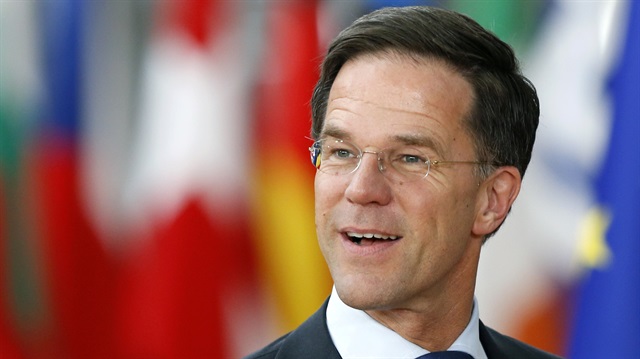
Netherlands Prime Minister Mark Rutte
The Dutch government will reconsider plans to scrap the country's dividend tax, Prime Minister Mark Rutte said on Friday, hours after multinational Unilever said it would not move its headquarters to the Netherlands.
Unilever scrapped plans to move its headquarters to Rotterdam earlier on Friday in the face of a shareholder revolt, keeping one of Britain's most valuable companies in London ahead of Brexit.
The change of course could have political consequences for Rutte, who worked for Unilever from 1992-2002 before entering politics. He has spent vast political capital convincing coalition government partners to support doing away with the 15 percent tax on corporate dividends.
Rutte has maintained that attracting Unilever was not the objective of dropping the tax, which is strongly opposed by many Dutch people who see it as a 1.9 billion euro ($2.2 billion) tax cut for foreign investors.
"We didn't decide to scrap the dividend tax for just one company, but the fact that such a large company that had decided to come to the Netherlands has withdrawn its plan is very relevant for our considerations," Rutte told journalists.
"Scrapping the dividend tax was part of a broad range of measures aimed at improving our competitiveness. We will reconsider this whole package in the coming time," he said.
European Union ministers debated on Friday what to offer the United States to ease trade tensions and avoid a return to a tit-for-tat tariff conflict that could hit EU cars.U.S. President Donald Trump agreed in July to hold back on a threatened 25-percent import tariff on EU cars while the United States and Europe discussed removing trade barriers, including duties on industrial goods.Austria, which holds the six-month rotating presidency of the European Union, put forward a paper ahead of Friday's meeting suggesting EU countries could agree the focus of transatlantic talks could be regulatory cooperation.This could include agreements that each side recognise as sufficient the other's safety standards in cars, pharmaceuticals and medical devices. For example, a seat belt meeting EU standards could be sold in the United States, and vice versa.Juncker urges EU member states to talk with one voiceGerman Economy Minister Peter Altmaier said the meeting in Innsbruck, Austria, was taking place against a "very, very difficult" international environment".He told reporters that the European Union needed to push ahead with talks to find an agreement with the United States."Time is getting tight. We must hurry up," he said. "We are working for an agreement that covers as many industrial goods as possible. That is our clear position."French minister of state Jean-Baptiste Lemoyne suggested any transatlantic agreement would be limited, emphasising that agricultural products, among the United States' major exports, would not be included.Lemoyne said the European Union could conclude comprehensive trade agreements only with parties that have signed up to the Paris climate accord, which Trump has abandoned."There needs to be consistency between our climate, our environmental commitments and our trade commitments," the French minister said. "We are in a process of dialogue... to look at certain segments in certain industries. So this is something much more restricted than the classic trade agreements." 
EU weighs what to offer Trump on trade
The head of the European Union's executive arm, Jean-Claude Juncker, on Friday called for member states to get rid of unanimity rules and make more decisions with qualified majorities to strengthen the bloc's role in the world."We have locked ourselves in the darkroom of unanimity," Juncker said at a speech to the Austrian parliament in Vienna. German minister presses for swift EU trade accord with USEU's Tusk wants close British ties after Brexit
Juncker urges EU member states to talk with one voice