

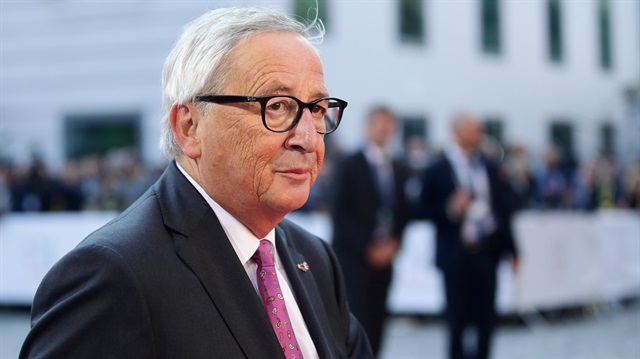
European Commission President Jean-Claude Juncker
The European Union will reach a deal with Britain on Brexit in November if it does not do so this month, European Commission president Jean-Claude Juncker told Austrian newspapers.
Juncker, whose optimism was echoed in comments on Saturday by European Council President Donald Tusk, said that the potential for a rapprochement had grown in the last few days, confirming what diplomatic sources have told Reuters.
EU Brexit negotiators believe a deal with Britain on leaving the bloc is "very close", the sources told Reuters, in a sign a compromise on the most contentious issue - the future Irish border - might be in the making, although details were scarce.
"We are not there yet. But our will to reach an understanding with the British government is unbroken," Juncker was quoted as saying by Der Standard and Kurier and Der Falter.
The European Union has yet to begin even "pre-work" towards a transatlantic trade agreement on industrial goods aimed at averting a tariff war with U.S. President Donald Trump, Trade Commissioner Cecilia Malmstrom said on Friday.Addressing a meeting of EU trade ministers, Malmstrom said there was progress in ongoing efforts to improve trade ties with the United States by cooperating on regulations, but she suggested a deal on reducing import duties was a long way off."We are not negotiating anything with the U.S... The pre-work on a possible trade agreement on industrial goods hasn't really started yet. We've been focusing now on the regulatory cooperation part," she said.The EU ministers met to debate what to offer the United States to ease trade tensions and avert a return to a tit-for-tat tariff conflict.Trump agreed in July to hold back on a threatened 25-percent import tariff on EU cars while the United States and Europe discussed removing trade barriers, including duties on industrial goods.Germany, Britain sign defence cooperation agreement amid Brexit talksMalmstrom said she would meet U.S. Trade Representative Robert Lighthizer in late November to see whether there could be agreement on regulatory issues."There are certain things that are quite low-hanging fruit. Over the years we have done a lot of preparatory work. Other things will be a little longer," Malmstrom said.Austria, which holds the six-month rotating presidency of the European Union, put forward a paper ahead of Friday's meeting suggesting EU countries could agree that transatlantic talks should focus on cooperation in regulation.This could include agreements that each side recognise as sufficient the other's safety standards in cars, pharmaceuticals and medical devices. For example, a seat belt meeting EU standards could be sold in the United States, and vice versa.EU weighs what to offer Trump on tradeGerman Economy Minister Peter Altmaier said the meeting in Innsbruck, Austria, was taking place against a "very, very difficult" international environment."Time is getting tight. We must hurry up," he said. "We are working for an agreement that covers as many industrial goods as possible. That is our clear position."French minister of state Jean-Baptiste Lemoyne suggested any transatlantic agreement would be limited, emphasising that agricultural products, among the United States' major exports, would not be included.Lemoyne said the European Union could conclude comprehensive trade agreements only with parties that have signed up to the Paris climate accord, which Trump has abandoned."There needs to be consistency between our climate, our environmental commitments and our trade commitments," the French minister said. "We are in a process of dialogue... to look at certain segments in certain industries. So this is something much more restricted than the classic trade agreements." 
Tariff deal with US not yet even in 'pre-work' stage: EU trade chief
On Friday, EU Brexit negotiators told ambassadors of the 27 states remaining in the bloc that there was no breakthrough on the Irish issue and much would depend on what their British counterparts bring to Brussels next week.
"We have to get away from this no-deal scenario. It wouldn’t be good for Britain or for the rest of the (European) Union," Juncker was quoted as saying.
Britain and the EU are trying to push for the divorce deal, as well as an agreement on post-Brexit relations, in time for two leaders' summits scheduled for Oct. 17-18 and Nov. 17-18.
"My assumption is that we will reach an accord which will achieve the conditions of the withdrawal treaty," Juncker said, adding that it was not possible to predict whether there will be a conclusion to the Brexit negotiations in October.
"If not, then we will do it in November."
The head of the European Union's executive arm, Jean-Claude Juncker, on Friday called for member states to get rid of unanimity rules and make more decisions with qualified majorities to strengthen the bloc's role in the world."We have locked ourselves in the darkroom of unanimity," Juncker said at a speech to the Austrian parliament in Vienna. German minister presses for swift EU trade accord with USEU's Tusk wants close British ties after Brexit
Juncker urges EU member states to talk with one voice
Tusk also said it was possible to agree a deal with Britain on leaving the European Union by the end of 2018.
"I have hope close to certainty that we will manage to reach an agreement both on exit and on best possible future relations ... I hope that it will be possible to avoid major losses on both sides," he said on the sidelines of a conference in Krakow, Poland.
"We will try for it in October ... and I think there is a chance to have an accord by the end of the year," he added.
Juncker told the Austrian papers that a political declaration on future relations between Britain and its former European partners was needed to accompany the Brexit deal.
"You can't absolutely keep separate the withdrawal treaty and the declaration of the future relationship between the United Kingdom and Europe," he said.
ITALIAN BUDGET
Apart from Brexit, one of the biggest headaches facing European Union leaders is the approach of Italy's new government to its public finances.
Asked about Italy's recent budget plans, Juncker said it was up to Italian policymakers to find rules and measures that will allow Italy to remain within agreed budgetary targets.
"We will assess the Italian budget ... and propose changes if necessary," he added.
The Italian government this week unveiled the core of its expansionary multi-year budget plan, raising the target for the fiscal deficit to 2.4 percent of gross domestic product in 2019.
The deficit is projected to ease gradually in the next two years to 2.1 percent and then 1.8 percent, while remaining far above targets previously agreed with the European Commission.
The targets are a "source of serious concern", the European Commission said in a letter to Italy's Economy Minister Giovanni Tria which called on Rome to ensure that the budget will be "in compliance with the common fiscal rules".