

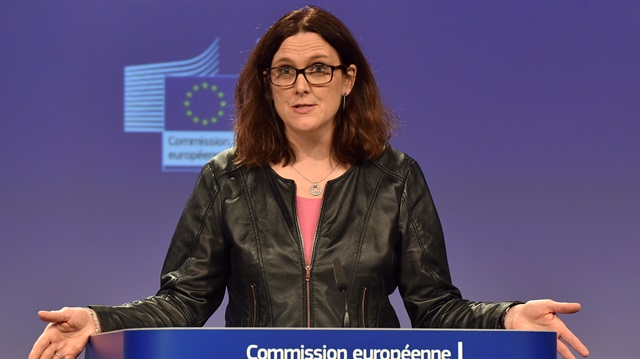
European Commissioner Cecilia Malmstrom
The European Union has yet to begin even "pre-work" towards a transatlantic trade agreement on industrial goods aimed at averting a tariff war with U.S. President Donald Trump, Trade Commissioner Cecilia Malmstrom said on Friday.
Addressing a meeting of EU trade ministers, Malmstrom said there was progress in ongoing efforts to improve trade ties with the United States by cooperating on regulations, but she suggested a deal on reducing import duties was a long way off.
"We are not negotiating anything with the U.S... The pre-work on a possible trade agreement on industrial goods hasn't really started yet. We've been focusing now on the regulatory cooperation part," she said.
The EU ministers met to debate what to offer the United States to ease trade tensions and avert a return to a tit-for-tat tariff conflict.
Trump agreed in July to hold back on a threatened 25-percent import tariff on EU cars while the United States and Europe discussed removing trade barriers, including duties on industrial goods.
Britain signed a military cooperation agreement with Germany on Friday, emphasising London's commitment to helping shield Europe from future security threats at a time when negotiations over its exit from the EU are reaching a crunch.One of the British government's strongest cards in Brexit negotiations is the expectation that, as the EU country with the highest defence spending, it will continue to play a central role in European security after it leaves the bloc.Britain's military capabilities easily dwarf those of any other EU member state apart from France. It also has diplomatic and intelligence services that are among Europe's best resourced and most capable."We will further strengthen the European pillar in NATO, contribute to European security and improve Europe's resilience to security threats," Britain and Germany said in a document which did not mention Brexit.Germany accuses Russia of committing cyber-attacksBritish Defence Minister Gavin Williamson and his German counterpart Ursula von der Leyen signed the agreement at a British army barracks in the western German town of Sennelager."We are determined to deepen and strengthen our relationship in order to achieve our common defence and security goals," the agreement said. Naval, land and air forces would work closely together and there would be cooperation in defence procurement.Prime Minister Theresa May has vowed to maintain Britain's commitment to protecting Europe after Brexit. She has accused Russia of fomenting violence in eastern Ukraine, of repeatedly violating the national airspace of several European countries, and mounting a campaign of cyber attacks.Russia is also blamed for hacking attacks in several European countries, including the Danish defence ministry and the German parliament.The European Union and Britain are trying to finalise a deal setting out their relationship after March 29, when Britain is expected to leave the bloc. Sources told Reuters that the EU's Brexit negotiators told national diplomats in Brussels late on Thursday that a divorce deal with Britain was "very close".Merkel offers qualified support for 'Jewish state'
Germany, Britain sign defence cooperation agreement amid Brexit talks
Malmstrom said she would meet U.S. Trade Representative Robert Lighthizer in late November to see whether there could be agreement on regulatory issues.
"There are certain things that are quite low-hanging fruit. Over the years we have done a lot of preparatory work. Other things will be a little longer," Malmstrom said.
Austria, which holds the six-month rotating presidency of the European Union, put forward a paper ahead of Friday's meeting suggesting EU countries could agree that transatlantic talks should focus on cooperation in regulation.
This could include agreements that each side recognise as sufficient the other's safety standards in cars, pharmaceuticals and medical devices. For example, a seat belt meeting EU standards could be sold in the United States, and vice versa.
European Union ministers debated on Friday what to offer the United States to ease trade tensions and avoid a return to a tit-for-tat tariff conflict that could hit EU cars.U.S. President Donald Trump agreed in July to hold back on a threatened 25-percent import tariff on EU cars while the United States and Europe discussed removing trade barriers, including duties on industrial goods.Austria, which holds the six-month rotating presidency of the European Union, put forward a paper ahead of Friday's meeting suggesting EU countries could agree the focus of transatlantic talks could be regulatory cooperation.This could include agreements that each side recognise as sufficient the other's safety standards in cars, pharmaceuticals and medical devices. For example, a seat belt meeting EU standards could be sold in the United States, and vice versa.Juncker urges EU member states to talk with one voiceGerman Economy Minister Peter Altmaier said the meeting in Innsbruck, Austria, was taking place against a "very, very difficult" international environment".He told reporters that the European Union needed to push ahead with talks to find an agreement with the United States."Time is getting tight. We must hurry up," he said. "We are working for an agreement that covers as many industrial goods as possible. That is our clear position."French minister of state Jean-Baptiste Lemoyne suggested any transatlantic agreement would be limited, emphasising that agricultural products, among the United States' major exports, would not be included.Lemoyne said the European Union could conclude comprehensive trade agreements only with parties that have signed up to the Paris climate accord, which Trump has abandoned."There needs to be consistency between our climate, our environmental commitments and our trade commitments," the French minister said. "We are in a process of dialogue... to look at certain segments in certain industries. So this is something much more restricted than the classic trade agreements." 
EU weighs what to offer Trump on trade
German Economy Minister Peter Altmaier said the meeting in Innsbruck, Austria, was taking place against a "very, very difficult" international environment.
"Time is getting tight. We must hurry up," he said. "We are working for an agreement that covers as many industrial goods as possible. That is our clear position."
French minister of state Jean-Baptiste Lemoyne suggested any transatlantic agreement would be limited, emphasising that agricultural products, among the United States' major exports, would not be included.
Lemoyne said the European Union could conclude comprehensive trade agreements only with parties that have signed up to the Paris climate accord, which Trump has abandoned.
"There needs to be consistency between our climate, our environmental commitments and our trade commitments," the French minister said. "We are in a process of dialogue... to look at certain segments in certain industries. So this is something much more restricted than the classic trade agreements."