

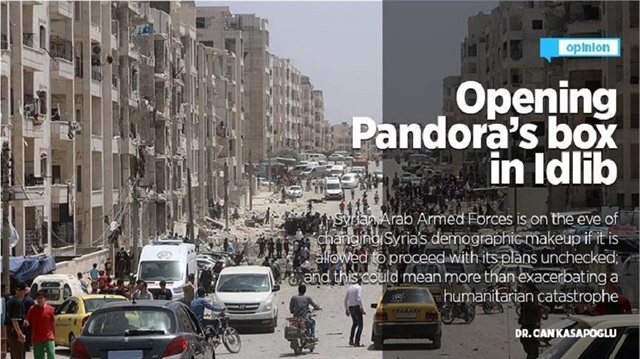
As hinted by some top Syrian generals the ruling clan of the country opts for turning all the displaced persons into permanent refugees to change the demographic makeup of the country.
Let’s put it bluntly. The Baath regime, and its military arm, the Syrian Arab Armed Forces, are not preparing for a fight to clear Idlib from armed non-state actors, including terrorist organizations. This objective if there is such an objective in the first place, remains secondary to the primary goal of forcing the Sunni inhabitants out and depopulating the province.
This notorious depopulation concept stems from the regime’s operational and strategic calculus.
At the operational level, the regime strives to compensate for its personnel shortcomings. Statistical studies in military sciences show that stability operations in low-intensity conflict environments necessitate, as a minimum requirement, 20 troops per 1,000 inhabitants. Thus, the Syrian Arab Army would need some 60,000 personnel to decisively control Idlib. The Baath regime simply cannot afford to allocate such a big military unit. Although Assad’s manpower is some 100,000-strong on paper, in reality, the regime has an estimated number of only 20,000 elite and reliable troops for major offensives. Besides, they cannot station the bulk of the elite formations hundreds of kilometers away from the capital and other key hubs for extended periods of time. In fact, this is why Assad still needs Tehran’s Quds Forces, a Shiite militia harbored by Iran, as well as the Lebanese Hezbollah, which altogether accounts for an extra 30,000-strong fighting power.
An expert analyst evaluated possible scenarios for the embattled opposition stronghold of Idlib, Syria, the effects of the great migration wave on Turkey and Europe, and Idlib’s strategic importance for Turkey.Anadolu Agency sat down with Veysel Kurt, a research specialist at the Foundation for Political, Economic and Social Research (SETA), based in Ankara, Turkey’s capital, and a faculty member of the political science department at Istanbul Medeniyet University,Question: Idlib, which shares borders with Turkey, has received the largest number of internally displaced people in Syria. In this context, what is the strategic importance of Idlib for Turkey and the Assad regime?Kurt: Having Aleppo to the east, Aleppo’s Afrin district to the northeast, Hama to the South, and Lazkiye to the northwest increases the strategic importance of Idlib, which has borders with Turkey in the northwest. Idlib is as you know is right next to Turkey and is a neighbor to our city of Hatay on our southern border. Idlib was one of Syria’s most populous cities before the crisis, as it is a fertile region for agriculture. Its population is said to be between 1.5 and 2 million.European media praise Russian-Turkish summit on SyriaWith the crisis, especially after 2015 when the opposition captured Idlib, migration from the conflicting regions intensified. As you know Aleppo is close to Idlib and at the end of 2016, as Aleppo was taken under control by the regime, another great migration started from Aleppo toward Idlib. The second serious migration wave was from Eastern Ghouta and lastly, when an operation was carried out on Dera, the population in Idlib reached 3.5-4 million.Q: Idlib is a city where anti-Assad regime groups are located. Hay'at Tahrir al-Sham (HTS) is the most important of these armed groups. What other armed anti-regime groups are in the region?Kurt: Idlib is important in terms of being the only city under the control of the opposition. Control of the city has a fragmented structure. Idlib is the last stronghold for the Syrian opposition. Besides, the largest opposition groups maintaining an armed struggle against the Assad regime are in Idlib. In 2015, after the opposition captured Idlib from regime control, they restructured themselves under the name of Army of Conquest and the city was controlled through this.Foreign troops reach significant numbers in Syria and Iraq The Army of Conquest was the largest organization that the Syrian opposition formed. The city was controlled by a coalition which included the Al-Nusra Front and other opposition groups. Then these structures began to splinter among themselves and divide the city according to spheres of influence. In other words, these structures which entered the city with a consensus, a coalition, became groups at odds with each other from time to time after they achieved control. There were serious conflicts between Ahrar us-Sham and HTS. Serious scenarios were also seen between the Nureddin Mahmud Zengi group and HTS.Consequently at this point we see that some regions are controlled by HTS, some by Nurettin Zengi, and some by Ahrar us-Sham. Here, countries such as Turkey and the U.S. treat these structures differently on certain levels and don’t regard all the groups as terrorist groups. For instance, the Nusra Front, under its previous name, was seen as a terrorist group. Today things are the same with HTS. But Nurettin Zengi and Ahrar us-Sham have not been declared a terrorist group by Turkey, the U.S., Western countries, or some Gulf countries. On the other hand the trio of Russia, the Syrian regime, and Iran treats almost all the groups as terrorist groups. From time to time they declare this openly.Terrorist groupsQ: How did Turkey's designation of the HTS as a terrorist group before the Tehran summit affect the status of these groups?Kurt: The situation which makes the question of Idlib complicated originates partially from this: that Turkey saw the HTS as a terrorist group before the Tehran summit indicated that it is necessary to seriously differentiate these groups from each other. In the meantime, it was a concrete step, a concrete proposal of solution towards the theses of the Russia, Iran, and regime trio. In other words, it was a serious message from Turkey suggesting, “If you’re talking about a terrorist group here, let’s define them, reach a consensus on who they are, and solve a potential Idlib problem this way.”Germany welcomes Turkey-Russia agreement on IdlibTurkish President Recep Tayyip Erdoğan made it clear whether the problem is a terror problem or something else frequently and openly during the summit. At the summit, we witnessed that Turkey presented constructive and concrete suggestions and approaches. I can sum up the primary elements that make the Idlib problem a complicated matter as having a border with Turkey and having twice the population of its potential, that groups divided up the city according to their activity regions, and that Turkey, Russia, and Iran present approaches to these groups different from one another.Q: Stephane Dujarric, spokesman for the UN secretary-general, warned that a great humanitarian tragedy may take place, saying that all sides in Idlib are responsible for protecting civilians under international law. Do you have concerns about the probability of a great migration wave too?Kurt: First of all, it is necessary to underline a very basic and humane thing. There is a set of things to do to prevent a humanitarian crisis, migration waves, refugee influxes. For this, it is necessary to prevent and stop the conflicts in Idlib. It should be underlined that little conflicts create little migration waves and great conflicts and attacks create large migration waves. There is a variety of measures that can be taken after a humanitarian crisis has occurred, such as easing that humanitarian crisis, building places where people can get accommodation, giving them protection, providing food security. But if a refugee influx or a great migration isn’t desired, this is directly related to the operation to be done in Idlib, that is, the conflict itself.Syrian opposition says Turkish-Russian deal excludes Idlib attackQ: About the attacks in Idlib, the EU countries have been making statements in line with Turkey’s concerns. They know that this migration wave doesn’t concern Turkey only, but will threaten Europe seriously as well. In this context, I would like to ask this: Does Europe have arrangements or plans to collaborate with Turkey against such a great migration wave?Kurt: As you have expressed, after the attacks on Idlib started, EU countries made statements that support Turkey. In fact these are not the first statements that the EU countries have made within this period. They make such statements all the time whenever a migration or refugee risk is in question. Indeed, at the beginning of the Syria crisis, they made statements for the end of the Assad regime directly. However, when we look at how this proceeds, we see that there’s a crucial difference between their practices during the process and their statements.Very serious treaties on the institutional level have been signed between Turkey and the EU. Especially a treaty focused on the two issues including refugee problems and visa liberalization. However, they haven’t fulfilled any of the pledges they made to Turkey. Turkey kept the Syrians in Turkey, not only taking a great risk but also probably acting out of the refugees’ wills. I think it is very difficult for a similar scenario to take place if Idlib leads to new refugee influxes.UN hails 'important' Erdoğan-Putin meeting on SyriaThe reason is that Turkey is now at the limits of its “we should somehow keep the refugees” policy. Turkey has a serious problem with the refugee burden. In fact, Turkish President Erdoğan declared this very openly, stating, “We have come to the limits of our refugee burden. We somehow keep enduring this burden itself. However, when it comes to taking up a new burden, Turkey does not have the power or capacity to take more responsibility.”Q: So you find the EU’s positive statements tactical.Kurt: Both the burden carried along with the will and wishes of the refugees will most likely constrain Turkey’s refugee policy on a cyclical and tactical level and will make it evolve. Since the beginning of the Idlib crisis, the statements of Europe in line with Turkey’s concerns are based on the mindset of “Turkey has already taken in 3-4 million Syrians, it will take 1 million more, and Europe won’t have to deal with that problem.” We can’t change this mindset from European minds because Turkey is no longer at that point.With that tactical logic they try to motivate Turkey. Moreover, the influx of refugees isn’t only about the economy. So who will come alongside those refugees, what kind of armed radical elements will be involved among them and come here… These risks must be considered by both Turkey and Europe.'Turkey-Russia deal on Idlib ends Assad dream to regain control over Syria'Claiming victoryQ: Why is Idlib so important to the Assad regime and their allies, do they aim for a decisive victory by taking control of Idlib?Kurt: That is certainly correct. Assad is aiming toward claiming victory by way of Idlib. So I think he’s trying to show that the Syrian crisis has been resolved, the opposition has been decisively beaten, and Syrian lands are under control by also somehow leaving the east of Euphrates out of the argument and this way claim a victory. When I say Assad I don’t just mean Assad himself, Russia and Iran must also be taken into account. For a decisive victory, Assad cares symbolically about putting Idlib under control.I think the reason why Putin, in his statement after Tehran summit, said that 90 percent of Syria has been taken under control is about this too. I mean, there’s 10 percent left and there are expectations once that part is also under control that the Assad administration will be less questioned, its legitimacy will be improved, and countries in the international arena will act quicker so that Assad is once again ruling legitimately.Iran foreign minister says diplomacy averted war in Syria's IdlibQ: In Idlib, there are other actors besides Assad and his allies trying to get into the play. James Mattis, the U.S. defense secretary, has statements on an “operation plan” regarding Idlib. Why did Idlib became a field of struggle between international powers?Kurt: Each of those actors has of course a reasoning, a method, and a goal. For instance, Russia wants to gain a decisive victory over the opposition. The tools they utilize for this are very clear, they adopt military methods as broadly as possible without even caring about massacring civilians. Their reasoning is the terror groups in Idlib. Their ultimate goal is to get this area back in Assad’s control. We can also say similar things about Iran and Assad.However, I think the attitude of the U.S. here is indecisive. I find such expressions regarding Turkey in the operation plans mentioned by Mattis, the statements made by Trump on Twitter, and the occasional meetings, to be indecisive. When we look at their Syria policy and the attitude they hold so far, they see Idlib not as a problem to be fixed, but as a tool for precipitating the crisis in that region. They see it as an area where they can once again put Turkey, Russia, and Iran against each other. So I think they approach this issue from that perspective.US welcomes efforts to reduce violence in SyriaIn Syria, there are issues that are costly for Turkey such as the PKK, Daesh, the Assad regime. In all of these vital and essential issues, Turkey’s concerns were not met either in the field or politically. So the statements made by the U.S. regarding collaboration with Turkey aren’t honest. The U.S. won’t be on Turkey’s side on the Idlib issue either. On the contrary, they will only precipitate the crisis. It is possible to say that they are conspiring to pit the actors who are looking for a solution in Syria against each other. However Turkey might take advantage of the statements made by U.S. and use them as leverage to balance it out with Russia and Iran.Turkey after Idlib operationQ: How do you assess the statements saying that if the Assad regime and their allies are successful with operations in Idlib, Turkey’s presence in Idlib will be problematized?Kurt: If you’ve noticed, the trio of the Assad regime, Iran, and Russia use two statements in regards to Turkey. The first concerns the terror groups issue which usually leaves the PYD out of it. For instance while [Hassan] Rouhani, the president of Iran, problematized the presence of the U.S. east of the Euphrates throughout the Tehran summit, he said nothing about the PYD. This must not be ignored. Their second statement is about them legitimizing their presence in Syria, via the invitation of the regime.Iran welcomes Turkey-Russia deal over IdlibSo if the Idlib issue is resolved in their favor, the statements saying the areas taken under control through Operations Euphrates Shield and Olive Branch along with Turkey’s presence here will be problematized even more vocally are correct, that is what I think as well. So, when we look behind the scenes of the Idlib issue, I think these hold great importance. Thus, there’s the oft-discussed issue of refugees regarding Idlib. Also, the terrorizing and marginalizing of the sponsoring groups are the second important topic for Turkey.Q: So then, can we say that there’s no solid foundation for our cooperation with Russia and Iran on finding a resolution in Syria?Kurt: When we take a look at the Astana process and the cooperation with Russia in Syria, we need to underline that these issues are always potentially troublesome. For instance, Russia had no serious objections to Operations Euphrates Shield and Olive Branch. However they don’t recognize the PYD/PKK as a terrorist group. They still don’t problematize the presence of the PYD east of the Euphrates. Since the PYD is under U.S. protection, one could even say they are involved in a secretive agreement with the U.S. So, the platform that we see when we look at the Syria problem as a whole also applies here.While we agree with Russia on certain topics, our disagreement still goes on with other topics. One of the political solutions agreed upon in Syria was the return of refugees. However, the agreed principles and the developments in the field don’t add up to each other. The most heavily disputed topics were saved for last. You don’t bring the most heavily disputed topic to the table first. This is where we are now, actually. However I don’t think that these issues carry the potential of pitting Turkey and Russia against each other on a grand scale, either. That’s what diplomacy is for.Q: What do you think about criticisms claiming that the Sept. 7 Turkey-Russia-Iran summit in Tehran eliminated the gains of the Astana and Sochi summits?Kurt: To be franks, Tehran was a summit where three actors came together regarding the Syria crisis. However, Russia and Iran were at the table with different motivations from Turkey. At the table, there was a struggle regarding the legitimization of the Assad regime rather than a solution to the Idlib problem. Also, the fact that the PYD isn’t problematized was also implied. We can say that they came to the table trying to force their own way of providing a solution to the Idlib crisis. President Erdoğan’s outcries in front of cameras must be assessed in that context.Here’s what I’m trying to say. Iran and Russia wanted to impose certain things on Turkey by way of a fait accompli in a live broadcast. Because there was a calculated move to achieve a fait accompli on the Idlib issue. Also while there was a request for recognition of all the groups that are terrorists, there were moves to leave the PYD out of it. President Erdoğan’s political moves prevented that.RussiaQ: Do you think UN Secretary-General Antonio Guterres’ call for Turkey, Russia, and Iran to prevent war in Idlib and not spare any efforts to protect civilians will be answered by Russia and Iran?Kurt: I don’t think so. Neither Russia nor Iran have so far supported any UN initiative on Syria. They didn’t object when the Assad regime undermined the UN’s endeavor towards humanitarian relief and regarding the issue of chemical weapons research, and acted similarly during sessions of the UN Security Council meant to prevent aggression. Now, it’s unlikely for the UN to be taken seriously by Russia in a period where the U.S. and Russia don’t tread on each other’s feet.Q: They try to paint Idlib as the final phase of the crisis. Does the same critical situation apply to Turkey as well in this context?Kurt: President Erdoğan clearly stated that let alone being involved in a large-scale attack on Idlib, they won’t even stand aside to watch. The PYD is carrying out serious preparations for a potential operation in Idlib. We can see that they do this partly to exact revenge on Turkey and the opposition, and partly by making long-term plans to settle again in Afrin by sitting at the negotiation table with the Assad regime. Thus, all these concerns call for Turkey to be more sensitive and aware on the Idlib issue.The military activity being carried out by Turkey both on the border and in Idlib for a while now is a development that must be paid attention to in this context. Turkey must maintain as strong a military presence as possible with the PKK/PYD on one hand, the regime backed by Russia and Iran on the other, along with potential threats posed by some other groups there. As you said, it was not a correct approach to consider Idlib the final phase of the ongoing crisis. Yes, for Turkey Idlib is a critical phase but it’s not the final issue or the final phase. East of the Euphrates is of much more serious concern to us. Thus Idlib may be the final phase when it comes to a large war or battle.Q: If Russia, in agreement with the Assad regime, embarks on a large-scale operation in Idlib, is there any possibility of us meeting halfway or coming to an agreement?Kurt: Honestly, I don’t think the U.S. will be involved in the Idlib issue as much as or on the same level as Turkey, Iran, and Russia. Thus Turkey may take advantage of the statements made by the U.S. in support of Turkey, use it for balance. But I don’t think Turkey will act on the U.S. side with expectations toward developments in its own favor, and I don’t think it should anyway.Q: Do you have any predictions on what the future holds for Syria?Kurt: Even if the parties get together today and agree for the conflicts to be left behind, the Syrian crisis won’t end. That is because there’s no scenario or otherwise on the table that will resolve the crisis in a week, a month, or three months. We can show various precedents for this from history or even from the present day. The simplest example would be Libya. There’s no large-scale conflict going on but there’s a situation going on where nearly all the groups are actively holding onto their weapons and engaging in combat from time to time. This crisis has been going on for at least three or four years in Libya and seems that it will continue. Similarly, I don’t think that the Syrian crisis will be resolved by negotiations in the near future.Q: Would creating a new constitution or holding new elections in Syria facilitate an easier solution, is that possible?Kurt: I don’t think elections in Syria would solve the problem. Because the conditions in which elections are held are also important. For instance elections were held in Syria last year and I’m talking about an election won by Assad with 95 percent of the votes. It was an election where the unarmed opposition, ordinary people didn’t take part. In order to provide a healthy election, first of all the majority of Syrian citizens in Turkey and Jordan must return and their political preferences must be reflected in the vote. Otherwise there’s no point to holding an election. Of course I don’t intend to paint a negative picture but for instance to resolve this issue, making a constitution is a very important process. Holding elections is also an equally important cornerstone. However in my opinion, we must also pay attention to the conditions of each of these.
'Russia, Iran planning to declare victory over Idlib'
At the strategic level, the regime has a more insidious plan. As hinted by some top Syrian generals, including the head of the Syrian Air Force Intelligence General Jamil Hassan, the ruling clan of the country opts for turning all the displaced persons into permanent refugees to change the demographic makeup of the country.
In the United Nations parlance, such an operational concept falls under crimes against humanity. This is what is happening right now in Syria.
Problematic military leadership
Open-source pieces of intelligence suggest that the Syrian Arab Army has been concentrating its battle-hardened, elite formations for a robust offensive in Idlib and adjacent provinces. These praetorian units, such as the Republican Guard, the Tiger Forces, and the 4th Armored Division, are organized in a sectarian fashion in compliance with the Baath regime’s foundations.
The summit between Turkish President Recep Tayyip Erdoğan and Russian leader Vladimir Putin in Sochi Monday night has been covered extensively in European newspapers on Tuesday.The two leaders met in the Russian resort city to discuss the situation in the Syrian province of Idlib, on which an all-out assault by Syrian regime forces was feared.The story was on the front page of major Russian newspapers.The Kommersant newspaper commented on the perseverance of the Russian and Turkish presidents who found a compromise in Sochi.The newspaper cited two representatives of the Syrian opposition. One of the leaders of Syria’s armed opposition Fateh Hasun told Kommersant: "Sochi managed to stop the bloodshed of tens of thousands of Syrians -- between the opposition and those who are loyal to the authorities. And this is a positive step in Russia's relations with the forces of the Syrian revolution.”Chairman of the Building the Syrian State (BSS) political movement Louay Hussein predicts that sooner or later Damascus will try to eventually take control of Idlib.“Neither Damascus, nor the forces loyal to it, nor the Russians will leave the 'island of security' outside the control of the Syrian army and will allow illegal weapons to remain in the region. At the same time, the agreement in Sochi will put an end to terrorists, including the al-Nusra Front,” he said.The Izvestia newspaper, in an article titled “Russia and Turkey clarified the future of Idlib” said the meeting in Sochi “brought clarity” to the Russian and Turkish positions on Idlib and helped to find a compromise.Turkey, Russia cooperation to be ‘hope’ for region'Limits of Putin's power'The daily does warn about difficulties in the realization of the agreement and possible implications.The Rossiyskaya Gazeta in a story under the headline “Syrian breakthrough” praised the understanding between the two leaders.German media also widely covered the Erdogan-Putin summit and underlined Turkey’s strong influence in the region.“The agreement with Erdogan shows the limits of Putin’s power,” weekly Die Zeit commented.“Until recently Vladimir Putin has intensified the military threat backdrop in Idlib. But his agreement with Turkey once again showed that Russia cannot control Syria alone,” the weekly newspaper reported.Under the headline “An attack on opposition stronghold Idlib averted”, the Frankfurter Rundschau daily welcomed the agreement between Turkey and Russia to set up up a demilitarized zone.“With this a Russian military offensive is ruled out, for the time being,” it reported.'Welcomed by international community'The British media also welcomed the last-minute deal over Idlib.The BBC said “any diplomatic arrangement that postpones a full-scale onslaught against Idlib will be welcomed by the international community”.It said “such an attack by the [Bashar al-] Assad government -- backed by its Russian and Iranian allies -- risked not just a humanitarian catastrophe, but also a direct military confrontation with Turkey.”Recalling that Turkey has deployed troops at a number of locations in Idlib and has been reinforcing these recently, the BBC also said Assad wanted “to reassert control over Idlib -- the last province in rebel hands.”The Guardian said an “immediate risk of a humanitarian disaster in the last major Syrian rebel enclave of Idlib appears to have been averted by a joint Russian-Turkish plan to set up a demilitarised zone as a buffer between the Syrian army and the rebels”.The daily also quoted Jan Egeland, an adviser to the UN envoy for Syria, Staffan de Mistura, as describing the deal as “hope at long last for 3 million Syrian civilians in Idlib”.“Russia and Turkey agree on plan that may avert horrific war among displaced people. The Syrian government and armed opposition groups must respect deal, not provoke bloodshed and allow humanitarian access,” Egeland said, according to the paper.French daily Liberation emphasized the “primordial” role of Turkey in reaching the deal. “Ankara has been doing everything” for months “to prevent the Syrian regime and its allies from launching the assault, said the daily”.Newspaper Le Figaro said Ankara was facing two challenges: avoiding “a new influx of Syrian refugees caused by a major offensive, while the country has already hosted more than 3 million Syrians since the beginning of the conflict.” And protecting Turkish soldiers “deployed in 12 observation posts established in Idlib to ensure compliance with the 'de-escalation' implemented by the Astana process, started in January 2017 as well as 'moderate' Syrian rebel groups.”Germany welcomes Turkey-Russia agreement on Idlib
European media praise Russian-Turkish summit on Syria
Many of the principal unit commanders, General Suheil Hassan, General Talal Makhlouf, General Aous Aslan, and General Maher al-Assad, to name a few, have notorious records of committing systematic crimes ranging from indiscriminate use of force to barrel bombings and employment of chemical weapons. Such a problematic military leadership would pose significant risks to the Syrian people and to the region.
In addition, the Syrian Arab Army advances with various paramilitary groups backing it. These thuggish auxiliaries cannot be fully controlled by strict rules of engagement like a regular unit. In many corners of Syria, what these sectarian paramilitaries have been doing is best termed as ethno-sectarian cleansing, and definitely not as military operations.
All in all, the underlying reason for the problem of Syrian refugees pouring into Europe is, in essence, the Syrian Arab Armed Forces’ violent campaigns. Idlib is just a revealing example of them. Unless the Baath regime’s intention of forcibly building a country with more favorable demographics is prevented, Syrian refugees will never be able to return to their homes.
Hundreds of thousands of foreign troops, including militias, who were deployed to the region under the pretext of fighting Daesh or supposedly providing humanitarian relief still maintain their military presence in Iraq and Syria.The U.S., Russia, Italy, Germany, UK, Iran and France lead the military presence in both countries. US seeks to deliver Kirkuk to Peshmerga in cooperation with PKK terroristsIraq deploys forces along Turkey border to thwart PKK infiltrationForeign involvement in IraqApproximately 6,000 American troops are present in Iraq and the U.S. uses the oil resources in the region as a guise. The Washington administration also deployed Kurdistan Worker’s Party (PKK) terrorists along with Peshmerga forces who are tasked with ensuring the security of the oil-wells.Here are the approximate numbers for the foreign involvement in Iraq:Iran: Tehran has no soldiers in Iraq but commands and controls more than 100,000 Hashd al-Shaabi soldiers. Hashd al-Shaabi is also known as the Popular Mobilization Forces (PMF).Germany: 200 military personnel.UK: The British presence in Iraq is thought to be between 400 and 1,000 troops.France: 500 to 1,000 soldiers.Germany: Approximately 200 troops.Italy: 500 troops.Netherlands, Denmark, Norway and Sweden are also among the countries who are present in Iraq, even though they have few soldiers – a total 200 troops – as part of the Global Coalition against Daesh.Turkey, Russia cooperation to be ‘hope’ for regionUS leads foreign military presence in SyriaThe countries that are involved in Iraq are also present in Syria.There are about 5,000 U.S. troops in Syria, positioned in 22 separate bases that control over 50,000 PKK/PYD terrorists in the region.Russia deployed 2,000 troops in four separate bases that are thought to be dispatched to counter the the Global Coalition against Daesh. Iran has positioned 1,000 soldiers in Syria to train militias and Assad’s forces. Iran extends its presence with between 60,000 and 70,000 Tehran-backed militias, who are also in alliance with the Syrian regime. France maintains it presence with between 500 and 1,000 troops, and Germany follows with 100 to 200 military personnel.Israel’s current precise number of troops are unknown that are dispatched to Golan Heights.Turkish responseThe military presence of foreign powers in Iraq and Syria can be evaluated as a threat to Turkey, which is a neighbor to both countries. As a result, Turkey is also increasing its military presence in these countries in order to defend Iraq and Syria against those who seek to target their territorial integrity.Through operations Euphrates Shield and Olive Branch, Turkey protected locals and cleared northern Syria of terror elements.Turkey has launched anti-terror operations in both Qandil and Sinjar regions in northern Iraq.'Turkey-Russia deal on Idlib ends Assad dream to regain control over Syria'
Foreign troops reach significant numbers in Syria and Iraq
Ghosts of the past
The current situation in Idlib is a residue of the past, and also a determinant of the future.
In fact, when the Trump administration assumed the office, they found an already undermined, mismanaged Syrian portfolio. President Trump’s predecessor, President Obama, built his foreign and security strategy to reverse the Bush presidency’s legacy. To do so, the Obama administration opted for undoing the neo-con republican policies in key security issues. The year 2013 marked a historic milestone in this respect, a milestone that may have led to the collapse of a very necessary international norm prohibiting the use of chemical weapons. That year, the Syrian Arab Army perpetrated the Ghouta chemical attacks, claiming the lives of more than 1,500 people. As a result, President Obama had his plate full with yet another Baath regime, a weapons of mass destruction case, and prospects of military intervention in the Middle East. Instead of asking ‘what should we do now’ -- not only for saving the Syrian people but also the global norms of armed conflict -- it seems that the Obama administration asked themselves what the Bush presidency would do, and opted for the opposite.
Resembling Isaac Asimov’s famous 1980 op-ed, “A Cult of Ignorance”, Washington, back in 2013, witnessed a cult of idealist optimism (some might prefer ‘naive’ or ‘unrealistic’ to depict it) along with an obsession -- not preference -- of promoting non-military choices in hard security affairs regardless of the circumstances.
Germany has welcomed on Tuesday an agreement between Turkey and Russia to establish a demilitarized zone in Syria's Idlib province, the last major stronghold of the opposition groups."We welcome all steps towards avoiding a humanitarian catastrophe," Germany’s Foreign Minister Heiko Maas said on Twitter, referring to the Turkey-Russia agreement.He called for concrete steps towards implementing the agreement."The agreement in Sochi now needs to be implemented. This had not been possible for other agreements in Syria in the past years," he added.Maas met with Russian Foreign Minister Sergey Lavrov last week in Berlin and urged Moscow to avoid a large-scale military offensive in Idlib, which he said could lead to a humanitarian catastrophe and new refugee influx.Syrian opposition says Turkish-Russian deal excludes Idlib attack'Turkey-Russia deal on Idlib ends Assad dream to regain control over Syria'Turkish President Recep Tayyip Erdogan and Russian President Vladimir Putin agreed on Monday, following their talks in Sochi, to establish a demilitarized zone in Syria's Idlib province.Putin said the demilitarized zone will extend between 15 to 20 kilometers (9-12 miles) deep into Idlib by Oct. 15.Turkish and Russian armed forces will conduct joint patrols along the zone's perimeter, according to the agreement.Located near the Turkish border, Idlib province is home to more than 3 million Syrians, many of whom fled from other cities following attacks by regime forces.Erdoğan's aide hails Ankara-Moscow deal on IdlibUS welcomes efforts to reduce violence in SyriaThe Syrian regime had announced plans last month to launch a major military offensive to the area, long controlled by various armed opposition groups. The UN warned that such an offensive would lead to the "worst humanitarian catastrophe in the 21st century".
Germany welcomes Turkey-Russia agreement on Idlib
In 2012, before the 2013 Ghouta attacks, Jihad Makdissi, the then spokesperson of the Syrian Foreign Office, underlined that the regime would not use chemical or biological weapons against its people. In fact, this statement marked the first clear confession highlighting the presence of a non-nuclear WMD arsenal at Damascus’ disposal. Notably, at the outset of the civil war, President Obama had drawn a red line regarding the use of these terror weapons. Once that red line was breached with impunity, the U.S. military was preparing for action. Yet, the Russian brokering saved Assad by talking Washington into halting the military buildup in return for Syria’s chemical disarmament.
At that critical point, some experts warned the U.S. administration about the serious drawbacks that such a ‘soft and naive’ approach could bring about. However, in those euphoric days, nearly all international scholarly events were dominated by a ‘liberal oppression’, showing the textbook example of oxymoron. Clearly, the case of (not) punishing the Syrian regime’s use of chemical weapons demonstrated that undoing the Bush legacy was not a foreign policy choice anymore, but an obsession that was causing analytical pathologies. Tellingly, before President Obama left the office, the U.S. intelligence community had already concluded that the regime had indeed breached the disarmament plan.
Subsequently, the 2017 Khan Sheikun chemical attack forced the incumbent U.S. administration to take military action with its international allies. It was too little, too late… In other words, the 2013 moment not only failed to disarm Syria’s WMD arsenal, but also showed the regime that it could get away with such crimes.
An agreement between Russia and Turkey over the northwestern province of Idlib has "practically excluded" a Syrian government offensive in the region, the spokesman for the opposition Syrian Negotiations Commission told Reuters on Tuesday.The "scenario of attack is practically excluded, at least for a period of time that is not small, and we hope that it will be permanent," Yahya al-Aridi told Reuters by telephone. Aridi said the deal announced on Monday had safeguarded the lives of millions of Syrians and was an indication that the "path of peace" must now be opened.'Turkey-Russia deal on Idlib ends Assad dream to regain control over Syria'Erdoğan's aide hails Ankara-Moscow deal on Idlib
Syrian opposition says Turkish-Russian deal excludes Idlib attack
Amidst escalatory risks, Turkey retains capabilities to respond
Returning back to the current, troublesome case of Idlib, it should be underlined that opening Pandora’s box could mean more than exacerbating a humanitarian catastrophe.
Turkey, shielding Europe and already hosting nearly four million refugees for years, cannot tolerate another mass wave. If left unchecked, the Baath regime’s relentless aggression in Idlib could cause a regional conflict. In this respect, two critical developments could trigger a robust response from Turkey.
Firstly, there is the risk of chemical weapons contamination. In the event the regime opts for depopulating and capturing Idlib without totally destroying the infrastructure, it can employ, once again, its chemical arsenal. Assad’s military planners could also consider using chemical weapons to compensate for their shortcomings in manpower. Depending on the weather conditions and the chemical warfare agent of choice, the Turkish territory, or Turkey’s forward-deployed military formations, might be affected by a contamination in Idlib. Throughout the civil war, Syria’s several conventional weapons, such as ballistic missiles and air defense missiles, hit Turkey several times. However, using WMDs at Turkey’s immediate doorstep would cross a very dangerous threshold. Such a dangerous move would force Ankara to respond massively, probably by hitting the Baath regime’s strategic assets or directly targeting the operational command of the Idlib campaign.
The meeting between Turkish President Recep Tayyip Erdoğan and his Russian counterpart, Vladimir Putin, on Syria was "very important", a UN official said on Monday.UN Secretary-General spokesman Stephane Dujarric said the talk would have a "positive" impact on civilians in Syria's northwestern Idlib province since they are at "great risk".His remarks came after Turkey and Russia on Monday agreed to turn Idlib into a demilitarized zone.Ankara and Moscow signed a memorandum of understanding calling for the stabilization of the situation in Idlib's de-escalation zone, in which acts of aggression are prohibited.Senior Advisor to UN Special Envoy for Syria Jan Egeland on Monday urged the Syrian government and armed opposition to respect the deal and not provoke bloodshed and allow humanitarian access."Hope at long last for 3 million Syrian civilians in Idleb: Russia and Turkey agree on plan that may avert horrific war among displaced people," Egeland wrote on Twitter.Turkey, Russia cooperation to be ‘hope’ for region
UN hails 'important' Erdoğan-Putin meeting on Syria
Secondly, Turkey’s forward-deployed military units in Idlib could be exposed to provocations. At present, 12 Turkish outposts surround the Idlib province in the southwest–northeast axis in compliance with the Astana de-escalation framework. The Syrian Arab Air Force’s indiscriminate bombardments by using unguided munitions (predominantly improvised barrel bombs) could lead to Turkish casualties. Likewise, the observation posts could also be attacked by the rogue paramilitaries advancing with the Syrian Arab Army. In either scenario, the Turkish administration would respond militarily. In fact, at the time of writing, the Turkish Armed Forces already reinforced these outposts, as well as the border formations, with heavy armor and artillery.
More importantly, if the de-escalation observation posts should be targeted by the Baath regime, this would mark the dead-end for the Astana talks along with the Russian political efforts in Syria.
Yet another 2013 moment seems ahead
At present, we are witnessing yet another 2013 moment in Syria. The Syrian Arab Armed Forces is on the eve of changing Syria’s demographic makeup if it is allowed to proceed with its plans unchecked. The resulting refugee wave would spur hundreds of thousands toward Turkey, which could then function as a vector for the terrorist cells in the area.
A deal brokered between Turkey and Russia over Syria's northwestern Idlib region puts an end to President Bashar al-Assad's dream of regaining full control over the country, a Free Syrian Army (FSA) commander said on Tuesday.The buffer zone agreed to in Idlib will save civilian lives and protect the area from Syrian army bombing and create a "geographic area" under the control of the FSA that is capable of pushing for a post-Assad political transition in Syria."The Idlib deal preserves lives of civilians and their direct targeting by the regime. It buries Assad's dreams of imposing his full control over Syria," prominent FSA commander Mustafa Sejari said.Erdoğan's aide hails Ankara-Moscow deal on IdlibTurkey, Russia agree on 'weapons-free zone' in IdlibThe deal has "practically excluded" a Syrian government offensive in the region, the spokesman for the opposition Syrian Negotiations Commission told Reuters.The "scenario of attack is practically excluded, at least for a period of time that is not small, and we hope that it will be permanent," Yahya al-Aridi. Aridi said the deal announced on Monday had safeguarded the lives of millions of Syrians and was an indication that the "path of peace" must now be opened.Turkey and Russia on Monday agreed to turn Idlib into a demilitarized zone after a meeting between President Recep Tayyip Erdoğan and his counterpart Vladimir Putin in Russia's coastal city of Sochi.Ankara and Moscow signed a memorandum of understanding calling for the stabilization of the situation in Idlib's de-escalation zone, in which acts of aggression are prohibited."We have agreed on the establishment of a weapons-free zone between the opposition- and [Assad] regime-controlled areas," Erdoğan said in a news conference with Putin in the Black Sea coastal city of Sochi, following a meeting between the two leaders.Iran welcomes Turkey-Russia deal over IdlibPutin said the demilitarized zone will extend between 15 to 20 kilometers (9-12 miles) deep into Idlib by Oct. 15. He added that the establishment of the zone would be accompanied by the withdrawal of armed groups, including the al-Nusra Front.Putin said all heavy weapons had to be withdrawn from the zone by Oct. 10, according to Erdoğan’s proposal. This includes tanks, rocket launchers, guns and mortars of all opposition groups.Erdoğan said Russia and Turkey will conduct joint patrols along the zone's perimeter, and the two countries will restore transit routes between Syria's Aleppo, Latakia, Hama by the end of 2018.
'Turkey-Russia deal on Idlib ends Assad dream to regain control over Syria'
The international community will either watch or take action and do something about it. Something that can stop the Baath war machine. Something that will protect the people of Syria from a sectarian, a Cold-War-remnant kind of regime; more importantly, something to protect the humanity’s gains in limiting armed conflicts with legal and humanitarian norms.
By Dr. Can Kasapoğlu, a defense analyst at the Centre for Economics and Foreign Policy (EDAM), an Istanbul-based think-tank.
Diplomacy between Iran, Turkey and Russia has succeeded in averting war in Idlib in northwest Syria, Iranian Foreign Minister Mohammad Javad Zarif said on Tuesday."Intensive responsible diplomacy over the last few weeks-pursued in my visits to Ankara & Damascus, followed by the Iran-Russia-Turkey Summit in Tehran and the meeting (in) Sochi-is succeeding to avert war in #Idlib with a firm commitment to fight extremist terror. Diplomacy works," Zarif wrote on Twitter.Intensive responsible diplomacy over the last few weeks-pursued in my visits to Ankara & Damascus, followed by the Iran-Russia-Turkey Summit in Tehran and the meeting is Sochi-is succeeding to avert war in #Idlib with a firm commitment to fight extremist terror. Diplomacy works.— Javad Zarif (@JZarif) 18 Eylül 2018 Iran welcomes Turkey-Russia deal over Idlib
Iran foreign minister says diplomacy averted war in Syria's Idlib
The United States welcomes any "sincere effort" to reduce violence in Syria, a State Department official said Monday."We are encouraged that Turkey and Russia appear to have taken steps to avert a military offensive by the Assad regime and its allies in Idlib and welcome any sincere effort to reduce the violence in Syria. We hope de-escalation is made permanent," the official told Anadolu Agency, speaking on condition of anonymity.The official added that the U.S. was not involved in the negotiations between the Turkish and Russian governments in the Russian city of Sochi over the future of Syria’s northwestern Idlib province."As we have noted before, an offensive by the Assad regime and its allies against the densely populated Idlib province would be a reckless escalation and would have serious consequences for Syria and the surrounding region," the official added.The official said Washington remains "concerned by the Assad regime’s pattern of destabilizing actions in Idlib and elsewhere”, noting that the U.S. will continue to watch the situation and the regime's actions closely."We reiterate something that both President [Donald] Trump and President [Vladimir] Putin agreed to in Da Nang, Vietnam: There is no military solution to this conflict," the official said, adding that all parties should "redirect their energies to forging a durable political resolution in Syria"."As the United Nations Security Council has long emphasized, ending the conflict will require a political solution based on UNSCR 2254 and the Geneva process," the official said."The United States supports any credible efforts that prevent a resurgence of violence and protects civilians. Civilians must be allowed freedom of movement, including the right to return home, and provided access to immediate humanitarian assistance and medical care," the official added.Speaking to Anadolu Agency, Pentagon spokesman Cmdr. Sean Robertson also affirmed U.S. support for the “de-escalation of violence in Syria, unhindered humanitarian access, an enduring defeat of ISIS and other terrorists and progress toward a credible political resolution”. He was referring to the Islamic State of Iraq and Syria, another name for Daesh.“We continue to support the UN-led Geneva peace process to resolve the hostilities in Syria under the auspices of United Nations Security Council Resolution 2254," he added.
US welcomes efforts to reduce violence in Syria
Turkey and Russia on Monday agreed to turn Syria's northwestern Idlib province into a demilitarized zone."We have agreed on the establishment of a weapons-free zone between the opposition- and [Assad] regime-controlled areas," Turkish President Recep Tayyip Erdoğan said in a news conference with his Russian counterpart Vladimir Putin in the Black Sea coastal city of Sochi, following a meeting between the two leaders.Following the news conference, Ankara and Moscow signed a memorandum of understanding calling for the stabilization of the situation in Idlib's de-escalation zone, in which acts of aggression are prohibited."I believe that with this memorandum, we have prevented a great humanitarian crisis in Idlib," Erdoğan said.Putin said the demilitarized zone will extend between 15 to 20 kilometers (9-12 miles) deep into Idlib by Oct. 15.He added that the establishment of the zone would be accompanied by the withdrawal of armed groups, including the al-Nusra Front.Putin said all heavy weapons had to be withdrawn from the zone by Oct. 10, according to Erdoğan’s proposal. This includes tanks, rocket launchers, guns and mortars of all opposition groups.Iran welcomes Turkey-Russia deal over IdlibJoint patrolsHe also said Russia and Turkey would restore transit routes between Syria's Aleppo, Latakia, Hama by the end of 2018.Erdoğan said Russia and Turkey will conduct joint patrols along the zone's perimeter.He added Turkey would strengthen observation points in the Idlib de-escalation zone."The opposition will remain in areas in which they are already present. We will ensure that radical groups will not operate in the area," Erdoğan said.He said Russia will take necessary measures to protect the de-escalation zone in Idlib."We will jointly ensure the detection and prevention of both third parties' provocations and violations against this agreed memorandum," Erdoğan added.Putin said: "Russia and Turkey reaffirmed their determination to fight terrorism in Syria in all its forms. [...] The practical implementation of the planned steps will give an additional impetus to the process of a political settlement of the Syrian conflict, will accelerate work on the Geneva platform and will contribute to the return of peace to the Syrian land."The Russian president said that this approach was supported by the Syrian side. He said consultations with Damascus could be held in the near future.Erdoğan also said "terror nests" east of the Euphrates river posed the "biggest" threat for Syria's future."The main structure that attempts against Syria's territorial integrity and threatens Turkey's national security is PYD/YPG," Erdoğan said, adding these "terror swamps" should be drained.Bilateral relationsErdogan said the trade volume between Russia and Turkey increased 33 percent in the first of half of 2018 and reached around $15 billion.He added 6 million Russian tourists will have visited Turkey by the end of this year.Erdogan also said Ankara expected Moscow to launch the visa-free regime once again."Our ministries are working in this regard and we expect to get immediate results about this," he added.Putin said Russia and Turkey should trade in local currencies.Turkey, Russia cooperation to be ‘hope’ for regionVideo: Turkish president Erdoğan meets his Russian counterpart in Sochi
Turkey, Russia agree on 'weapons-free zone' in Idlib