

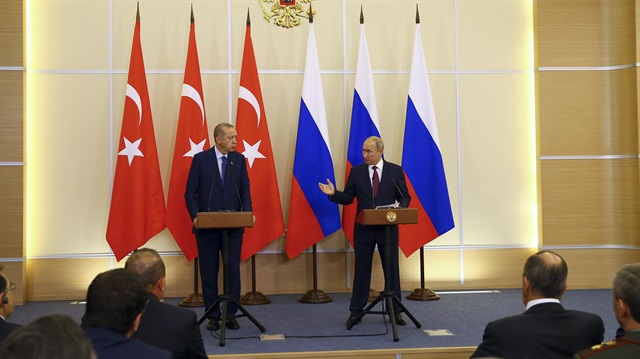
Recep Tayyip Erdoğan - Vladimir Putin meeting in Russia
The summit between Turkish President Recep Tayyip Erdoğan and Russian leader Vladimir Putin in Sochi Monday night has been covered extensively in European newspapers on Tuesday.
The two leaders met in the Russian resort city to discuss the situation in the Syrian province of Idlib, on which an all-out assault by Syrian regime forces was feared.
The story was on the front page of major Russian newspapers.
The Kommersant newspaper commented on the perseverance of the Russian and Turkish presidents who found a compromise in Sochi.
The newspaper cited two representatives of the Syrian opposition. One of the leaders of Syria’s armed opposition Fateh Hasun told Kommersant: "Sochi managed to stop the bloodshed of tens of thousands of Syrians -- between the opposition and those who are loyal to the authorities. And this is a positive step in Russia's relations with the forces of the Syrian revolution.”
Chairman of the Building the Syrian State (BSS) political movement Louay Hussein predicts that sooner or later Damascus will try to eventually take control of Idlib.
“Neither Damascus, nor the forces loyal to it, nor the Russians will leave the 'island of security' outside the control of the Syrian army and will allow illegal weapons to remain in the region. At the same time, the agreement in Sochi will put an end to terrorists, including the al-Nusra Front,” he said.
The Izvestia newspaper, in an article titled “Russia and Turkey clarified the future of Idlib” said the meeting in Sochi “brought clarity” to the Russian and Turkish positions on Idlib and helped to find a compromise.
Turkish President Recep Tayyip Erdoğan and his Russian counterpart Vladimir Putin held a meeting at the Russian leader’s presidential residence on Monday in the coastal city of Sochi.Russian President Putin said that he has a lot to discuss with Turkey's Erdoğan, including complicated matters to review and solve.Erdoğan said on Monday that a joint statement due to be made after his meeting with Russian President Vladimir Putin on the crisis in Syria would bring "new hope" to the region."Exchanging views on political, military, economic issues will strengthen Turkey and Russia", Erdoğan added.Putin in his turn said that "In terms of trade, it's growing intensely. Our relations are also improving in terms of regional security,".Relations between Turkey and Russia, economy and energy issues, as well as regional and international issues, particularly Syria, were among the topics expected to be discussed.Video: Turkey, Russia cooperation to be ‘hope’ for regionErdoğan is accompanied by Turkish Foreign Minister Mevlüt Çavuşoğlu, Energy and Natural Sources Minister Fatih Dönmez, Treasury and Finance Minister Berat Albayrak, Defense Minister Hulusi Akar, Trade Minister Ruhsar Pekcan, head of National Intelligence Service (MIT) Hakan Fidan, Presidential Spokesman Ibrahim Kalın and Presidency Communications Director Fahrettin Altun.Among the Russian delegation are Russian Foreign Minister Sergey Lavrov, Energy Minister Aleksandr Novak, Defense Minister Sergey Shoygu and Kremlin Spokesman Dmitry Peskov.The bilateral meeting, which was closed to the media, started at 2.50 pm local time (1150GMT).Relations between Turkey and Russia, economy and energy issues, as well as regional and international issues, particularly Syria, were among the topics expected to be discussed.
Turkey, Russia cooperation to be ‘hope’ for region
'Limits of Putin's power'
The daily does warn about difficulties in the realization of the agreement and possible implications.
The Rossiyskaya Gazeta in a story under the headline “Syrian breakthrough” praised the understanding between the two leaders.
German media also widely covered the Erdogan-Putin summit and underlined Turkey’s strong influence in the region.
“The agreement with Erdogan shows the limits of Putin’s power,” weekly Die Zeit commented.
“Until recently Vladimir Putin has intensified the military threat backdrop in Idlib. But his agreement with Turkey once again showed that Russia cannot control Syria alone,” the weekly newspaper reported.
Under the headline “An attack on opposition stronghold Idlib averted”, the Frankfurter Rundschau daily welcomed the agreement between Turkey and Russia to set up up a demilitarized zone.
“With this a Russian military offensive is ruled out, for the time being,” it reported.
'Welcomed by international community'
The British media also welcomed the last-minute deal over Idlib.
The BBC said “any diplomatic arrangement that postpones a full-scale onslaught against Idlib will be welcomed by the international community”.
It said “such an attack by the [Bashar al-] Assad government -- backed by its Russian and Iranian allies -- risked not just a humanitarian catastrophe, but also a direct military confrontation with Turkey.”
Recalling that Turkey has deployed troops at a number of locations in Idlib and has been reinforcing these recently, the BBC also said Assad wanted “to reassert control over Idlib -- the last province in rebel hands.”
The Guardian said an “immediate risk of a humanitarian disaster in the last major Syrian rebel enclave of Idlib appears to have been averted by a joint Russian-Turkish plan to set up a demilitarised zone as a buffer between the Syrian army and the rebels”.
The daily also quoted Jan Egeland, an adviser to the UN envoy for Syria, Staffan de Mistura, as describing the deal as “hope at long last for 3 million Syrian civilians in Idlib”.
“Russia and Turkey agree on plan that may avert horrific war among displaced people. The Syrian government and armed opposition groups must respect deal, not provoke bloodshed and allow humanitarian access,” Egeland said, according to the paper.
French daily Liberation emphasized the “primordial” role of Turkey in reaching the deal. “Ankara has been doing everything” for months “to prevent the Syrian regime and its allies from launching the assault, said the daily”.
Newspaper Le Figaro said Ankara was facing two challenges: avoiding “a new influx of Syrian refugees caused by a major offensive, while the country has already hosted more than 3 million Syrians since the beginning of the conflict.” And protecting Turkish soldiers “deployed in 12 observation posts established in Idlib to ensure compliance with the 'de-escalation' implemented by the Astana process, started in January 2017 as well as 'moderate' Syrian rebel groups.”
Germany has welcomed on Tuesday an agreement between Turkey and Russia to establish a demilitarized zone in Syria's Idlib province, the last major stronghold of the opposition groups."We welcome all steps towards avoiding a humanitarian catastrophe," Germany’s Foreign Minister Heiko Maas said on Twitter, referring to the Turkey-Russia agreement.He called for concrete steps towards implementing the agreement."The agreement in Sochi now needs to be implemented. This had not been possible for other agreements in Syria in the past years," he added.Maas met with Russian Foreign Minister Sergey Lavrov last week in Berlin and urged Moscow to avoid a large-scale military offensive in Idlib, which he said could lead to a humanitarian catastrophe and new refugee influx.Syrian opposition says Turkish-Russian deal excludes Idlib attack'Turkey-Russia deal on Idlib ends Assad dream to regain control over Syria'Turkish President Recep Tayyip Erdogan and Russian President Vladimir Putin agreed on Monday, following their talks in Sochi, to establish a demilitarized zone in Syria's Idlib province.Putin said the demilitarized zone will extend between 15 to 20 kilometers (9-12 miles) deep into Idlib by Oct. 15.Turkish and Russian armed forces will conduct joint patrols along the zone's perimeter, according to the agreement.Located near the Turkish border, Idlib province is home to more than 3 million Syrians, many of whom fled from other cities following attacks by regime forces.Erdoğan's aide hails Ankara-Moscow deal on IdlibUS welcomes efforts to reduce violence in SyriaThe Syrian regime had announced plans last month to launch a major military offensive to the area, long controlled by various armed opposition groups. The UN warned that such an offensive would lead to the "worst humanitarian catastrophe in the 21st century".
Germany welcomes Turkey-Russia agreement on Idlib