


File photo
Hundreds of thousands of foreign troops, including militias, who were deployed to the region under the pretext of fighting Daesh or supposedly providing humanitarian relief still maintain their military presence in Iraq and Syria.
The U.S., Russia, Italy, Germany, UK, Iran and France lead the military presence in both countries.
The U.S., taking advantage of the rising tensions in Syria’s Idlib and Iraq’s struggle to form a government, is now in preparation for a Kirkuk-centered bloody scenario in the region in alliance with the Peshmerga and Kurdistan Workers' Party (PKK) terrorists.With the aim of delivering Turkmen towns to the Peshmerga, PKK terrorists are being deployed to the region.Speaking exclusively to Yeni Şafak daily, Iraqi Turkmen Front (ITF) officer Mehmet Seman Ağaoğlu divulged details about the Washington administration’s recent occupational plans in cooperation with the Peshmerga in Iraq, while conflicts remain after the May 12 elections and wide-spread protests that have resulted in death and violence.“Barzani and Talabani are planning a bloody return to Kirkuk from which they were forced to withdraw on October 16,” he said.A military initiative launched by Baghdad following the illegitimate Sept. 25 independence referendum enabled the swift recapture of the oil-rich city of Kirkuk as well as several other parts of Iraq that were disputed between Baghdad and the Kurdistan Regional Government (KRG).The KRG obtained half of the oil they exported from the Bai Hassan and Havana oil fields northwest of Kirkuk.Iraqi forces took control of these oilfields northwest, after Kurdish Peshmerga fighters had retreated.The Barzani and Talabani administrations dispatched PKK terrorists to Kirkuk, Mosul, Hanakin and surrounding towns.Since July 9, Iraq’s Shia-majority central and southern provinces -- especially Basra -- have been rocked by protests to demand better public services, more job opportunities and an end of government corruption.Iraqi parliament elects second deputy speakerIraq parliament elects Sunni lawmaker Al-Halbousi as speaker, breaking deadlockTurkmen centers surrounded by terroristsPKK terrorists were especially deployed near to the Turkmen regions where the Turkmen Party and association centers are located.“PKK terrorists are being sent to the regions, notably to the Iraq Turkmen Front’s buildings, that are near to the headquarters of Turkmeneli TV and Turkmen Party. “We have identified more than 20 houses and work offices that are used by PKK terrorists as observations posts,” he said.“A ferocious massacre similar to the one conducted on July 14, 1959 is currently being prepared and the PKK will play active role in this process,” he added.At least 30 Turkmens were killed, and over 100 injured, in what is today known as the three-day long "Kirkuk Massacre," after a rally to celebrate the first anniversary of the 1958 revolution deteriorated.Iraqi parliament holds second session to elect Speaker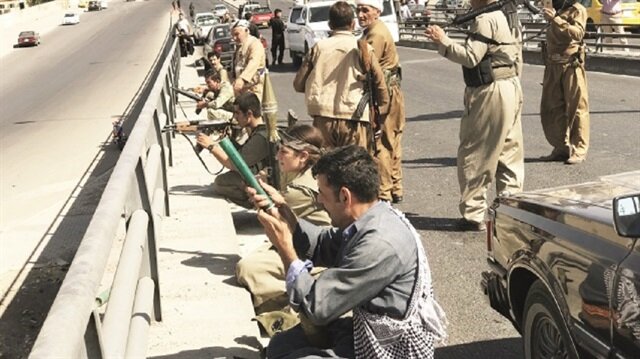
US seeks to deliver Kirkuk to Peshmerga in cooperation with PKK terrorists
Iraq will deploy border guards to its northern border with Turkey in order to stop infiltration attempts by terrorists from the Kurdistan Workers’ Party (PKK). The move, which was ordered by Prime Minister Haider al-Abadi and approved by Iraq’s National Security Council, will see a force of border guards affiliated with the interior ministry sent to the border. Speaking to Yeni Şafak daily about details surrounding the decision, Turkey’s envoy to Baghdad Fatih Yıldız pointed that Iraqi PM Abadi had mentioned during his last visit to Turkey that his country is willing to increase the presence of forces linked to the interior ministry along the border. During his visit to Turkey back in August, the premier said that the two countries share the same ideas on border security.Video: Turkish President receives Iraqi Premier in AnkaraAbadi’s visit to Turkey ushered in a new eraAfter meeting with Turkish President Recep Tayyip Erdoğan in Ankara, the two leaders vowed to improve bilateral relations that would usher in a new era in Turkish- Iraqi ties.“We have come to a mutual agreement to be in full cooperation against the terrorists,” Erdoğan said at a joint press conference with al-Abadi in Ankara.The neutralization of senior PKK terrorist and so-called Sinjar responsible İsmail Özden is thought to have been the result of an intelligence tip that came from the Iraqi government following Abadi’s visit.Five PKK terrorists neutralized in SE Turkey, N.Iraq‘We will not allow PKK attacks’ “We share the same views on border security. We are against any group using Iraqi territories to attack Turkey and other neighboring countries,” the prime minister said during his visit to Ankara.Ovaköy border gateDetails regarding the Ovaköy Border Gate that will directly link Turkey to Baghdad via a 570-kilometer (354-mile) highway are expected to emerge after a delegation conducted a detailed analysis earlier this month. The border gate will play an important role in improving trade ties between Turkey and Iraq and will be a focal point of unity on the border with Syria.The strategic border gate, an alternative to the Ibrahim Khalil (Habur) border crossing located between Turkey and the Kurdish region in northern Iraq, will cut off the weapons supply of the PKK terror group. The PKK is listed as a terrorist organization by Turkey, the European Union and the United States. The PKK has been conducting armed violence in the southeastern part of Turkey since 1984. More than 40,000 people, mostly civilians, have been killed in the three-decade long conflict.Turkish delegation to visit Iraq for Ovaköy border gate next weekUS envoy holds slew of meetings in Iraq to halt Ovaköy border gate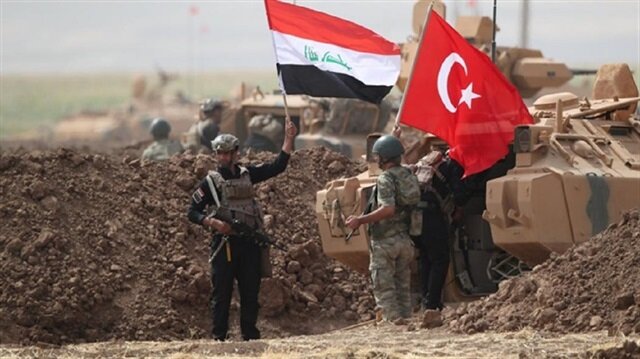
Iraq deploys forces along Turkey border to thwart PKK infiltration
Foreign involvement in Iraq
Approximately 6,000 American troops are present in Iraq and the U.S. uses the oil resources in the region as a guise. The Washington administration also deployed Kurdistan Worker’s Party (PKK) terrorists along with Peshmerga forces who are tasked with ensuring the security of the oil-wells.
Here are the approximate numbers for the foreign involvement in Iraq:
Iran: Tehran has no soldiers in Iraq but commands and controls more than 100,000 Hashd al-Shaabi soldiers. Hashd al-Shaabi is also known as the Popular Mobilization Forces (PMF).
Germany: 200 military personnel.
UK: The British presence in Iraq is thought to be between 400 and 1,000 troops.
France: 500 to 1,000 soldiers.
Germany: Approximately 200 troops.
Italy: 500 troops.
Netherlands, Denmark, Norway and Sweden are also among the countries who are present in Iraq, even though they have few soldiers – a total 200 troops – as part of the Global Coalition against Daesh.
Turkish President Recep Tayyip Erdoğan and his Russian counterpart Vladimir Putin held a meeting at the Russian leader’s presidential residence on Monday in the coastal city of Sochi.Russian President Putin said that he has a lot to discuss with Turkey's Erdoğan, including complicated matters to review and solve.Erdoğan said on Monday that a joint statement due to be made after his meeting with Russian President Vladimir Putin on the crisis in Syria would bring "new hope" to the region."Exchanging views on political, military, economic issues will strengthen Turkey and Russia", Erdoğan added.Putin in his turn said that "In terms of trade, it's growing intensely. Our relations are also improving in terms of regional security,".Relations between Turkey and Russia, economy and energy issues, as well as regional and international issues, particularly Syria, were among the topics expected to be discussed.Video: Turkey, Russia cooperation to be ‘hope’ for regionErdoğan is accompanied by Turkish Foreign Minister Mevlüt Çavuşoğlu, Energy and Natural Sources Minister Fatih Dönmez, Treasury and Finance Minister Berat Albayrak, Defense Minister Hulusi Akar, Trade Minister Ruhsar Pekcan, head of National Intelligence Service (MIT) Hakan Fidan, Presidential Spokesman Ibrahim Kalın and Presidency Communications Director Fahrettin Altun.Among the Russian delegation are Russian Foreign Minister Sergey Lavrov, Energy Minister Aleksandr Novak, Defense Minister Sergey Shoygu and Kremlin Spokesman Dmitry Peskov.The bilateral meeting, which was closed to the media, started at 2.50 pm local time (1150GMT).Relations between Turkey and Russia, economy and energy issues, as well as regional and international issues, particularly Syria, were among the topics expected to be discussed.
Turkey, Russia cooperation to be ‘hope’ for region
US leads foreign military presence in Syria
The countries that are involved in Iraq are also present in Syria.
There are about 5,000 U.S. troops in Syria, positioned in 22 separate bases that control over 50,000 PKK/PYD terrorists in the region.
Russia deployed 2,000 troops in four separate bases that are thought to be dispatched to counter the the Global Coalition against Daesh.
Iran has positioned 1,000 soldiers in Syria to train militias and Assad’s forces. Iran extends its presence with between 60,000 and 70,000 Tehran-backed militias, who are also in alliance with the Syrian regime.
France maintains it presence with between 500 and 1,000 troops, and Germany follows with 100 to 200 military personnel.
Israel’s current precise number of troops are unknown that are dispatched to Golan Heights.
Turkish response
The military presence of foreign powers in Iraq and Syria can be evaluated as a threat to Turkey, which is a neighbor to both countries. As a result, Turkey is also increasing its military presence in these countries in order to defend Iraq and Syria against those who seek to target their territorial integrity.
Through operations Euphrates Shield and Olive Branch, Turkey protected locals and cleared northern Syria of terror elements.
Turkey has launched anti-terror operations in both Qandil and Sinjar regions in northern Iraq.
A deal brokered between Turkey and Russia over Syria's northwestern Idlib region puts an end to President Bashar al-Assad's dream of regaining full control over the country, a Free Syrian Army (FSA) commander said on Tuesday.The buffer zone agreed to in Idlib will save civilian lives and protect the area from Syrian army bombing and create a "geographic area" under the control of the FSA that is capable of pushing for a post-Assad political transition in Syria."The Idlib deal preserves lives of civilians and their direct targeting by the regime. It buries Assad's dreams of imposing his full control over Syria," prominent FSA commander Mustafa Sejari said.Erdoğan's aide hails Ankara-Moscow deal on IdlibTurkey, Russia agree on 'weapons-free zone' in IdlibThe deal has "practically excluded" a Syrian government offensive in the region, the spokesman for the opposition Syrian Negotiations Commission told Reuters.The "scenario of attack is practically excluded, at least for a period of time that is not small, and we hope that it will be permanent," Yahya al-Aridi. Aridi said the deal announced on Monday had safeguarded the lives of millions of Syrians and was an indication that the "path of peace" must now be opened.Turkey and Russia on Monday agreed to turn Idlib into a demilitarized zone after a meeting between President Recep Tayyip Erdoğan and his counterpart Vladimir Putin in Russia's coastal city of Sochi.Ankara and Moscow signed a memorandum of understanding calling for the stabilization of the situation in Idlib's de-escalation zone, in which acts of aggression are prohibited."We have agreed on the establishment of a weapons-free zone between the opposition- and [Assad] regime-controlled areas," Erdoğan said in a news conference with Putin in the Black Sea coastal city of Sochi, following a meeting between the two leaders.Iran welcomes Turkey-Russia deal over IdlibPutin said the demilitarized zone will extend between 15 to 20 kilometers (9-12 miles) deep into Idlib by Oct. 15. He added that the establishment of the zone would be accompanied by the withdrawal of armed groups, including the al-Nusra Front.Putin said all heavy weapons had to be withdrawn from the zone by Oct. 10, according to Erdoğan’s proposal. This includes tanks, rocket launchers, guns and mortars of all opposition groups.Erdoğan said Russia and Turkey will conduct joint patrols along the zone's perimeter, and the two countries will restore transit routes between Syria's Aleppo, Latakia, Hama by the end of 2018.
'Turkey-Russia deal on Idlib ends Assad dream to regain control over Syria'