

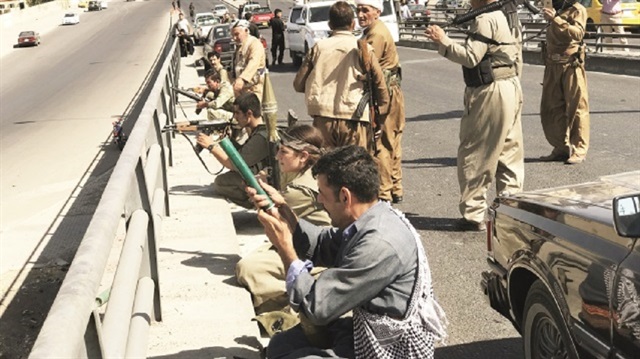
The U.S. seeks to deliver Turkmen towns to the Peshmerga
The U.S., taking advantage of the rising tensions in Syria’s Idlib and Iraq’s struggle to form a government, is now in preparation for a Kirkuk-centered bloody scenario in the region in alliance with the Peshmerga and Kurdistan Workers' Party (PKK) terrorists.
With the aim of delivering Turkmen towns to the Peshmerga, PKK terrorists are being deployed to the region.
Speaking exclusively to Yeni Şafak daily, Iraqi Turkmen Front (ITF) officer Mehmet Seman Ağaoğlu divulged details about the Washington administration’s recent occupational plans in cooperation with the Peshmerga in Iraq, while conflicts remain after the May 12 elections and wide-spread protests that have resulted in death and violence.
“Barzani and Talabani are planning a bloody return to Kirkuk from which they were forced to withdraw on October 16,” he said.
A military initiative launched by Baghdad following the illegitimate Sept. 25 independence referendum enabled the swift recapture of the oil-rich city of Kirkuk as well as several other parts of Iraq that were disputed between Baghdad and the Kurdistan Regional Government (KRG).
The KRG obtained half of the oil they exported from the Bai Hassan and Havana oil fields northwest of Kirkuk.
Iraqi forces took control of these oilfields northwest, after Kurdish Peshmerga fighters had retreated.
The Barzani and Talabani administrations dispatched PKK terrorists to Kirkuk, Mosul, Hanakin and surrounding towns.
Since July 9, Iraq’s Shia-majority central and southern provinces -- especially Basra -- have been rocked by protests to demand better public services, more job opportunities and an end of government corruption.
The Iraqi parliament on Sunday elected Bashir al-Haddad as second deputy speaker.The candidate of the Democratic Party of Kurdistan Bashir al-Haddad won the post of second deputy speaker by obtaining more than 185 out of 282 votes, according to Anadolu Agency's reporter.Iraq's parliament on Saturday elected Sunni politician Mohammed al-Halbusi as assembly speaker and the Shia MP Hassan Karim al-Kaabi as the first deputy speaker.Earlier this month, the newly-elected parliament postponed the election of a new assembly speaker to mid-September after a number of lawmakers decided to boycott the vote.Under Iraq’s constitution, the majority bloc in parliament has the right to draw up the country’s next government.According to results of Iraq’s May 12 parliamentary poll, Muqtada al-Sadr's Sairoon Coalition won 54 seats, followed by a Hashd al-Shaabi-led coalition (47 seats) and Prime Minister Haider al-Abadi's Victory Bloc (42 seats).
Iraqi parliament elects second deputy speaker
Iraq's parliament elected Sunni lawmaker Mohammed al-Halbousi as speaker on Saturday, marking an important step towards establishing a new government four months after an inconclusive national election.Parliament had been due to elect a speaker and two deputies during its first meeting on Sept 3, but failed to do so as lawmakers were unable to determine which competing bloc had the most seats.Halbousi's election marks the start of a 90-day process outlined in the constitution, designed to eventually lead to a new government.Lawmakers must next elect a new president and task the leader of the largest bloc to form a government as prime minister. But a dominant bloc has yet to emerge, against a backdrop of shifting political alliances.Iraqi parliament holds second session to elect SpeakerHalbousi defeated former Defence Minister Khaled al-Obeidi, winning the position with 169 votes, according to Shi'ite lawmaker Husham al-Suhail. Iraq's parliament contains 329 seats.Announcing the vote, the temporary leader of the assembly said Halbousi, 37, had become the youngest speaker of parliament in Iraq's history.Before running in May's national election as a candidate on the Anbar Our Identity electoral list, Halbousi was the governor of Anbar province. He had previously served in Iraq's parliament, from 2014 to 2017.Since Saddam Hussein was toppled in a 2003 U.S.-led invasion, power has been shared among Iraq's three largest ethnic-sectarian components. The prime minister has traditionally been a Shi'ite Arab, the speaker of parliament a Sunni Arab and the president a Kurd.Iraqis voted in May in their first parliamentary election since the defeat of Daesh, but a contentious recount process delayed the announcement of final results until last month.
Iraq parliament elects Sunni lawmaker Al-Halbousi as speaker, breaking deadlock
Turkmen centers surrounded by terrorists
PKK terrorists were especially deployed near to the Turkmen regions where the Turkmen Party and association centers are located.
“PKK terrorists are being sent to the regions, notably to the Iraq Turkmen Front’s buildings, that are near to the headquarters of Turkmeneli TV and Turkmen Party.
“We have identified more than 20 houses and work offices that are used by PKK terrorists as observations posts,” he said.
“A ferocious massacre similar to the one conducted on July 14, 1959 is currently being prepared and the PKK will play active role in this process,” he added.
At least 30 Turkmens were killed, and over 100 injured, in what is today known as the three-day long "Kirkuk Massacre," after a rally to celebrate the first anniversary of the 1958 revolution deteriorated.
The Iraqi parliament on Saturday held its second session to elect the parliament speaker and his two deputies.A source from within the parliament told Anadolu Agency that after the winning MPs are sworn in they will vote for the speaker of the house of representatives and his two deputies.The source, preferring not to be named because he was not authorized to talk to the media, said the Iraqi security forces inside parliament prevented the media from entering the building without giving any reasons.Earlier this month, the newly-elected parliament postponed the election of a new assembly speaker to mid-September after a number of lawmakers decided to boycott the vote.Attended by only 85 of 329 MPs, the first session saw fierce disagreements between rival coalitions (Al-Bina and Reform Construction), both of which claimed to have attained a majority bloc in the assembly. Under Iraq’s constitution, the majority bloc in parliament has the right to draw up the country’s next government.Among the most prominent nominees for the post of speaker is Osama al-Nujaifi and Mohamed al-Halbusi.According to results of Iraq’s May 12 parliamentary poll, Muqtada al-Sadr's Sairoon Coalition won 54 seats, followed by a Hashd al-Shaabi-led coalition (47 seats) and Prime Minister Haider al-Abadi's Victory Bloc (42 seats).Iraqi Sunni parliament bloc chooses nominee for speakerIran commemorates soldiers slain during war with IraqCar bomb in Iraq’s Saladin leaves 6 dead, 42 injuredTurkey ramps up diplomatic efforts as Iraq spirals into chaos
Iraqi parliament holds second session to elect Speaker