

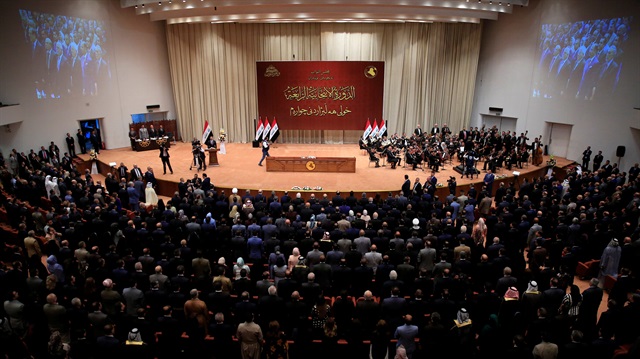
File photo
The Iraqi parliament on Saturday held its second session to elect the parliament speaker and his two deputies.
A source from within the parliament told Anadolu Agency that after the winning MPs are sworn in they will vote for the speaker of the house of representatives and his two deputies.
The source, preferring not to be named because he was not authorized to talk to the media, said the Iraqi security forces inside parliament prevented the media from entering the building without giving any reasons.
Earlier this month, the newly-elected parliament postponed the election of a new assembly speaker to mid-September after a number of lawmakers decided to boycott the vote.
Attended by only 85 of 329 MPs, the first session saw fierce disagreements between rival coalitions (Al-Bina and Reform Construction), both of which claimed to have attained a majority bloc in the assembly.
Under Iraq’s constitution, the majority bloc in parliament has the right to draw up the country’s next government.
Among the most prominent nominees for the post of speaker is Osama al-Nujaifi and Mohamed al-Halbusi.
According to results of Iraq’s May 12 parliamentary poll, Muqtada al-Sadr's Sairoon Coalition won 54 seats, followed by a Hashd al-Shaabi-led coalition (47 seats) and Prime Minister Haider al-Abadi's Victory Bloc (42 seats).
The National Axis, a Sunni-leaning parliamentary bloc, has nominated Mohamed al-Halbusi for the post of speaker of Iraq’s recently-elected parliament.In a statement, National Axis spokesman Laith al-Deleimi said the bloc had chosen its “sole nominee” for the post, which, under Iraq’s constitution (promulgated after the 2003 U.S. invasion), is reserved for a Sunni Muslim.A National Axis source, speaking on condition of anonymity, told Anadolu Agency that the bloc had informed other parliamentary coalitions regarding al-Halbusi’s nomination.Turkish FM meets Chinese envoy, Iraqi Turkmen leaderThe source added, however, that the position of parliament’s main Shia and Kurdish blocs regarding al-Halbusi’s candidacy “still remains unclear”.Other prominent Sunni politicians nominated for the post include former Defense Minister Khaled al-Obaidi and current Vice-President Osama al-Nujaifi.On Saturday, parliament will try -- for the third time -- to elect a new assembly speaker, along with two deputies.60,000 cases of water poisoning in Basra: Iraq watchdogLast week, parliament postponed the election for speaker to mid-September after a number of lawmakers decided to boycott the vote.Within 30 days of its first session, which was held early last week, parliament should elect -- by a two-thirds majority -- the country’s next president, according to the terms of the constitution.The new president will then task the majority bloc in parliament with drawing up a government, the outlines of which must be referred back to the assembly for final approval.US says Iran to pay for any attack on missions in IraqTurkey ramps up diplomatic efforts as Iraq spirals into chaos
Iraqi Sunni parliament bloc chooses nominee for speaker
Iran on Thursday held state funerals for a number of Iranian military personnel killed during the Iraq-Iran War (1980-1988) after their remains were repatriated earlier this week.Attended by Iranian political and military officials, Thursday’s funerals were held on the premises of the University of Tehran.After additional funerals are held in other Iranian provinces (including Eastern Azerbaijan, Isfahan, Kermanshah and Khurasan), the remains of 135 slain soldiers -- located by the Iraqi authorities earlier this year -- will be buried.During the 1980s, the two countries fought a devastating conflict that left hundreds of thousands dead and resulted in economic losses estimated at $1 trillion.Relations between Baghdad and Tehran improved after the overthrow of the Saddam Hussein regime following the U.S.-led invasion of Iraq in 2003.Since then, the two countries have continued to exchange the remains of slain soldiers under an agreement brokered by the International Committee of the Red Cross.
Iran commemorates soldiers slain during war with Iraq
Six people were killed -- and 42 more injured -- when a car bomb went off in Iraq’s Saladin province north of Baghdad on Wednesday, according to a local police source.The bomb went off outside a restaurant on the road linking Saladin’s city of Baiji to provincial capital Tikrit, Police First Lieutenant Numan al-Jabouri told Anadolu Agency.The police officer went on to suggest that remnants of the Daesh terrorist group -- which overran much of Iraq in 2014 before being crushed by the army last year -- could be behind Wednesday’s deadly attack.Recent months have seen frequent attacks on security personnel deployed in northern and eastern Iraq, especially in the provinces of Diyala, Kirkuk and Saladin.Last year, Iraqi officials declared that Daesh's military presence in the country had been all but destroyed following a three-year conflict with the army.Nevertheless, Iraqi security forces continue to carry out sporadic operations aimed at eliminating the group’s lingering presence in certain parts of the country.
Car bomb in Iraq’s Saladin leaves 6 dead, 42 injured
The power struggle between Iran and Saudi Arabia has sparked internal conflict in Iraq, which has yet to agree on a government, engulfing the country in protests that have resulted in death and violence.The international community is worried about the protests that began in Baghdad spreading across the country.As Iraq’s and Syria’s territorial integrity are on the top of Turkey’s agenda, it has been ascertained that Ankara should take action to soften the crisis, send delegations to the region and take urgent measures in Iraq.Since July 9, Iraq’s Shia-majority central and southern provinces -- especially Basra -- have been rocked by protests to demand better public services, more job opportunities and an end of government corruption.Tension between Shi’ite Iran and Saudi Arabia’s conservative Sunni monarchy has run high in recent years. The two countries have backed opposing forces in wars across the Middle East, usually along sectarian lines.Since Saddam Hussein was toppled in a 2003 U.S. invasion, power has been shared among Iraq’s three largest ethnic-sectarian components. The prime minister is a Shi’ite Arab, the speaker of parliament a Sunni Arab and the president a Kurd. Tensions rise day by dayThe crisis comes at a time when politicians still have not agreed on a government after an inconclusive election in May. The new parliament met for the first time on Monday, but failed to elect a prime minister or even speaker.Iraqi experts and army officials are worried about a civil war breaking out in the country after thousands of militias were dispatched to the region.For more than two months, the results of Iraq’s hard-fought parliamentary polls had remained the subject of a bitter dispute amid widespread allegations of voter fraud.According to the results, Shia cleric Muqtada al-Sadr's Sairoon Coalition won 54 parliamentary seats, followed by a Hashd al-Shaabi-led coalition (47 seats) and Prime Minister Haider al-Abadi's Victory Bloc (42 seats).Parliament convened an emergency session on Saturday to discuss the crisis in Basra and the current prime minister, Haider al-Abadi, warned that the situation could descend into armed conflict.“Politics should be separated from security and services,” he said.At least 30 protesters have reportedly been killed -- and scores more injured -- in clashes with security forces since the beginning of the conflict. In recent days, protesters have torched government and political party headquarters as well as the Iranian consulate.Turkish army ‘neutralizes’ two PKK terrorists in N. IraqPM arrives in Iraq’s protest-hit Basra provinceTurkey ready to help BaghdadTurkey’s counter-terrorism operations in northern Iraq and the new Ovaköy project which enhanced ties between Ankara and Baghdad disturb Western countries.The Ovaköy border gate project is an alternative to the Ibrahim Khalil (Habur) border crossing located between Turkey and the Kurdish region in northern Iraq, and will cut off the U.S. weapons supply to the Kurdistan Workers’ Party (PKK) terror group.Turkey's Ambassador to Baghdad Fatih Yıldız is a key factor in relations with his diplomatic efforts, closely following the developments, and is in constant contact with Baghdad.Since the beginning of the conflict, Turkey conveyed messages of support to Iraq, saying that it was ready to help.“Turkey is ready to assist Iraq in water management and agricultural irrigation,” Yıldız said in August.On the other hand, the Turkish Consulate-General in Iraq's southern city of Basra, which was closed for security reasons in 2014, is considered to be reopened in near future.Iraqi groups demand prime minister's resignationIraqi officials impose Basra curfew amid violent protests
Turkey ramps up diplomatic efforts as Iraq spirals into chaos