

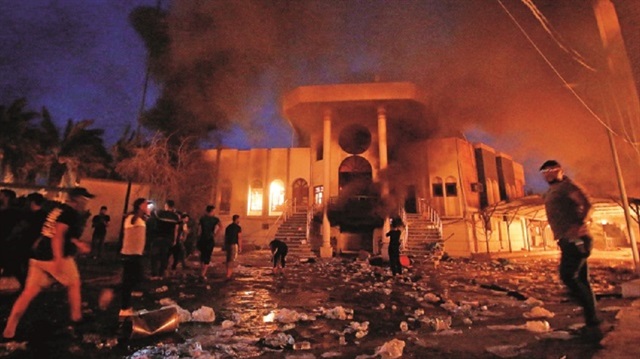
Protests in Iraq
The power struggle between Iran and Saudi Arabia has sparked internal conflict in Iraq, which has yet to agree on a government, engulfing the country in protests that have resulted in death and violence.
The international community is worried about the protests that began in Baghdad spreading across the country.
As Iraq’s and Syria’s territorial integrity are on the top of Turkey’s agenda, it has been ascertained that Ankara should take action to soften the crisis, send delegations to the region and take urgent measures in Iraq.
Since July 9, Iraq’s Shia-majority central and southern provinces -- especially Basra -- have been rocked by protests to demand better public services, more job opportunities and an end of government corruption.
Tension between Shi’ite Iran and Saudi Arabia’s conservative Sunni monarchy has run high in recent years. The two countries have backed opposing forces in wars across the Middle East, usually along sectarian lines.
Since Saddam Hussein was toppled in a 2003 U.S. invasion, power has been shared among Iraq’s three largest ethnic-sectarian components. The prime minister is a Shi’ite Arab, the speaker of parliament a Sunni Arab and the president a Kurd.
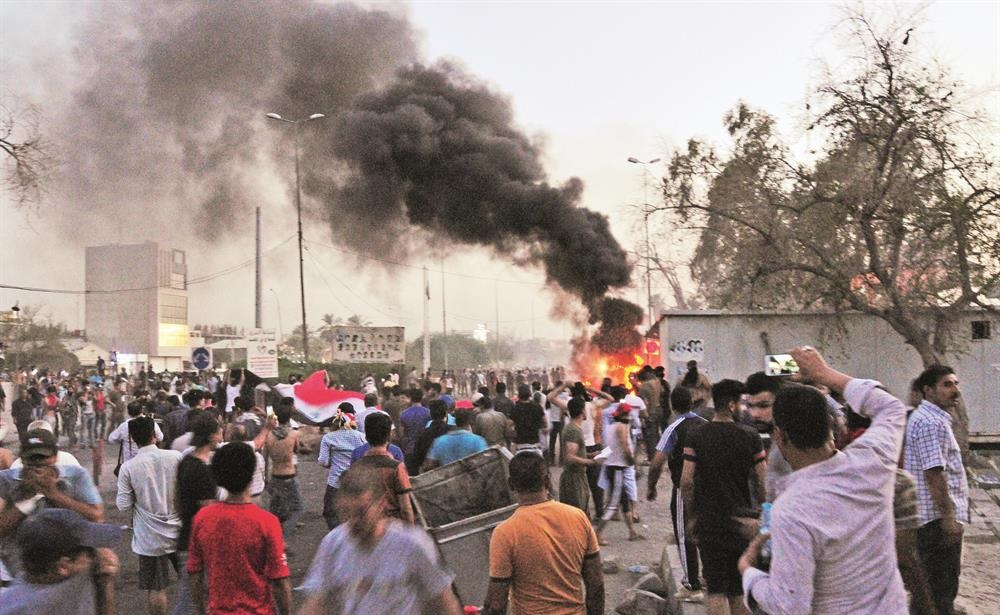
Tensions rise day by day
The crisis comes at a time when politicians still have not agreed on a government after an inconclusive election in May. The new parliament met for the first time on Monday, but failed to elect a prime minister or even speaker.
Iraqi experts and army officials are worried about a civil war breaking out in the country after thousands of militias were dispatched to the region.
For more than two months, the results of Iraq’s hard-fought parliamentary polls had remained the subject of a bitter dispute amid widespread allegations of voter fraud.
According to the results, Shia cleric Muqtada al-Sadr's Sairoon Coalition won 54 parliamentary seats, followed by a Hashd al-Shaabi-led coalition (47 seats) and Prime Minister Haider al-Abadi's Victory Bloc (42 seats).
Parliament convened an emergency session on Saturday to discuss the crisis in Basra and the current prime minister, Haider al-Abadi, warned that the situation could descend into armed conflict.
“Politics should be separated from security and services,” he said.
At least 30 protesters have reportedly been killed -- and scores more injured -- in clashes with security forces since the beginning of the conflict.
In recent days, protesters have torched government and political party headquarters as well as the Iranian consulate.
At least two PKK terrorists were “neutralized” in an airstrike in northern Iraq, according to the Turkish army on Monday.Turkish authorities often use the word "neutralized" in statements to imply the terrorists in question either surrendered, were killed or captured.The Turkish General Staff said on Twitter that the operation was conducted in the Metina region on Sunday.The terrorist positions and shelters were also destroyed during the operation, the military added.In its more than 30-year terror campaign against Turkey, the PKK -- listed as a terrorist organization by Turkey, the U.S. and the EU -- has been responsible for the deaths of 40,000 people, including women and children.Nine PKK terrorists ‘neutralized’ in N. Iraq, SE TurkeyTurkish army ‘neutralizes’ 3 PKK terrorists in N. IraqRegime trains YPG/PKK, leftist terrorists in NW SyriaTurkish forces 'neutralize' three PKK terrorists in N. Iraq
Turkish army ‘neutralizes’ two PKK terrorists in N. Iraq
Iraqi Prime Minister Haider al-Abadi arrived in Basra on Monday in hopes of containing a wave of popular protest that has gripped the southern province since early July.According to a statement released by al-Abadi’s office, the prime minister arrived in Basra early Monday at the head of a large delegation.A source close to Iraq’s Council of Ministers told Anadolu Agency that, while in Basra, al-Abadi and members of his delegation hoped to oversee the application of several government resolutions aimed at easing the popular unrest.Daesh kills four civilians in Iraq’s DiyalaAccording to the source, al-Abadi is being accompanied on his visit by several top government officials, including the ministers of information, defense, the interior, health and water resources.Members of the delegation, the same source said, hope to directly oversee the launch of several new projects in Basra aimed at improving public services.Since July 9, Iraq’s Shia-majority central and southern provinces -- especially Basra -- have been rocked by protests to demand better public services, more job opportunities and an end of government corruption.Since the demonstrations erupted more than two months ago, at least 30 protesters have reportedly been killed -- and scores more injured -- in clashes with security forces.Iraq summons Algerian envoy over pro-Saddam chants
PM arrives in Iraq’s protest-hit Basra province
Turkey ready to help Baghdad
Turkey’s counter-terrorism operations in northern Iraq and the new Ovaköy project which enhanced ties between Ankara and Baghdad disturb Western countries.
The Ovaköy border gate project is an alternative to the Ibrahim Khalil (Habur) border crossing located between Turkey and the Kurdish region in northern Iraq, and will cut off the U.S. weapons supply to the Kurdistan Workers’ Party (PKK) terror group.
Turkey's Ambassador to Baghdad Fatih Yıldız is a key factor in relations with his diplomatic efforts, closely following the developments, and is in constant contact with Baghdad.
Since the beginning of the conflict, Turkey conveyed messages of support to Iraq, saying that it was ready to help.
“Turkey is ready to assist Iraq in water management and agricultural irrigation,” Yıldız said in August.
On the other hand, the Turkish Consulate-General in Iraq's southern city of Basra, which was closed for security reasons in 2014, is considered to be reopened in near future.
Two major Iraqi groups demanded the resignation of Prime Minister Haidar al-Abadi and his Cabinet on Saturday following the events in southern Basra.Shia cleric Muqteda al-Sadr’s Sairoon coalition and pro-Iranian faction Hashd al-Shaabi's Fatah coalition urged the premier to resign.In a news conference, Sairoon coalition's head Hasan Akuli said they will work hard to form a stronger coalition.The Sairoon coalition came first in May 12 elections.In another press briefing, Fatah coalition spokesman Ahmad al-Asadi said Abadi and his Cabinet must resign because of negative developments in Basra and the death of civilians.Seven Iraqis have been killed during protests against poor public utilities in southern Basra province, according to the Health Ministry.Ministry spokesman Seif al-Badr confirmed the death toll to the media on Saturday, adding that Friday's protests had left three dead and 50 others injured.
Iraqi groups demand prime minister's resignation
Iraqi officials have imposed a curfew on Basra starting at 4pm local time (1300 GMT) on Saturday, a military statement said.Iraq's second biggest city has been rocked by five days of deadly demonstrations, in which government buildings have been ransacked and set alight by protesters angry over perceived political corruption. Iran summons Iraqi envoy over consulate torchingBasra airport targeted by three rockets, no casualtiesIraq protesters enter oilfield facility, hold two staff hostageOne protester dead, 11 wounded during protests in Iraq's Basra
Iraqi officials impose Basra curfew amid violent protests