

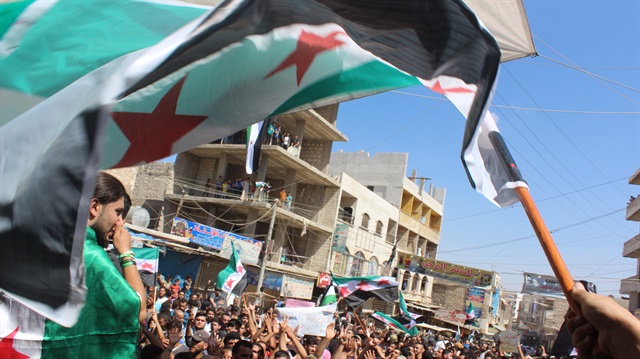
Anti-regime protest in Idlib
A deal brokered between Turkey and Russia over Syria's northwestern Idlib region puts an end to President Bashar al-Assad's dream of regaining full control over the country, a Free Syrian Army (FSA) commander said on Tuesday.
The buffer zone agreed to in Idlib will save civilian lives and protect the area from Syrian army bombing and create a "geographic area" under the control of the FSA that is capable of pushing for a post-Assad political transition in Syria.
"The Idlib deal preserves lives of civilians and their direct targeting by the regime. It buries Assad's dreams of imposing his full control over Syria," prominent FSA commander Mustafa Sejari said.
Turkish President Recep Tayyip Erdoğan made a "diplomatic attempt" to prevent a major humanitarian crisis in Syria's northwestern province of Idlib, presidential spokesman İbrahim Kalın said on Monday.Kalin's remarks came after Turkey and Russia on Monday agreed to turn Idlib into a demilitarized zone after a meeting between Erdogan and his counterpart Vladimir Putin in Russia's coastal city of Sochi.Ankara and Moscow signed a memorandum of understanding calling for the stabilization of the situation in Idlib's de-escalation zone, in which acts of aggression are prohibited."According to the agreement: The opposition will remain in areas in which they are already present. Russia and Turkey will conduct joint patrols. Russia will take measures to prevent attack on Idlib," Kalin said on Twitter.US welcomes efforts to reduce violence in SyriaIran welcomes Turkey-Russia deal over Idlib
Erdoğan's aide hails Ankara-Moscow deal on Idlib
Turkey and Russia on Monday agreed to turn Syria's northwestern Idlib province into a demilitarized zone."We have agreed on the establishment of a weapons-free zone between the opposition- and [Assad] regime-controlled areas," Turkish President Recep Tayyip Erdoğan said in a news conference with his Russian counterpart Vladimir Putin in the Black Sea coastal city of Sochi, following a meeting between the two leaders.Following the news conference, Ankara and Moscow signed a memorandum of understanding calling for the stabilization of the situation in Idlib's de-escalation zone, in which acts of aggression are prohibited."I believe that with this memorandum, we have prevented a great humanitarian crisis in Idlib," Erdoğan said.Putin said the demilitarized zone will extend between 15 to 20 kilometers (9-12 miles) deep into Idlib by Oct. 15.He added that the establishment of the zone would be accompanied by the withdrawal of armed groups, including the al-Nusra Front.Putin said all heavy weapons had to be withdrawn from the zone by Oct. 10, according to Erdoğan’s proposal. This includes tanks, rocket launchers, guns and mortars of all opposition groups.Iran welcomes Turkey-Russia deal over IdlibJoint patrolsHe also said Russia and Turkey would restore transit routes between Syria's Aleppo, Latakia, Hama by the end of 2018.Erdoğan said Russia and Turkey will conduct joint patrols along the zone's perimeter.He added Turkey would strengthen observation points in the Idlib de-escalation zone."The opposition will remain in areas in which they are already present. We will ensure that radical groups will not operate in the area," Erdoğan said.He said Russia will take necessary measures to protect the de-escalation zone in Idlib."We will jointly ensure the detection and prevention of both third parties' provocations and violations against this agreed memorandum," Erdoğan added.Putin said: "Russia and Turkey reaffirmed their determination to fight terrorism in Syria in all its forms. [...] The practical implementation of the planned steps will give an additional impetus to the process of a political settlement of the Syrian conflict, will accelerate work on the Geneva platform and will contribute to the return of peace to the Syrian land."The Russian president said that this approach was supported by the Syrian side. He said consultations with Damascus could be held in the near future.Erdoğan also said "terror nests" east of the Euphrates river posed the "biggest" threat for Syria's future."The main structure that attempts against Syria's territorial integrity and threatens Turkey's national security is PYD/YPG," Erdoğan said, adding these "terror swamps" should be drained.Bilateral relationsErdogan said the trade volume between Russia and Turkey increased 33 percent in the first of half of 2018 and reached around $15 billion.He added 6 million Russian tourists will have visited Turkey by the end of this year.Erdogan also said Ankara expected Moscow to launch the visa-free regime once again."Our ministries are working in this regard and we expect to get immediate results about this," he added.Putin said Russia and Turkey should trade in local currencies.Turkey, Russia cooperation to be ‘hope’ for regionVideo: Turkish president Erdoğan meets his Russian counterpart in Sochi
Turkey, Russia agree on 'weapons-free zone' in Idlib
The deal has "practically excluded" a Syrian government offensive in the region, the spokesman for the opposition Syrian Negotiations Commission told Reuters.
The "scenario of attack is practically excluded, at least for a period of time that is not small, and we hope that it will be permanent," Yahya al-Aridi.
Aridi said the deal announced on Monday had safeguarded the lives of millions of Syrians and was an indication that the "path of peace" must now be opened.
Turkey and Russia on Monday agreed to turn Idlib into a demilitarized zone after a meeting between President Recep Tayyip Erdoğan and his counterpart Vladimir Putin in Russia's coastal city of Sochi.
Ankara and Moscow signed a memorandum of understanding calling for the stabilization of the situation in Idlib's de-escalation zone, in which acts of aggression are prohibited.
"We have agreed on the establishment of a weapons-free zone between the opposition- and [Assad] regime-controlled areas," Erdoğan said in a news conference with Putin in the Black Sea coastal city of Sochi, following a meeting between the two leaders.
Iran welcomes an agreement between Turkey and Russia over Idlib province in northwestern Syria and was consulted before it was announced, Lebanon's al-Mayadeen TV station reported on Tuesday, citing Iran's foreign ministry spokesman.Under the agreement announced on Monday after a meeting between the presidents of Russia and Turkey, Russian and Turkish troops are to enforce a new demilitarised zone in the Idlib region.Iran has fought as an ally of President Bashar al-Assad in the Syrian conflict alongside Russian forces.
Iran welcomes Turkey-Russia deal over Idlib
Putin said the demilitarized zone will extend between 15 to 20 kilometers (9-12 miles) deep into Idlib by Oct. 15. He added that the establishment of the zone would be accompanied by the withdrawal of armed groups, including the al-Nusra Front.
Putin said all heavy weapons had to be withdrawn from the zone by Oct. 10, according to Erdoğan’s proposal. This includes tanks, rocket launchers, guns and mortars of all opposition groups.
Erdoğan said Russia and Turkey will conduct joint patrols along the zone's perimeter, and the two countries will restore transit routes between Syria's Aleppo, Latakia, Hama by the end of 2018.