

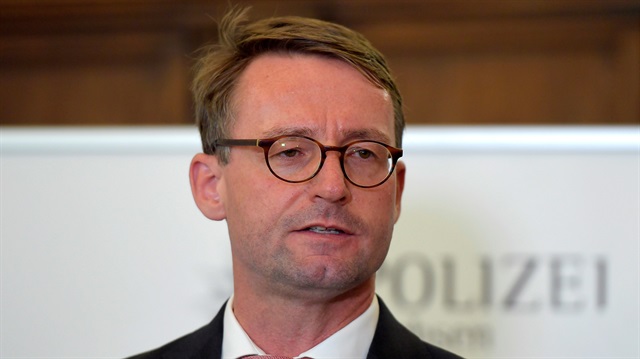
Saxony state Interior Minister Roland Woelle
About 6,000 far right supporters participated in Monday's demonstrations in the eastern German city of Chemnitz, including many hooligans who came from other parts of Germany, the interior minister of the state said on Tuesday.
The demonstrations were triggered by the deadly stabbing of a German man that authorities have blamed on two migrants, and a great deal of "fake news" circulating on the Internet, the state official, Roland Woeller, told reporters. He said about 1,000 people participated in anti-right wing protests.
Michael Kretschmer, premier of the state, said Saxony was stepping up its fight against right-wing extremism after a spate of violence and harassment targeting of migrants in the wake of the crime, as well as cases in which people performed the so-called Hitler salute, banned in Germany after the Nazi era.
The German federal government is ready to provide police assistance to the state of Saxony if asked, Interior Minister Horst Seehofer said on Tuesday amid growing concerns about the state's ability to contain violence after a deadly stabbing.Seehofer, leader of the Bavarian conservatives, said public concern about the stabbing of a German man was understandable, but there was no place in German society for calls to violence or violent acts."The police in Saxony are in a difficult situation. If requested, the federal government is ready to make police support measures available," Seehofer said in a statement.Far-right demonstrators clashed with leftist protesters in the eastern German city of Chemnitz on Monday after an Iraqi and a Syrian were arrested over the stabbing, which had triggered demonstrations where migrants were harrassed and attacked.Germany condemns far-right demo in eastern city after fatal disputeGermany slams US President Trump’s sanctions policyRacism in Germany ‘must be taken seriously,’ says Merkel after Özil debate
Germany ready to help Saxony state police if asked
Germany will not tolerate "vigilante justice", Chancellor Angela Merkel's spokesman said on Monday, after hundreds of far-right supporters protested in the eastern city of Chemnitz against the death of a man involved in a multi-ethnic dispute.Police said around 800 demonstrators had gathered in Chemnitz on Sunday, hours after a 35-year-old man died following a dispute between several people of "different nationalities". Some of the protesters had thrown bottles at police officers.The demonstration followed calls on social media by far-right groups for protests over the man's death. Two other men were injured in the incident and police have detained two suspects, aged 22 and 23.An amateur video posted on social media and aired by national broadcasters showed skinheads chasing a young Arab-looking man at a major intersection in the city. Other clips showed hundreds of demonstrators shouting "We are the people!" - a slogan used by far-right supporters.A police spokeswoman could not comment on the nationalities of those involved or on media reports that the protesters were far-right supporters who had hounded migrants. The cause of the man's death was also not immediately clear.Merkel's spokesman Steffen Seibert condemned Sunday's impromptu demonstration."We don't tolerate such unlawful assemblies and the hounding of people who look different or have different origins and attempts to spread hatred on the streets," he told a regular news briefing."That has no place in our cities and we, as the German government, condemn it in the strongest terms," he said. "Our basic message for Chemnitz and beyond is that there is no place in Germany for vigilante justice, for groups that want to spread hatred on the streets, for intolerance and for extremism."Far-rightMerkel's decision in 2015 to let in about a million migrants, many fleeing wars in the Middle East, has fueled support for far-right groups such as PEGIDA and the Alternative for Germany (AfD), now the main opposition party in parliament.Tweeting about Sunday's incident, AfD politician Markus Frohnmaier said: "If the state is no longer to protect citizens then people take to the streets and protect themselves. It's as simple as that!"Martina Renner, a lawmaker for the radical Left party, accused the far-right of trying to exploit a murder for its own political ends. "A terrible murder, the background to which is still unclear, is being instrumentalised in the most repugnant way for racist riots in Chemnitz," she tweeted.The violence in Chemnitz is likely to put further pressure on Merkel's conservatives, who last week faced accusations of ignoring the rise of far-right groups in the eastern state of Saxony, where Chemnitz lies.Police in Chemnitz are preparing for further demonstrations. They were expected to issue a further statement about Sunday's incident later on Monday. Germany's public debt could fall below EU ceiling this yearGerman foreign minister to visit Turkey next monthGerman military turns to under 18s to boost recruitment
Germany condemns far-right demo in eastern city after fatal dispute
German Chancellor Angela Merkel stressed that poor treatment of migrants in Germany should be discussed, and touched on the debate sparked by German-Turkish footballer Mesut Özil with his decision to quit Germany’s national team due to the discrimination and racist propaganda he faced recently.“I have a very clear stance on the matter. There may be differing views as to whether the photograph that was taken was right or wrong,” Merkel said.Since May, Özil was criticized by German politicians and media outlets for meeting Turkish President Recep Tayyip Erdoğan and taking a photograph with him in London ahead of elections in Turkey.Özil defended his meeting, and stressed that a picture with the Turkish president was not about politics, but respect to his family’s country. “It was about me respecting the highest office of my family’s country. I am German when we win, but I am an immigrant when we lose,” Özil had said in a social media post.“Be it Özil or someone else,” if migrants in Germany believe that they are treated poorly in German society, this “must be taken seriously and discussed,” Merkel stated.Özil also accused far-right politicians and media for using his picture with Erdoğan “as an opportunity to express their previously hidden racist tendencies” ahead of June's football World Cup.Video: Germany haunted by racist historyGermany’s President Frank-Walter Steinmeier echoed Merkel’s sentiments, and called on all citizens to stand up against racism and discrimination on Wednesday.“There are no first and second class citizens. A permanent suspicion of migrants, no matter how long they’ve lived in Germany, isn’t only hurtful for the individual. It’s a cause of shame for our country,” he said to a small group of Turkish and German citizens who were invited to the presidential palace to voice their views on migration, integration, discrimination and racism in everyday life.Some 19.3 million people out of 81.7 million in Germany are immigrants or their descendants, according to the federal statistics office.People of Turkish origin continue to be the largest immigrant group in Germany with an estimated population of 2.8 million, followed by 2.1 million Poles and 1.4 million Russians.Germany says Turkey’s stability important for Europe
Racism in Germany ‘must be taken seriously,’ says Merkel after Özil debate
Germany's public sector debt could fall below the European Union's debt ceiling before the end of the year, Finance Minister Olaf Scholz said on Sunday, after figures this week showed a booming economy was generating a record surplus.Speaking at the annual open day at which Berlin's ministries open their doors to the public, Scholz said that Germany's debt levels could fall below 60 percent of economic output earlier than the originally planned target of 2019.The plummeting debt levels are helped by the robust health of Europe's largest economy, which grew 0.5 percent in the second quarter, driving the public sector surplus for the first half of the year to a record 48.1 billion euros ($55 billion).That towering surplus has drawn increasingly urgent calls from lobbyists and other governments for Germany to invest more, prompting even the ultra-cautious Scholz to concede that the shower of cash offered "further possibilities".But on Sunday, Scholz reaffirmed Germany's commitment to meeting the so-called Maastrict criteria, the public debt element of which has been breached by most participants since the 2008 financial crisis, implying that Germany's debt could fall even further."In 1990 debt was about 40 percent of social product," he said, referring to the time immediately before West Germany took on the the ageing industries and weak currency of formerly Communist East Germany, seeking to overturn 40 years of relative decline with one of the biggest investment programmes in history.The EU's Maastricht Treaty requires member states to run a deficit of no more than 3 percent of gross domestic product each year. The 60 percent public debt threshold has been violated by many member states for years, with Germany last keeping under the threshold 17 years ago. 
Germany's public debt could fall below EU ceiling this year
Germany’s foreign minister is scheduled to visit Turkey next month to discuss bilateral ties and regional issues, diplomatic sources said on Friday.During his two-day visit on Sept. 5-6, Heiko Maas will meet his Turkish counterpart Mevlut Cavusoglu and other senior officials in the capital Ankara.Later the two top diplomats will travel to Istanbul for a celebration at the city’s German School marking its 150th anniversary.Maas’ trip to Turkey comes ahead of Turkish President Recep Tayyip Erdogan’s key visit to Germany on Sept. 28-29.Over the past two years political relations between Ankara and Berlin have suffered setbacks, but in recent months both sides have taken steps towards improving ties.EU heavyweight Germany remains Turkey’s main economic and trade partner, despite political disagreements between the governments on a number of issues.Germany's Merkel has made no decision on next ECB chiefAfter Trump attack on Russia ties, Merkel eyes Azeri gas
German foreign minister to visit Turkey next month