

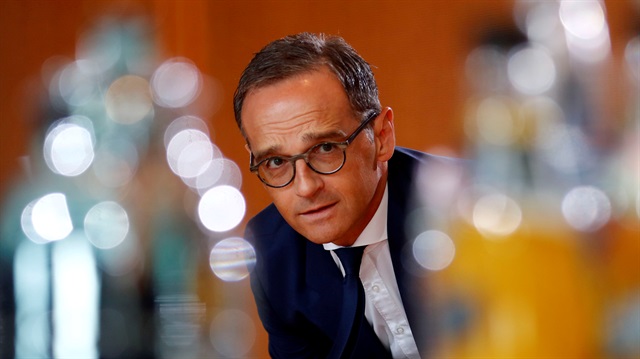
German Foreign Minister Heiko Maas
Germany’s foreign minister is scheduled to visit Turkey next month to discuss bilateral ties and regional issues, diplomatic sources said on Friday.
During his two-day visit on Sept. 5-6, Heiko Maas will meet his Turkish counterpart Mevlut Cavusoglu and other senior officials in the capital Ankara.
Later the two top diplomats will travel to Istanbul for a celebration at the city’s German School marking its 150th anniversary.
Maas’ trip to Turkey comes ahead of Turkish President Recep Tayyip Erdogan’s key visit to Germany on Sept. 28-29.
Over the past two years political relations between Ankara and Berlin have suffered setbacks, but in recent months both sides have taken steps towards improving ties.
EU heavyweight Germany remains Turkey’s main economic and trade partner, despite political disagreements between the governments on a number of issues.
German Chancellor Angela Merkel said on Thursday she had taken no decision yet on who she wanted to be the next president of the European Central Bank, adding that discussions were only just starting on top European jobs to be filled next year."Discussions about the personal decisions to be made in conjunction with elections to the European Parliament are now slowly starting to take place," she told a news conference on a visit to Georgia."That means no decisions at all have been taken and the post of European Central Bank chief is to be filled much later, so I can't confirm any wishes I have. Rather, we will wait for the developments and then see how the German positions develop."
Germany's Merkel has made no decision on next ECB chief
Castigated by U.S. President Donald Trump as relying too much on Russian gas supplies, German Chancellor Angela Merkel heads to Azerbaijan this week to discuss the development of a southern pipeline to deliver gas to Europe from the Caspian.The visit underscores Merkel's openness to finding alternative sources of affordable gas even as she remains committed to the Nord Stream 2 pipeline, which will carry gas directly from Russia under the Baltic Sea to Germany."We have a big interest in further developing the Southern Corridor," a senior German government official said."This is part of the EU's diversification strategy of getting gas from other regions, not just Russia, to Europe."In Baku, Merkel will discuss energy issues, including improving the infrastructure to help transport gas from Azerbaijan to Europe via Turkey, officials said.Azerbaijan looks set to play a crucial role as it plans to launch the second stage of a gas pipeline from the vast Shah Deniz field to Europe. Shah Deniz II is expected to produce 16 billion cubic metres (bcm) of gas a year from 2020, with 10 bcm earmarked for Europe and 6 bcm for Turkey and Georgia.Later, gas could be brought from Turkmenistan, Iran and Iraq to Europe. In a sign of progress, Iran, Russia, Kazakhstan, Turkmenistan and Azerbaijan agreed in principle this month on how to divide the potentially huge oil and gas resources of the Caspian Sea.However, the southern pipeline is dwarfed by Nord Stream 2, a Gazprom initiative that will double Russia's export capacity to Europe to 110 bcm. That pipeline is welcomed by much of German industry, which wants as much cheap gas as possible.Last month Trump, who is pressing Germany to buy more U.S. liquefied natural gas, lambasted Germany as being "a captive" of Russia due to its dependence on Russian energy, a charge Germany denies. Trump has called Nord Stream 2 "horrific".Germany imported 39 percent of its gas from Russia in the first half of 2018, figures from state foreign trade authority BAFA showed.Merkel discussed energy in talks with Russian President Vladimir Putin at a palace outside Berlin at the weekend. She is trying to assuage some Nord Stream 2 critics by ensuring Ukraine does not suffer from lower gas transit revenues.Merkel also travels to Georgia and Armenia on her three-day trip, which starts on Thursday. She will hold talks with Azeri President Ilham Aliyev on Saturday.
After Trump attack on Russia ties, Merkel eyes Azeri gas