

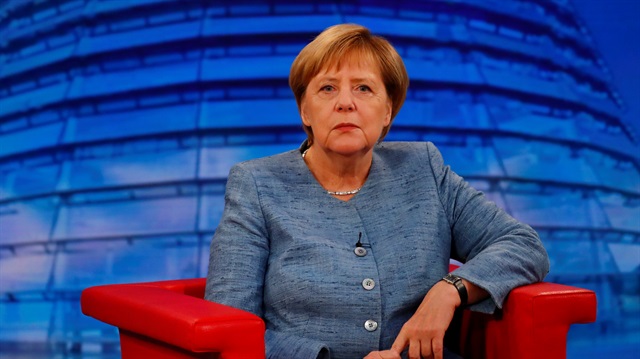
German Chancellor Angela Merkel
Germany will not tolerate "vigilante justice", Chancellor Angela Merkel's spokesman said on Monday, after hundreds of far-right supporters protested in the eastern city of Chemnitz against the death of a man involved in a multi-ethnic dispute.
Police said around 800 demonstrators had gathered in Chemnitz on Sunday, hours after a 35-year-old man died following a dispute between several people of "different nationalities". Some of the protesters had thrown bottles at police officers.
The demonstration followed calls on social media by far-right groups for protests over the man's death. Two other men were injured in the incident and police have detained two suspects, aged 22 and 23.
An amateur video posted on social media and aired by national broadcasters showed skinheads chasing a young Arab-looking man at a major intersection in the city. Other clips showed hundreds of demonstrators shouting "We are the people!" - a slogan used by far-right supporters.
A police spokeswoman could not comment on the nationalities of those involved or on media reports that the protesters were far-right supporters who had hounded migrants. The cause of the man's death was also not immediately clear.
Merkel's spokesman Steffen Seibert condemned Sunday's impromptu demonstration.
"We don't tolerate such unlawful assemblies and the hounding of people who look different or have different origins and attempts to spread hatred on the streets," he told a regular news briefing.
"That has no place in our cities and we, as the German government, condemn it in the strongest terms," he said. "Our basic message for Chemnitz and beyond is that there is no place in Germany for vigilante justice, for groups that want to spread hatred on the streets, for intolerance and for extremism."
Merkel's decision in 2015 to let in about a million migrants, many fleeing wars in the Middle East, has fueled support for far-right groups such as PEGIDA and the Alternative for Germany (AfD), now the main opposition party in parliament.
Tweeting about Sunday's incident, AfD politician Markus Frohnmaier said: "If the state is no longer to protect citizens then people take to the streets and protect themselves. It's as simple as that!"
Martina Renner, a lawmaker for the radical Left party, accused the far-right of trying to exploit a murder for its own political ends. "A terrible murder, the background to which is still unclear, is being instrumentalised in the most repugnant way for racist riots in Chemnitz," she tweeted.
The violence in Chemnitz is likely to put further pressure on Merkel's conservatives, who last week faced accusations of ignoring the rise of far-right groups in the eastern state of Saxony, where Chemnitz lies.
Police in Chemnitz are preparing for further demonstrations. They were expected to issue a further statement about Sunday's incident later on Monday.
Germany's public sector debt could fall below the European Union's debt ceiling before the end of the year, Finance Minister Olaf Scholz said on Sunday, after figures this week showed a booming economy was generating a record surplus.Speaking at the annual open day at which Berlin's ministries open their doors to the public, Scholz said that Germany's debt levels could fall below 60 percent of economic output earlier than the originally planned target of 2019.The plummeting debt levels are helped by the robust health of Europe's largest economy, which grew 0.5 percent in the second quarter, driving the public sector surplus for the first half of the year to a record 48.1 billion euros ($55 billion).That towering surplus has drawn increasingly urgent calls from lobbyists and other governments for Germany to invest more, prompting even the ultra-cautious Scholz to concede that the shower of cash offered "further possibilities".But on Sunday, Scholz reaffirmed Germany's commitment to meeting the so-called Maastrict criteria, the public debt element of which has been breached by most participants since the 2008 financial crisis, implying that Germany's debt could fall even further."In 1990 debt was about 40 percent of social product," he said, referring to the time immediately before West Germany took on the the ageing industries and weak currency of formerly Communist East Germany, seeking to overturn 40 years of relative decline with one of the biggest investment programmes in history.The EU's Maastricht Treaty requires member states to run a deficit of no more than 3 percent of gross domestic product each year. The 60 percent public debt threshold has been violated by many member states for years, with Germany last keeping under the threshold 17 years ago. 
Germany's public debt could fall below EU ceiling this year
Germany’s foreign minister is scheduled to visit Turkey next month to discuss bilateral ties and regional issues, diplomatic sources said on Friday.During his two-day visit on Sept. 5-6, Heiko Maas will meet his Turkish counterpart Mevlut Cavusoglu and other senior officials in the capital Ankara.Later the two top diplomats will travel to Istanbul for a celebration at the city’s German School marking its 150th anniversary.Maas’ trip to Turkey comes ahead of Turkish President Recep Tayyip Erdogan’s key visit to Germany on Sept. 28-29.Over the past two years political relations between Ankara and Berlin have suffered setbacks, but in recent months both sides have taken steps towards improving ties.EU heavyweight Germany remains Turkey’s main economic and trade partner, despite political disagreements between the governments on a number of issues.Germany's Merkel has made no decision on next ECB chiefAfter Trump attack on Russia ties, Merkel eyes Azeri gas
German foreign minister to visit Turkey next month
When Marlon finished high school in Germany, a military career seemed far more appealing than working on a car production line.So, a few months before he turned 18, he joined the German army, becoming one of more than 10,000 minors to sign up since mandatory military service ended in 2011."I wanted to experience something and to get to know my own limits, to see how far I can go," Marlon, who asked for his last name not be used, told Reuters at a base in Viereck, near the Polish border in northeastern Germany.The German military, or Bundeswehr https://www.bundeswehr.de/portal/a/bwde/start, has dramatically stepped up its recruitment efforts as part of a broader reset following Russia's annexation of Crimea from Ukraine in 2014.In 2017, Germany said it would increase the size of its armed forces to 198,000 active soldiers by 2024 from 179,000.Pressure on Berlin to beef up its military mounted again in July when U.S. President Donald Trump told a NATO summit that Washington could withdraw support for the alliance if Europe did not boost military spending.To help attract new recruits, the military has targeted youngsters with slick online video campaigns, drawing criticism from some left-wing politicians and child welfare advocates in Germany, where the army remains a sensitive career choice more than 70 years after World War Two.But the campaigns are paying off.In 2017, 2,128 people under 18 joined the German army, up 11.4 percent from 2016 and accounting for 9 percent of new recruits, according to government data.Volunteer ArmyWith lively music and scenes showing the lives of young soldiers, the Bundeswehr's shows on YouTube, which is owned by Alphabet, have attracted more than 64 million views.In October, traffic at the Bundeswehr jobs website increased 60 percent during a six-week broadcast of "Mali", a YouTube series centred on eight soldiers serving in the U.N.'s peacekeeping mission in the West African country.The Bundeswehr Exclusive YouTube channel has over 330,000 followers and its latest production portrays the lives of a group of young paratroopers. The army is also active on other sites such as Facebook, Instagram and Snapchat.According to a Trendence Institut https://www.trendence.com survey of 20,000 school students across the country, the military is now considered Germany's third most attractive employer, behind sportswear maker Adidas and the police in first place.Overall, the army spent about 35 million euros ($40 million) on recruitment last year, more than double its spending in 2011, the year compulsory military service ended, annual parliament reports about the Bundeswehr showed."The Bundeswehr today is a volunteer army ... Therefore, it must approach young people to win them over," a spokeswoman for the personnel management department at the Bundeswehr said.Before signing up, Marlon said he browsed the army's website and watched a series of YouTube videos.He needed his mother's consent to join because he was under 18, but she was happy to give it and is now pleased her once-messy son has become more organised, Marlon said.Baltic pipeline won't make us energy-dependent on Russia: Merkel'Wrong Signal'The Bundeswehr says the YouTube content aims to offer a realistic and authentic image of life in the military, but some politicians and children's rights advocates argue the glossy marketing gives minors a false impression."The entire advertising efforts of the Bundeswehr are more adventurous than a realistic description of the job," Tobias Pflueger, defence policy spokesman for the pacifist Left Party https://en.die-linke.de/welcome.More than 30,000 people signed a letter delivered to German Defence Minister Ursula von der Leyen a year ago that urged the Bundeswehr to stop recruiting minors.She said then that the army must have the same chance as other employers to attract people before they turn 18, adding that minors were trained in safe spaces and didn't handle weapons alone until they turned 18."This is embarrassing and sends a wrong signal to the world," said Ralf Willinger from rights group terre des hommes https://www.tdh.de."It weakens the international 18-year standard, encouraging armed groups and armies from other countries to legitimate the use of minors as soldiers."Recruits under 18 in Germany undergo military training like other adult trainees, but they have special provisions such as not being allowed to participate in guard duty or foreign missions, and weapons are only used for educational purposes.Ilka Hoffmann, a board member at the GEW union https://www.gew.de that represents about 280,000 teachers, social workers and education workers, says the nature of military work meant there should be more caution about hiring under 18s."This is not a normal profession. In no other profession does one learn to kill, and is one confronted with the danger of dying in war. That is the one difference," Hoffmann said.
German military turns to under 18s to boost recruitment