

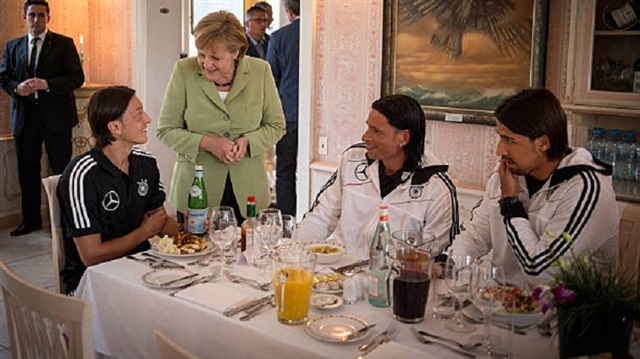
German Chancellor Angela Merkel talks to German National Team players Mesut Özil (L), Tim Wiese (C) and Sami Khedira during a shared dinner at the Euro 2012 Team Hotel on June 6, 2012 in Sopot, Poland.
German Chancellor Angela Merkel stressed that poor treatment of migrants in Germany should be discussed, and touched on the debate sparked by German-Turkish footballer Mesut Özil with his decision to quit Germany’s national team due to the discrimination and racist propaganda he faced recently.
“I have a very clear stance on the matter. There may be differing views as to whether the photograph that was taken was right or wrong,” Merkel said.
Since May, Özil was criticized by German politicians and media outlets for meeting Turkish President Recep Tayyip Erdoğan and taking a photograph with him in London ahead of elections in Turkey.
Özil defended his meeting, and stressed that a picture with the Turkish president was not about politics, but respect to his family’s country.
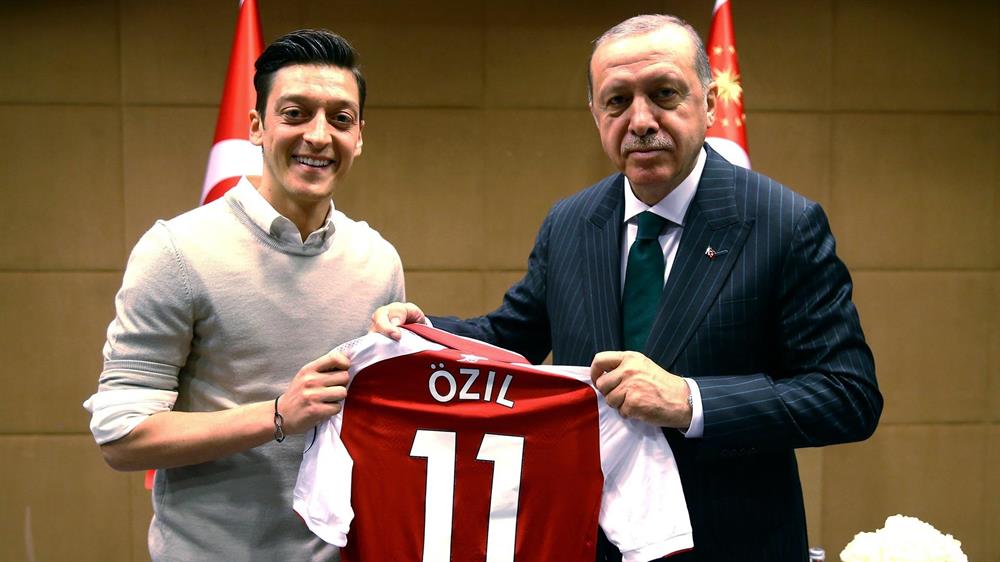
Özil and Erdoğan
“It was about me respecting the highest office of my family’s country. I am German when we win, but I am an immigrant when we lose,” Özil had said in a social media post.
“Be it Özil or someone else,” if migrants in Germany believe that they are treated poorly in German society, this “must be taken seriously and discussed,” Merkel stated.
Özil also accused far-right politicians and media for using his picture with Erdoğan “as an opportunity to express their previously hidden racist tendencies” ahead of June's football World Cup.
The racism and dicrimination against Turkish-German footballer Mesut Özil, who has decided to resign from the German national team, is just one of hundreds of examples that blackens country's history.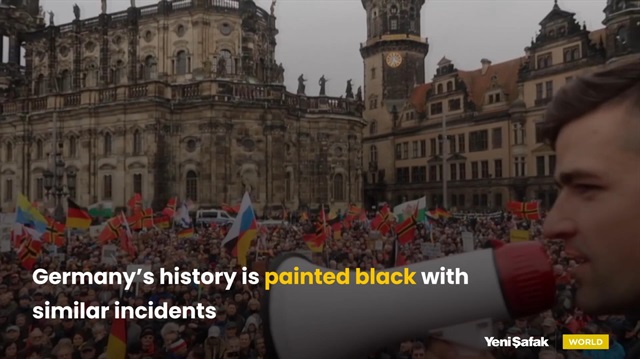
Germany haunted by racist history
Germany’s President Frank-Walter Steinmeier echoed Merkel’s sentiments, and called on all citizens to stand up against racism and discrimination on Wednesday.
“There are no first and second class citizens. A permanent suspicion of migrants, no matter how long they’ve lived in Germany, isn’t only hurtful for the individual. It’s a cause of shame for our country,” he said to a small group of Turkish and German citizens who were invited to the presidential palace to voice their views on migration, integration, discrimination and racism in everyday life.
Some 19.3 million people out of 81.7 million in Germany are immigrants or their descendants, according to the federal statistics office.
People of Turkish origin continue to be the largest immigrant group in Germany with an estimated population of 2.8 million, followed by 2.1 million Poles and 1.4 million Russians.
Germany’s economy minister voiced support on Sunday for Turkey amid market worries after U.S. President Donald Trump slammed sanctions and raised tariffs on Turkey.Responding to questions by citizens during an open house event of his ministry, Peter Altmaier underlined Turkey’s importance for Germany and for the European Union.“We can have no interest in the destabilization of a country like Turkey with 80 million population, which also hosts around 4 million refugees,” he said.Political tensions between Ankara and Washington had sparked worries in markets early this month, after Trump threatened to use economic pressure over the prosecution of an American pastor who faces terrorism-related charges in Turkey.The Turkish lira declined but staged a recovery recently, after positive messages from European capitals and Qatar’s decision to invest $15 billion in Turkey. Altmaier did not totally rule out possibility of assistance to Turkey, if Ankara would ask for support from its European partners.But he stressed that the situation has not come to such a point.“I do not think that at the moment we are in a situation where we have to take concrete decisions on financial or economic assistance,” he said.Altmaier, a close ally of Chancellor Angela Merkel, acknowledged political differences between Berlin and Ankara on a number of issues, but also expressed his hope for overcoming them through dialogue.Political relations between Turkey and Germany suffered several setbacks in the past two years, but both sides took steps in the recent months towards normalization of ties.Turkish President Recep Tayyip Erdogan is expected to pay an official visit to Berlin on Sept. 28-29.Germany is home to more than 3 million people with Turkish roots. Many of them are second or third-generations of Turkish families who migrated to Germany in the 1960s.EU heavyweight Germany is Turkey’s main economic and trade partner, and more than 7,500 German companies are active in the country. In 2017, the bilateral trade volume reached €37.6 billion ($43.6 billion).
Germany says Turkey’s stability important for Europe