

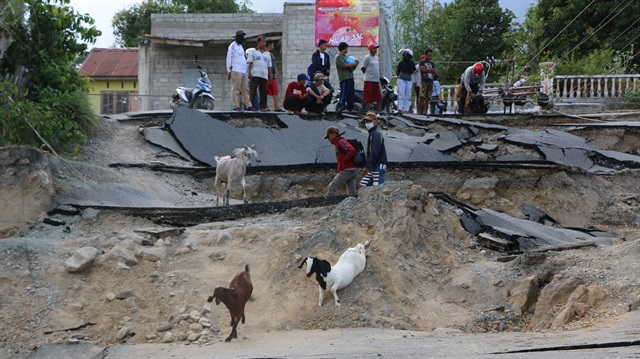
Indonesian rescue workers will stop searching for the bodies of victims of an earthquake and tsunami on the island of Sulawesi on Thursday
Indonesian rescue workers will stop searching for the bodies of victims of an earthquake and tsunami on the island of Sulawesi on Thursday, the national disaster mitigation agency said on Sunday.
The announcement came after the official death toll from the 7.5 magnitude quake and a tsunami it triggered on Sept. 28 rose to 1,763.
Bodies are still being recovered, especially from ruins of buildings in the small city of Palu and from neighbourhoods hit by liquefaction, a phenomenon that turns the ground into a roiling quagmire, in the south of city.
"Evacuation stops on October 11," the national disaster mitigation agency spokesman Sutopo Purwo Nugroho told a news briefing, using an Indonesian word that applies to the search and retrieval of both living and dead people.
"Victims who have not been found are declared missing," he said. Some limited searching might still be undertaken but large-scale searches with many personnel and heavy equipment would cease, he said.
Many hundreds of people are still buried in mud and debris in the south of Palu, where neighbourhoods were obliterated by liquefaction and desperate relatives have been seeking help to find loved ones.
The UN on Friday announced a $50 million response plan for disaster relief efforts in Indonesia.For the next three months, the UN will work with the Indonesian government to provide technical assistance to help 191,000 victims in the aftermath of the earthquake and tsunami that wreaked havoc in the country.The plan was announced by Stephen Dujarric, spokesman for the UN Secretary-General, during a news briefing.On Sept. 28, a powerful 7.4-magnitude earthquake struck Sulawesi Island that triggered a tsunami, towering up to 10 feet (3 meters) high, shaking the island.The National Disaster Management Agency (BNPB) estimates the death toll at 1,571, while the UN estimates more than 2,500 injuries, according to Dujarric.After Indonesia quake, empowering coastal communities will save lives: UNBodies of mother clutching baby found as Indonesia quake toll rises above 1,500Earlier this week, the UN said it was allocating $15 million to assist victims in the aftermath.However, the plan published by the UN is a more concrete effort to support the government in coordinating relief efforts and distributing humanitarian aid.The UN Resident Coordinator in Indonesia Anita Nirody noted some areas, such as Palu and Donggala, are cut off because of landslides and infrastructure damage, which has created access and transport problems for relief efforts.Nirody said the new plan "provide[s], not only immediate relief items, but also the logistical support needed to provide aid to those in need."Video: Indonesian search and rescue team removes body from hospital in Palu
UN announces $50M in relief efforts for Indonesia
More than 1000 people are feared to be under debris in disaster-hit Indonesia after the 7.4-magnitude earthquake and tsunami hit Sulawesi Island, the disaster management authority announced Friday.Indonesian National Disaster Management (BNPB) spokesperson Sutopo Purwo Nugroho said over 1000 earthquake and tsunami victims are estimated to be trapped under the rubble, citing the reports by the villages in the region.Indonesia's Widodo makes second visit to quake city as aid effort gears upUN pledges aid for Indonesian quake, tsunami victimsAt Indonesia hotel destroyed by quake, hunt for survivors goes onThe search and rescue efforts are still underway, Nugroho said.Around 70,000 houses were damaged, while the financial loss climbed to $658 million in the region, he added.According to the latest data by disaster authority, the death toll from the quake and tsunami has risen to 1,558, with 113 missing.The disaster in Central Sulawesi could be Indonesia’s second-largest tragedy after the 2004 Aceh tsunami that killed more than 170,000 people.Indonesia continues relief efforts post-quake, tsunamiMalaysian PM urges ASEAN to aid disaster-hit IndonesiaBodies pile up as Indonesia suffers from devastating effects of quake, tsunami
1000 feared under debris in Indonesia quake, tsunami
Dozens of rescuers removed 34 bodies from one place on Saturday.
Nugroho said the debris would be removed from those places and they would be turned into public spaces like parks and sports venues.
"We don't want the community to be relocated to such dangerous places," he said.
Most of the dead have been found in Palu, the region's main urban centre. Figures for more remote areas, some just re-connected to the outside world by road, are trickling in.
Sulawesi is one of Indonesia's five main islands and, like the others, is exposed to frequent earthquakes and tsunamis.
In 2004, a quake off Sumatra island triggered a tsunami across the Indian Ocean that killed 226,000 people in 13 countries, including more than 120,000 in Indonesia.
A big aid operation is gearing up to help hard-hit communities where some 70,000 people have been displaced.
Indonesia has often been reluctant to be seen as relying on outside help to cope with disasters.
The government shunned foreign aid this year when earthquakes struck the island of Lombok but it accepted help from abroad for Sulawesi.
The government says it particularly needs aircraft, generators, tents, water treatment and field medical facilities.
Rescue efforts continued in Indonesia on Saturday in the aftermath of a deadly earthquake and tsunami eight days ago.A 7.4-magnitude earthquake and tsunami hit Sulawesi Island on Sept. 28 leaving thousands dead and injured and hundreds missing.According to the Indonesian National Board for Disaster Management (BNPB), the death toll from the natural disaster has risen to 1,649, with 113 people missing.Eruptions recorded on volcanic island in IndonesiaSome 2,549 people are critically injured and are receiving treatment at hospitals in and outside Palu city, the board added.More than 1,400 bodies were buried in a mass grave.A total of 66,238 houses are estimated to be destroyed, and the number of internally displaced people has climbed to 70,821.Telecommunication networks have been partially restored in the affected area.Many lives spared at Indonesia quake epicentre by earlier shakeUN announces $50M in relief efforts for Indonesia
Indonesia continues relief efforts post-quake, tsunami
At least 348 eruptions were recorded in the past 24 hours in Indonesia’s Anak Krakatau island, the met office said on Saturday.According to a statement from the Indonesian Agency for Meteorology, Climatology and Geophysics (BMKG), the smoke from the volcano -- which is located in the region of Lampung province -- reached a height of up to 200 meters.Sounds around the volcano and small-scale vibrations were recorded, the statement added.A warning was issued for those living nearby to move to safe places.Indonesia was hit by a 7.4-magnitude earthquake and tsunami at Sulawesi Island on Sept. 28, which led to at least 1,649 deaths.Video: Indonesian earthquake-hit village still waiting for aid
Eruptions recorded on volcanic island in Indonesia
The lives of many villagers living at the epicentre of a devastating earthquake that struck Indonesia's Sulawesi island and killed more than 1,600 people were spared because they had been terrified by a smaller one that hit three hours earlier.A coastal strip dotted with villages north of the devastated city of Palu was cut off for nearly a week by landslides blocking its single road link after the major 7.5 magnitude quake struck late in the afternoon on Sept. 28.But the way is now open and aid is starting to trickle in to the area that rescue workers feared had been obliterated.While destruction is extensive, with many houses destroyed, villagers said on Saturday countless lives were saved by a 6.1 magnitude quake that struck about 20 km (12 miles) to the south about three hours earlier."Luckily most people were already outside," said Rahman Lakuaci, chief of Lende Tovea village in Sirenja district.Video: Debris still a hurdle in Indonesia aid efforts: Turkish Red Crescent"Everyone ran outside when the first quake happened and few people were brave enough to go back in."Authorities have yet to conduct a tally of casualties in Sirenja and the other districts near the epicentre north of Palu, but Lakuaci estimated dozens of people had been killed in the area.The city of Palu, on the other hand, 78 km (48 miles) away, suffered heavy casualties, with hotels, shopping malls and countless houses destroyed in the quake and by a tsunami that scoured the city's oceanfront shortly after.Soil liquefaction, a phenomenon that turns the ground into a roiling quagmire, also killed many hundreds of people in and around Palu.But that did not happen near the epicentre of the quake and, even though many villagers ran up into the hills rising to the east of the coastline, tsunami waves did not crash into the small fishing communities and pretty beaches.The quake brought down power lines and communications networks and more than half the houses in Sirenja district were destroyed. Those left standing were so battered they were "not fit for use", Lakuaci said.Most would have to torn down and rebuilt, he said.People have survived the past week by searching for food in fields and orchards and scavenging in the forested hills.Thousands of people are living in tents and crude shelters and some supplies have been flow in by helicopter."What we need most now are tents and medicine," Lakuaci said. Children and the elderly were starting to get sick and fuel was also in very short supply, he said.The area saw no looting after the quake, unlike in Palu, largely because there are no big warehouses and village leaders mobilised their volunteers to maintain order, villagers said.
Many lives spared at Indonesia quake epicentre by earlier shake
A team of French rescue experts began hunting through a huge expanse of debris on the outskirts of the Indonesian city of Palu on Saturday, looking for hands, feet or any body parts of earthquake victims sticking out of the mud.Indonesian President Joko Widodo has said all of the victims of the 7.5 magnitude earthquake and tsunami that struck the west coast of Sulawesi island on Sept. 28, killing more than 1,500 people, must be found.Hundreds of people are believed to be entombed in slowly drying mud that enveloped communities in the south of the small city of Palu when the quake triggered soil liquefaction, a phenomenon that turns the ground into a roiling quagmire.Arnaud Allibert and four other members of the group Pompiers Humanitaires Francais were the first rescuers in to one grim expanse of jumbled debris, which is all that remains of the village of Petobo.UN announces $50M in relief efforts for IndonesiaThe team's task is to find and retrieve the bodies at the surface to clear the way for the heavy machinery to come in and dig deeper.It's going to be a long, hard job."We're going to clear off all the superficial rubble that's on top and get into the spaces and see if there are bodies," Allibert told Reuters as he surveyed a dreadful jumble of debris."If there are bodies in the spaces, we'll extract them. If we see body parts sticking out, we're going to dig to get the body out ... It's a long-term job, but after that, they'll come with the heavy machinery," he said.The official death toll from the quake and the tsunami it triggered stands at 1,571, but it will certainly rise.Most of the dead have been found in Palu. Figures for more remote areas, some only just re-connected to the outside world by road, are only trickling in.Video: Debris still a hurdle in Indonesia aid efforts: Turkish Red CrescentFive MonthsNo one knows how many people were dragged to their deaths when the ground under Petobo and nearby areas south of Palu dissolved so violently.Homes were sucked into the earth, torn apart and thrust hundreds of metres by the churning mud.The national disaster agency says 1,700 homes in one neighbourhood alone were swallowed up and hundreds of people disappeared.Allibert said it would take months to find all of the bodies.Video: French volunteers in Indonesia search for bodies in jumbled mire"It might take 4 to 5 months to remove all the soil, and that's with the excavators," he said. "The excavators can't take huge amounts of soil because there are bodies underneath, you have to scrape the earth carefully."Traumatised survivors are desperate for any help."There are so many corpses around here," said Irwan, 37, who like many Indonesians goes by one name."I'm from here so all my family are here, so many are gone," he said, reeling off a list of the missing including a sister, an aunt and cousins."Where are they? What if they are still alive? We need help to find them," he said.
French volunteers in Indonesia search for bodies in jumbled mire