

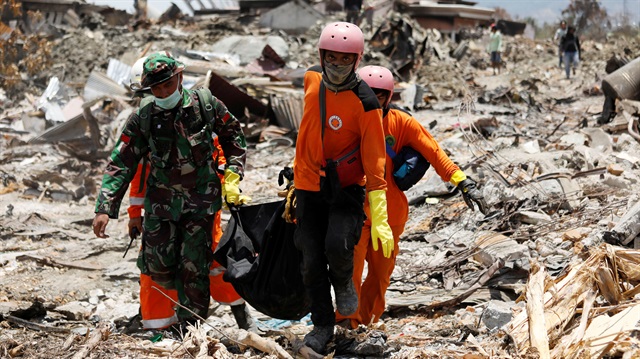
Rescue workers and a soldier remove a victim of last week's earthquake in the Balaroa neighbourhood in Palu, Central Sulawesi, Indonesia October 6, 2018.
Rescue efforts continued in Indonesia on Saturday in the aftermath of a deadly earthquake and tsunami eight days ago.
A 7.4-magnitude earthquake and tsunami hit Sulawesi Island on Sept. 28 leaving thousands dead and injured and hundreds missing.
According to the Indonesian National Board for Disaster Management (BNPB), the death toll from the natural disaster has risen to 1,649, with 113 people missing.
At least 348 eruptions were recorded in the past 24 hours in Indonesia’s Anak Krakatau island, the met office said on Saturday.According to a statement from the Indonesian Agency for Meteorology, Climatology and Geophysics (BMKG), the smoke from the volcano -- which is located in the region of Lampung province -- reached a height of up to 200 meters.Sounds around the volcano and small-scale vibrations were recorded, the statement added.A warning was issued for those living nearby to move to safe places.Indonesia was hit by a 7.4-magnitude earthquake and tsunami at Sulawesi Island on Sept. 28, which led to at least 1,649 deaths.Video: Indonesian earthquake-hit village still waiting for aid
Eruptions recorded on volcanic island in Indonesia
Some 2,549 people are critically injured and are receiving treatment at hospitals in and outside Palu city, the board added.
More than 1,400 bodies were buried in a mass grave.
A total of 66,238 houses are estimated to be destroyed, and the number of internally displaced people has climbed to 70,821.
Telecommunication networks have been partially restored in the affected area.
The lives of many villagers living at the epicentre of a devastating earthquake that struck Indonesia's Sulawesi island and killed more than 1,600 people were spared because they had been terrified by a smaller one that hit three hours earlier.A coastal strip dotted with villages north of the devastated city of Palu was cut off for nearly a week by landslides blocking its single road link after the major 7.5 magnitude quake struck late in the afternoon on Sept. 28.But the way is now open and aid is starting to trickle in to the area that rescue workers feared had been obliterated.While destruction is extensive, with many houses destroyed, villagers said on Saturday countless lives were saved by a 6.1 magnitude quake that struck about 20 km (12 miles) to the south about three hours earlier."Luckily most people were already outside," said Rahman Lakuaci, chief of Lende Tovea village in Sirenja district.Video: Debris still a hurdle in Indonesia aid efforts: Turkish Red Crescent"Everyone ran outside when the first quake happened and few people were brave enough to go back in."Authorities have yet to conduct a tally of casualties in Sirenja and the other districts near the epicentre north of Palu, but Lakuaci estimated dozens of people had been killed in the area.The city of Palu, on the other hand, 78 km (48 miles) away, suffered heavy casualties, with hotels, shopping malls and countless houses destroyed in the quake and by a tsunami that scoured the city's oceanfront shortly after.Soil liquefaction, a phenomenon that turns the ground into a roiling quagmire, also killed many hundreds of people in and around Palu.But that did not happen near the epicentre of the quake and, even though many villagers ran up into the hills rising to the east of the coastline, tsunami waves did not crash into the small fishing communities and pretty beaches.The quake brought down power lines and communications networks and more than half the houses in Sirenja district were destroyed. Those left standing were so battered they were "not fit for use", Lakuaci said.Most would have to torn down and rebuilt, he said.People have survived the past week by searching for food in fields and orchards and scavenging in the forested hills.Thousands of people are living in tents and crude shelters and some supplies have been flow in by helicopter."What we need most now are tents and medicine," Lakuaci said. Children and the elderly were starting to get sick and fuel was also in very short supply, he said.The area saw no looting after the quake, unlike in Palu, largely because there are no big warehouses and village leaders mobilised their volunteers to maintain order, villagers said.
Many lives spared at Indonesia quake epicentre by earlier shake
The UN on Friday announced a $50 million response plan for disaster relief efforts in Indonesia.For the next three months, the UN will work with the Indonesian government to provide technical assistance to help 191,000 victims in the aftermath of the earthquake and tsunami that wreaked havoc in the country.The plan was announced by Stephen Dujarric, spokesman for the UN Secretary-General, during a news briefing.On Sept. 28, a powerful 7.4-magnitude earthquake struck Sulawesi Island that triggered a tsunami, towering up to 10 feet (3 meters) high, shaking the island.The National Disaster Management Agency (BNPB) estimates the death toll at 1,571, while the UN estimates more than 2,500 injuries, according to Dujarric.After Indonesia quake, empowering coastal communities will save lives: UNBodies of mother clutching baby found as Indonesia quake toll rises above 1,500Earlier this week, the UN said it was allocating $15 million to assist victims in the aftermath.However, the plan published by the UN is a more concrete effort to support the government in coordinating relief efforts and distributing humanitarian aid.The UN Resident Coordinator in Indonesia Anita Nirody noted some areas, such as Palu and Donggala, are cut off because of landslides and infrastructure damage, which has created access and transport problems for relief efforts.Nirody said the new plan "provide[s], not only immediate relief items, but also the logistical support needed to provide aid to those in need."Video: Indonesian search and rescue team removes body from hospital in Palu
UN announces $50M in relief efforts for Indonesia