

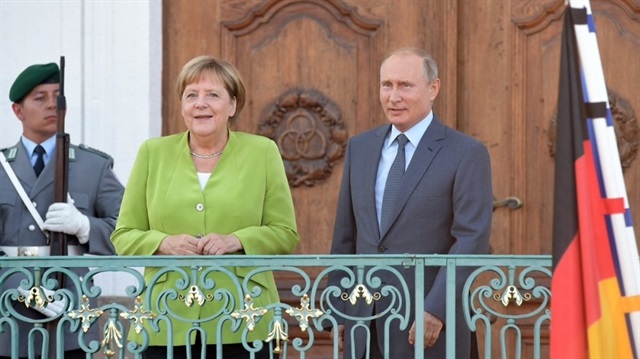
File photo
German Chancellor Angela Merkel discussed recent developments in Syria with Russian President Vladimir Putin over the phone, her office said on Wednesday.
Government spokesperson Steffen Seibert said in a statement that the leaders mainly talked about the recent agreement between Turkey and Russia to establish a demilitarized zone in Syria's northwestern Idlib province.
“The chancellor welcomed the efforts aimed at preventing a military escalation and protecting the civilian population,” Seibert said.
The two leaders also addressed the situation in eastern Ukraine and the humanitarian issues, he added.
On Monday, Turkey and Russia agreed to establish a demilitarized zone in Idlib, Syria’s last opposition stronghold, following a meeting in Sochi between Turkish President Recep Tayyip Erdogan and Putin.
Ankara and Moscow also signed a memorandum of understanding calling for the “stabilization” of Idlib's de-escalation zone, in which acts of aggression are expressly prohibited.
According to the MoU, opposition groups in Idlib will remain in areas where they are already present.
Turkish and Russian military forces, meanwhile, will conduct joint patrols along the zone's perimeter with a view to preventing any renewal of fighting.
Located near the Turkish border, Idlib is home to more than three million Syrians, many of whom fled from other cities following attacks by regime forces.
The Syrian regime announced plans last month to launch a major military offensive in the area, long controlled by various armed opposition groups.
But, the UN warned that such an offensive would lead to the "worst humanitarian catastrophe in the 21st century".
The summit between Turkish President Recep Tayyip Erdoğan and Russian leader Vladimir Putin in Sochi Monday night has been covered extensively in European newspapers on Tuesday.The two leaders met in the Russian resort city to discuss the situation in the Syrian province of Idlib, on which an all-out assault by Syrian regime forces was feared.The story was on the front page of major Russian newspapers.The Kommersant newspaper commented on the perseverance of the Russian and Turkish presidents who found a compromise in Sochi.The newspaper cited two representatives of the Syrian opposition. One of the leaders of Syria’s armed opposition Fateh Hasun told Kommersant: "Sochi managed to stop the bloodshed of tens of thousands of Syrians -- between the opposition and those who are loyal to the authorities. And this is a positive step in Russia's relations with the forces of the Syrian revolution.”Chairman of the Building the Syrian State (BSS) political movement Louay Hussein predicts that sooner or later Damascus will try to eventually take control of Idlib.“Neither Damascus, nor the forces loyal to it, nor the Russians will leave the 'island of security' outside the control of the Syrian army and will allow illegal weapons to remain in the region. At the same time, the agreement in Sochi will put an end to terrorists, including the al-Nusra Front,” he said.The Izvestia newspaper, in an article titled “Russia and Turkey clarified the future of Idlib” said the meeting in Sochi “brought clarity” to the Russian and Turkish positions on Idlib and helped to find a compromise.Turkey, Russia cooperation to be ‘hope’ for region'Limits of Putin's power'The daily does warn about difficulties in the realization of the agreement and possible implications.The Rossiyskaya Gazeta in a story under the headline “Syrian breakthrough” praised the understanding between the two leaders.German media also widely covered the Erdogan-Putin summit and underlined Turkey’s strong influence in the region.“The agreement with Erdogan shows the limits of Putin’s power,” weekly Die Zeit commented.“Until recently Vladimir Putin has intensified the military threat backdrop in Idlib. But his agreement with Turkey once again showed that Russia cannot control Syria alone,” the weekly newspaper reported.Under the headline “An attack on opposition stronghold Idlib averted”, the Frankfurter Rundschau daily welcomed the agreement between Turkey and Russia to set up up a demilitarized zone.“With this a Russian military offensive is ruled out, for the time being,” it reported.'Welcomed by international community'The British media also welcomed the last-minute deal over Idlib.The BBC said “any diplomatic arrangement that postpones a full-scale onslaught against Idlib will be welcomed by the international community”.It said “such an attack by the [Bashar al-] Assad government -- backed by its Russian and Iranian allies -- risked not just a humanitarian catastrophe, but also a direct military confrontation with Turkey.”Recalling that Turkey has deployed troops at a number of locations in Idlib and has been reinforcing these recently, the BBC also said Assad wanted “to reassert control over Idlib -- the last province in rebel hands.”The Guardian said an “immediate risk of a humanitarian disaster in the last major Syrian rebel enclave of Idlib appears to have been averted by a joint Russian-Turkish plan to set up a demilitarised zone as a buffer between the Syrian army and the rebels”.The daily also quoted Jan Egeland, an adviser to the UN envoy for Syria, Staffan de Mistura, as describing the deal as “hope at long last for 3 million Syrian civilians in Idlib”.“Russia and Turkey agree on plan that may avert horrific war among displaced people. The Syrian government and armed opposition groups must respect deal, not provoke bloodshed and allow humanitarian access,” Egeland said, according to the paper.French daily Liberation emphasized the “primordial” role of Turkey in reaching the deal. “Ankara has been doing everything” for months “to prevent the Syrian regime and its allies from launching the assault, said the daily”.Newspaper Le Figaro said Ankara was facing two challenges: avoiding “a new influx of Syrian refugees caused by a major offensive, while the country has already hosted more than 3 million Syrians since the beginning of the conflict.” And protecting Turkish soldiers “deployed in 12 observation posts established in Idlib to ensure compliance with the 'de-escalation' implemented by the Astana process, started in January 2017 as well as 'moderate' Syrian rebel groups.”Germany welcomes Turkey-Russia agreement on Idlib
European media praise Russian-Turkish summit on Syria
Hundreds of thousands of foreign troops, including militias, who were deployed to the region under the pretext of fighting Daesh or supposedly providing humanitarian relief still maintain their military presence in Iraq and Syria.The U.S., Russia, Italy, Germany, UK, Iran and France lead the military presence in both countries. US seeks to deliver Kirkuk to Peshmerga in cooperation with PKK terroristsIraq deploys forces along Turkey border to thwart PKK infiltrationForeign involvement in IraqApproximately 6,000 American troops are present in Iraq and the U.S. uses the oil resources in the region as a guise. The Washington administration also deployed Kurdistan Worker’s Party (PKK) terrorists along with Peshmerga forces who are tasked with ensuring the security of the oil-wells.Here are the approximate numbers for the foreign involvement in Iraq:Iran: Tehran has no soldiers in Iraq but commands and controls more than 100,000 Hashd al-Shaabi soldiers. Hashd al-Shaabi is also known as the Popular Mobilization Forces (PMF).Germany: 200 military personnel.UK: The British presence in Iraq is thought to be between 400 and 1,000 troops.France: 500 to 1,000 soldiers.Germany: Approximately 200 troops.Italy: 500 troops.Netherlands, Denmark, Norway and Sweden are also among the countries who are present in Iraq, even though they have few soldiers – a total 200 troops – as part of the Global Coalition against Daesh.Turkey, Russia cooperation to be ‘hope’ for regionUS leads foreign military presence in SyriaThe countries that are involved in Iraq are also present in Syria.There are about 5,000 U.S. troops in Syria, positioned in 22 separate bases that control over 50,000 PKK/PYD terrorists in the region.Russia deployed 2,000 troops in four separate bases that are thought to be dispatched to counter the the Global Coalition against Daesh. Iran has positioned 1,000 soldiers in Syria to train militias and Assad’s forces. Iran extends its presence with between 60,000 and 70,000 Tehran-backed militias, who are also in alliance with the Syrian regime. France maintains it presence with between 500 and 1,000 troops, and Germany follows with 100 to 200 military personnel.Israel’s current precise number of troops are unknown that are dispatched to Golan Heights.Turkish responseThe military presence of foreign powers in Iraq and Syria can be evaluated as a threat to Turkey, which is a neighbor to both countries. As a result, Turkey is also increasing its military presence in these countries in order to defend Iraq and Syria against those who seek to target their territorial integrity.Through operations Euphrates Shield and Olive Branch, Turkey protected locals and cleared northern Syria of terror elements.Turkey has launched anti-terror operations in both Qandil and Sinjar regions in northern Iraq.'Turkey-Russia deal on Idlib ends Assad dream to regain control over Syria'
Foreign troops reach significant numbers in Syria and Iraq
Russia on Tuesday accused Israel of a hostile provocation and threatened retaliation after Moscow blamed Israel for indirectly causing a Russian military plane to be shot down near Syria's Mediterranean coast.Russia's defence ministry, in a statement reported by Russian news agencies, said the Il-20 reconnaissance aircraft was brought down by anti-aircraft batteries of Moscow's ally, Syria, in a friendly fire incident.But the ministry said it held Israel responsible because, at the time of the incident, Israeli fighter jets were mounting air attacks on Syria targets and had only given Moscow one minute's warning, not enough time for the Russian plane to get to safety.Video: Israeli airstrikes target Syria’s coastal LatakiaThe defence ministry said 15 people were killed when the Russian plane was brought down as it came in to land at the Hmeymim air base in western Syria, which is controlled by Russian forces."As a result of the irresponsible actions of the Israeli military, 15 Russian service personnel perished. This absolutely does not correspond to the spirit of Russian-Israeli partnership," Interfax news agency quoted Russian Defence Ministry spokesman Igor Konashenkov as saying."We reserve the right to take commensurate measures in response," Konashenkov was quoted as saying.Konashenkov described the Israeli military's actions as hostile and an act of provocation, Interfax reported.Earlier, the Russian defence ministry had said the turbo-prop plane vanished from radar screens over Syria at the same time as Israeli and French forces were launching strikes on targets in Syria. Russian Defence Minister Sergei Shoigu spoke to his Israeli opposite number, Avigdor Lieberman, and told him Moscow holds Israel wholly to blame for the shooting down of a Russian military plane near Syria, Russian news agencies reported.A U.S. official said Washington believed the aircraft was inadvertently shot down by anti-aircraft artillery operated by Syrian government forces.Around the time the plane disappeared, the Syrian coastal city of Latakia came under attack from "enemy missiles", and missile defence batteries responded, Syrian state media reported.France denied any involvement in the plane's disappearance. Israel's military, contacted before Russia alleged Israel was to blame, declined to comment.France says not involved in disappearance of Russian plane over SyriaRussian military aircraft disappears from radar
Russia says Syria shot down one of its military planes, blames Israel
An agreement between Russia and Turkey over the northwestern province of Idlib has "practically excluded" a Syrian government offensive in the region, the spokesman for the opposition Syrian Negotiations Commission told Reuters on Tuesday.The "scenario of attack is practically excluded, at least for a period of time that is not small, and we hope that it will be permanent," Yahya al-Aridi told Reuters by telephone. Aridi said the deal announced on Monday had safeguarded the lives of millions of Syrians and was an indication that the "path of peace" must now be opened.'Turkey-Russia deal on Idlib ends Assad dream to regain control over Syria'Erdoğan's aide hails Ankara-Moscow deal on Idlib
Syrian opposition says Turkish-Russian deal excludes Idlib attack
France was not involved in the disappearance of a Russian military aircraft over Syria, a spokesman for the French military said on Tuesday.Russia's defence ministry said overnight that one of its military aircraft with 14 people on board disappeared from radar screens over Syria at the same time that Israeli and French forces were mounting aerial attacks on targets in Syria."We deny any involvement," Colonel Patrik Steiger told to journalists.
France says not involved in disappearance of Russian plane over Syria
A deal brokered between Turkey and Russia over Syria's northwestern Idlib region puts an end to President Bashar al-Assad's dream of regaining full control over the country, a Free Syrian Army (FSA) commander said on Tuesday.The buffer zone agreed to in Idlib will save civilian lives and protect the area from Syrian army bombing and create a "geographic area" under the control of the FSA that is capable of pushing for a post-Assad political transition in Syria."The Idlib deal preserves lives of civilians and their direct targeting by the regime. It buries Assad's dreams of imposing his full control over Syria," prominent FSA commander Mustafa Sejari said.Erdoğan's aide hails Ankara-Moscow deal on IdlibTurkey, Russia agree on 'weapons-free zone' in IdlibThe deal has "practically excluded" a Syrian government offensive in the region, the spokesman for the opposition Syrian Negotiations Commission told Reuters.The "scenario of attack is practically excluded, at least for a period of time that is not small, and we hope that it will be permanent," Yahya al-Aridi. Aridi said the deal announced on Monday had safeguarded the lives of millions of Syrians and was an indication that the "path of peace" must now be opened.Turkey and Russia on Monday agreed to turn Idlib into a demilitarized zone after a meeting between President Recep Tayyip Erdoğan and his counterpart Vladimir Putin in Russia's coastal city of Sochi.Ankara and Moscow signed a memorandum of understanding calling for the stabilization of the situation in Idlib's de-escalation zone, in which acts of aggression are prohibited."We have agreed on the establishment of a weapons-free zone between the opposition- and [Assad] regime-controlled areas," Erdoğan said in a news conference with Putin in the Black Sea coastal city of Sochi, following a meeting between the two leaders.Iran welcomes Turkey-Russia deal over IdlibPutin said the demilitarized zone will extend between 15 to 20 kilometers (9-12 miles) deep into Idlib by Oct. 15. He added that the establishment of the zone would be accompanied by the withdrawal of armed groups, including the al-Nusra Front.Putin said all heavy weapons had to be withdrawn from the zone by Oct. 10, according to Erdoğan’s proposal. This includes tanks, rocket launchers, guns and mortars of all opposition groups.Erdoğan said Russia and Turkey will conduct joint patrols along the zone's perimeter, and the two countries will restore transit routes between Syria's Aleppo, Latakia, Hama by the end of 2018.
'Turkey-Russia deal on Idlib ends Assad dream to regain control over Syria'