

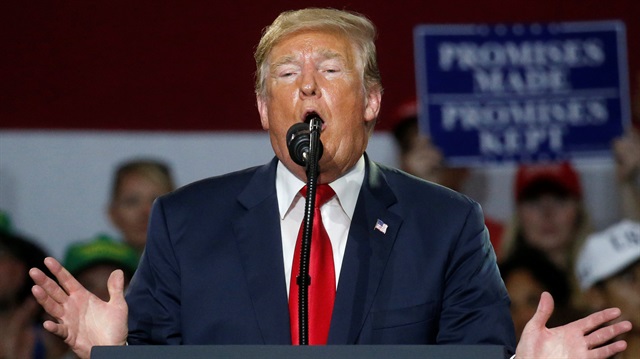
U.S. President Donald Trump
Chinese state media on Monday lashed out at U.S. President Donald Trump's trade policies in an unusually personal attack, and sought to reassure investors worried about China's economy as growth concerns rattled its financial markets.
China's strictly controlled news outlets have frequently rebuked the United States and the Trump administration as the trade conflict has escalated, but they have largely refrained from specifically targeting Trump.
The latest criticism from the overseas edition of the ruling Communist Party's People's Daily newspaper singled out Trump, saying he was starring in his own "street fighter-style deceitful drama of extortion and intimidation".
China's state media said on Saturday the government's retaliatory tariffs on $60 billion in U.S. goods showed rational restraint, although in an opinion piece it still admonished the United States for blackmail and bullyboy tactics.Late on Friday, China's finance ministry unveiled new sets of additional tariffs on 5,207 goods imported from the United States, with the extra levies ranging from 5 to 25 percent on a total value of goods less than half of that proposed by U.S. President Donald Trump's administration.The response follows the Trump administration's proposal of a 25 percent tariff on $200 billion worth of Chinese imports."China's countermeasures are rational," according to a commentary in the Global Times, a tabloid run by the official People's Daily.US pledges nearly $300 million security funding for Southeast Asia"China will not rush to compete with U.S. numbers," it said, echoing comments made by state television.The United States and China implemented tariffs on $34 billion worth of each others' goods in July. Washington is expected to soon implement tariffs on an additional $16 billion of Chinese goods, which China has already said it will match immediately."The White House's extreme pressure and blackmail are already clear to the international community," said a state television commentary."Such methods of extreme blackmail will not bear fruit against China," it said.Trump administration misled public on poverty: ReportChina has now either imposed or proposed tariffs on $110 billion in U.S. goods, representing the vast majority of China's annual imports of American products. Last year, China imported about $130 billion in goods from the United States.U.S. Secretary of State Mike Pompeo, however, remained staunch on Washington's push for fairer trading conditions with China."President Trump inherited an unfair trade regime where American workers and American companies were not treated reciprocally or fairly by the Chinese, and the efforts of the Trump administration are to right that, to correct that," Pompeo said to reporters on the sidelines of a regional forum in Singapore on Saturday.Pompeo added that he had discussed trade issues with China's State Councillor Wang Yi on Friday. 
State media says China's response to latest US tariffs restrained, rational
Trump's desire for others to play along with his drama is "wishful thinking", a commentary on the paper's front page said, arguing that the United States had escalated trade friction with China and turned international trade into a "zero-sum game".
"Governing a country is not like doing business," the paper said, adding that Trump's actions imperilled the national credibility of the United States.
The heated dispute between the world's two biggest economies has roiled financial markets including stocks, currencies and the global trade of commodities from soybeans to coal in recent months.
White House economic adviser Larry Kudlow warned China after it announced retaliatory tariffs on $60 billion worth of U.S. goods on Friday, saying Beijing should not underestimate U.S. President Donald Trump's determination to act on trade.China unveils retaliatory tariffs on $60 billion of US goods"They better not underestimate the president," Kudlow said in an interview on Fox Business Network. 
Trump adviser Kudlow warns China after new tariffs announced
The United States and China implemented tariffs on $34 billion worth of each other's goods in July. Washington is expected to soon implement tariffs on an additional $16 billion of Chinese goods, which China has already said it will match immediately.
On Friday, China's finance ministry unveiled new sets of additional tariffs on 5,207 goods imported from the United States worth $60 billion.
That move was in response to the Trump administration's proposal of a 25-percent tariff on $200 billion worth of Chinese imports.
The trade war, rising corporate bankruptcies, and a steep decline in the value of the yuan versus the dollar have raised concerns that China's economy could face a steeper slowdown.
China on Friday announced retaliatory tariffs on $60 billion worth of U.S. goods ranging from liquefied natural gas (LNG) to some aircraft and warned of further measures, signalling that it won't back down in a protracted trade war with Washington.China's finance ministry unveiled new sets of additional tariffs on 5,207 goods imported from the United States, ranging from 5 to 25 percent.Timing will depend on the actions of the United States, the Chinese Commerce Ministry said in a separate statement.The Trump administration ratcheted up pressure for trade concessions from Beijing this week by proposing a higher 25 percent tariff on $200 billion worth of Chinese imports. China immediately vowed to retaliate though at the same time urged the U.S. to act rationally and return to talks to resolve the dispute.The United States and China implemented tariffs on $34 billion worth of each others' goods in July. Washington is expected to soon implement more tariffs on $16 billion in additional Chinese goods, which China has already announced it will match immediately.Representatives for the White House and the U.S. Commerce Department did not immediately reply to a request for comment on China’s retaliatory move."The U.S. side has repeatedly escalated the situation against the interests of both enterprises and consumers," the Chinese Commerce Ministry said in its statement. "China has to take necessary countermeasures to defend its dignity and the interests of its people."Among U.S. products targeted were a wide range of agricultural and energy products such as beef and LNG. LNG's inclusion marks a deployment by Beijing of one of its last major weapons from its energy and commodities arsenal in its fight with Washington.The market is not large by value compared with the around $12 billion per year of U.S. crude that arrives in the country, but those levels could shoot up as Beijing forges ahead with its plan to switch millions of households to the fuel away from coal as part of its battle against smog.Other U.S. goods targeted by China also included semiconductors, some helicopters, small-to-mid-sized aircraft, condoms, beef, steel products and coffee.Possible new US tariffs on Chinese goods not 'cataclysmic', says Commerce SecretaryChina urges US to return to reason on tradeUS-China trade dispute hitting German companies
China unveils retaliatory tariffs on $60 billion of US goods
The government has responded by releasing more liquidity into the banking system, encouraging lending and promising a more "active" fiscal policy.
U.S. companies are putting in place measures to cushion the impact of the trade row, including price hikes, and a number of companies - from industrial firms to home furnishers and toymakers - have said they will move some sourcing and manufacturing outside of China.
STOCK MARKET SWINGS
The paper's vitriol follows Trump's comments on Twitter from Saturday in which he boasted that his strategy of placing steep tariffs on Chinese imports was "working far better than anyone ever anticipated", and that Beijing was now talking to the United States about trade.
Trump cited losses in China's stock market as he predicted the U.S. market could "go up dramatically" once trade deals were renegotiated.
China's stocks were lower on Monday as Beijing's latest tariff threats escalated the tit-for-tat Sino-U.S. trade war, though the central bank's efforts to shore up the tumbling yuan helped to stabilise the currency.
But a flurry of articles in Chinese state media emphasised the resilience of China's economy and downplayed concerns about the impact of the Sino-U.S. trade war.
"Market participants foresee a relatively stable Chinese currency in the near term, without fear of impacts from the U.S.-China trade dispute. They expect solid economic growth momentum amid policy fine-tuning," an article in the official English-language China Daily newspaper said, citing Chinese economists.
On Friday, the People's Bank of China said it would require banks to keep reserves equivalent to 20 percent of their clients' foreign exchange forwards positions from Monday, in a move to stabilise the yuan.
"Leading China's economy on a stable and far-reaching path, we have confidence and determination," another commentary in the main edition of the People's Daily said.
Trump has threatened tariffs on over $500 billion in Chinese goods, covering virtually all U.S. imports from the Asian giant, demanding that Beijing make fundamental changes to its policies on intellectual property protection, technology transfers and subsidies for high technology industries.
The nationalist Global Times, responding in an editorial late on Sunday to White House economic adviser Larry Kudlow's remarks that China should not underestimate Trump's resolve, said China did not fear "sacrificing short-term interests".
"China has time to fight to the end. Time will prove that the U.S. eventually makes a fool of itself," the Global Times said.
About 100 protesters, many wearing T-shirts emblazoned with "NRA = Not Real Activists," marched through the National Rifle Association's annual meeting in Dallas in May to slam the powerful gun lobby as too conciliatory on gun rights and rally for their candidate for the board.Adam Kraut, a gun rights lawyer, fell about 4,000 votes short of the 71,000 needed for election, but earned 5,000 more than the previous year, a sign of the growth of the Second Amendment purists within the NRA known to many as "gundamentalists."With opinion polls showing U.S. public support for more gun control growing in the wake of mass shootings in recent years, the NRA is facing internal pressure from this little-known force that is demanding that the leadership concede zero ground to gun-control advocates. Its rise has rattled the NRA leadership and threatens the association's ability to hold on to moderate supporters and to make compromises that might help fend off tougher gun control measures, according to some of the two dozen gun-rights activists, policy experts and gun-control advocates interviewed for this story."Generally, they have a disproportionately huge amount of power in the gun-rights movement," said Richard Feldman, a former NRA lobbyist.The NRA has faced divisions before. An internal revolt at the 1977 meeting in Cincinnati turned the polite, sport-shooting organization into a bare-knuckled political lobby that today claims five million members and is closely aligned with the Republican Party, funding pro-gun politicians. The NRA, which spent $30 million to support Donald Trump's 2016 presidential campaign, is often viewed by gun-control advocates as implacably opposed to tighter gun laws. The NRA leadership has put up obstacles to Kraut's election, both with bylaws that make it harder for candidates not put forward by the nominating committee to get elected to the board, and by enlisting a senior member to campaign against him.Marion Hammer, a past president of the NRA and one of the group's most successful lobbyists, denounced unsanctioned candidates in a column on the website Ammoland just as Kraut appeared on the 2018 ballot. Though Hammer did not name Kraut, he was one of only two non-approved candidates to run."Once again the NRA is being threatened by the enemy within," Hammer wrote. "It is time to wake up and stop it before it begins." Neither the NRA nor Hammer responded to requests to address the influence of the gundamentalists and the criticism that these activists and other gun-rights groups directed at the lobby.SOCIAL MEDIA PRESSUREThe Dallas protesters, almost all white men, included bearded outdoorsmen and buttoned-down libertarians. Some said they hid their T-shirts while entering the conventional hall for fear that NRA security would ban them.Kraut, 31, who says he grew up in a house without guns but as an adult taught his father how to shoot, practices firearms law in suburban Philadelphia and also hosts a video blog called The Legal Brief on The Gun Collective, a YouTube channel.He has campaigned for the NRA to push for even more expansive gun-rights laws. He wants to change NRA bylaws, such as imposing term limits for board members and mandatory meeting attendance, to renew its leadership. "Some members feel it (the NRA) doesn't go far enough to defend what we believe to be the core of the Second Amendment," Kraut told Reuters.One of Kraut's most prominent supporters, Tim Harmsen, who led the pro-Kraut march through the convention center, has 770,000 subscribers to the Military Arms Channel on YouTube, where he criticizes the NRA for being weak on gun laws."We're going to continue to apply pressure (on the NRA) every way that we can through social media and we'll be there again next year," Harmsen said.These hardliners deeply cherish their right under the U.S. Constitution's Second Amendment to keep and bear arms. They oppose any form of gun control, saying criminals will find ways around gun laws, which only strip lawful gun owners of the right to self-defense and protection against state tyranny. The gun-rights purists are outraged by any concessions the NRA makes in the wake of mass shootings, even if they are made to avoid stricter gun control laws. Opinion polls such as a regular Gallup survey https://news.gallup.com/poll/1... show growing support for gun control in recent years. Within that trend, support for gun control typically spikes immediately after mass shootings, then falls closer to pre-massacre levels within a few months.After a shooter killed 58 people at a country music concert in Las Vegas last year, the NRA supported federal regulation of bump stocks, accessories that the gunman used to fire his semiautomatic rifles more quickly. The Justice Department then ordered an effective ban that is close to being finalized.Amid nationwide protests that followed a Florida high school shooting that killed 17 people in February, the NRA endorsed strengthening background checks for gun purchasers and emergency protection orders that allow law-enforcement officials to temporarily take guns away from people deemed dangerous."For us, some of the things that come out of NRA headquarters are just outrageous and abhorrent," said Jeff Knox, a Kraut supporter whose father, Neal Knox, led the "Revolt at Cincinnati" in 1977. "It's: Holy cow, what are these guys thinking?"Russia confirms proposed Syria cooperation with USTrump administration misled public on poverty: ReportUS lauds Zimbabwe’s historic presidential poll
Hardline US 'gundamentalists' pressure NRA from within
To the sporting world and largely beyond, he's King James, but to President Trump, LeBron James' is no intellectual genius.In a tweet, Trump took aim at two of his regular critics, James and cable TV news personality Don Lemon. His tweet called Lemon the "the dumbest man on television," and then said Lemon "made LeBron look smart, which isn't easy to do."Trump finished the tweet with "I like Mike!" an apparent reference to favoring NBA legend Michael Jordan in a comparison with James as perhaps the best NBA player ever.James -- who last month announced his decision to leave the Cleveland Cavaliers for a second time, this time to come to Los Angeles and play for the Lakers -- gave an interview with Lemon on Monday, in large part to tout a new elementary school in his hometown of Akron, Ohio.The school, which is a joint effort of the LeBron James Family Foundation and Akron Public Schools, will benefit at-risk children.During the sit-down, James spoke of sports as something that unites people, and added that the president was "using sports to kinda divide us."Trump has repeatedly and strongly criticized the NFL in particular for not punishing players who kneel during the national anthem in a form of protest."Sports has never been something that divides people," James said during the interview. "It's always been something that brings someone together."James has previously criticized Trump on several occasions, publicly supporting Democratic candidate Hillary Clinton before the 2016 election and calling Trump a "bum" in September 2017, after the president rescinded an invitation to the Golden State Warriors to visit the White House after winning the NBA title."Going to the White House was a great honor until you showed up!" James tweeted at the time.Trump's first comments about the NFL and players who protest during the anthem came later that month.
Trump aims tweet at LeBron James, questions his intelligence
The U.S. administration misled the public in a report about poverty in the U.S., according to a new report.State Department emails and documents obtained by Foreign Policy magazine and Coda Story, a non-profit news site, show data provided by the U.S. in its reply to a UN report on the stark levels of impoverishment by economists were deleted or watered down.In December, Philip Alston, Special Rapporteur on extreme poverty and human rights, went to the U.S. on behalf of the UN to evaluate the government's policies and programs aimed at tackling poverty, and to see whether these policies were in line with the country's obligations to human rights.Trump adviser Kudlow warns China after new tariffs announcedAlston said in his report that 40 million Americans are poor and over 5 million live in “Third World conditions.” The Donald Trump administration said that the findings were inaccurate.The rebuttal by the Trump administration painted an optimistic picture of the country, even though that may not be the actual case.Trump’s Mideast peace plan delayed until after US pollsA draft of the U.S. reply read: “The U.S. is entering a new era of economic growth and prosperity.” An official with the White House Council of Economic Advisers said the line should be omitted, noting that this period of growth started long before Trump came into office and was soon to end.The ultimate version ended up ignoring the suggestion altogether.An official from the Council of Economic Advisers wrote a response to a line in the U.S.’s reply that suggested wages were increasing in the country.Possible new US tariffs on Chinese goods not 'cataclysmic', says Commerce Secretary“Wages haven’t really picked up, other than for supervisors,” said the official. That line was deleted.The office of the UN High Commissioner for Human Rights report condemned Trump’s economic policies, citing the “$1.5 trillion in tax cuts in December 2017 overwhelmingly benefited the wealthy and worsened inequality.”While the UN report was based on poverty data, it received unprecedentedly harsh criticism from the U.S. administration.Keith Harper, the former U.S. Ambassador to the Human Rights Council, told Foreign policy magazine and Coda Story that the U.S. response had the "kind of tone that I would expect from China or North Korea or Egypt or Bahrain.”
Trump administration misled public on poverty: Report