

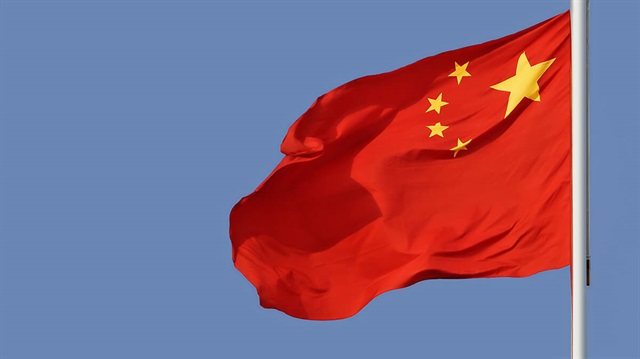
File photo
China's state media said on Saturday the government's retaliatory tariffs on $60 billion in U.S. goods showed rational restraint, although in an opinion piece it still admonished the United States for blackmail and bullyboy tactics.
Late on Friday, China's finance ministry unveiled new sets of additional tariffs on 5,207 goods imported from the United States, with the extra levies ranging from 5 to 25 percent on a total value of goods less than half of that proposed by U.S. President Donald Trump's administration.
The response follows the Trump administration's proposal of a 25 percent tariff on $200 billion worth of Chinese imports.
"China's countermeasures are rational," according to a commentary in the Global Times, a tabloid run by the official People's Daily.
U.S Secretary of State Mike Pompeo pledged on Saturday to provide nearly $300 million in new security funding for Southeast Asia, as China forges ahead with plans to bolster its engagement in the region.Pompeo unveiled the figure to reporters on the sidelines of a meeting of foreign ministers from the 10-member Association of Southeast Asian Nations (ASEAN) and other officials from around the world in Singapore."As part of our commitment to advancing regional security in the Indo-Pacific, the United States is excited to announce nearly $300 million in new funding to reinforce security cooperation throughout the entire region," he said.The new security assistance will strengthen maritime security, develop humanitarian assistance, peacekeeping capabilities and counter "transnational threats", he added.The United States said earlier this week it would invest $113 million in technology, energy and infrastructure initiatives in emerging Asia which he called "a downpayment on a new era of U.S. economic commitment to the region".The United States' developing vision for a "free and open Indo-Pacific" comes at the same time as China ramps up its influence as part of is Belt and Road plan to bolster trade ties with nations in Southeast Asia and beyond.Analysts have said that a spiralling trade dispute between Beijing and Washington could also ratchet up tensions over other regional hotspots, such as the South China Sea, claimed in whole by China and in part by some Southeast Asian nations.The Chinese government's top diplomat, State Councillor Wang Yi, told reporters at the same forum that China welcomed, and was willing to work with, the United States to help with faster development and better security in the region.He added, however, that the United States had been sending "massive strategic weaponry" into the South China Sea and the region as a show of military might that puts pressure on China and other regional countries."That is the biggest force behind militarisation in this region," he said.China and the ASEAN bloc on Thursday hailed a "milestone" agreement on a single working text to kick off what will likely be protracted negotiations towards a code of conduct for behaviour the disputed waters.But critics have said that this enthusiasm for talks is a means for China to buy time and solidify its position during a period of relative dominance in the region where it has built island bases on submerged reefs.Pompeo told reporters that he had raised concerns at the meeting about Chinese militarisation of the South China Sea and the importance of maintaining a rules-based order.Progress towards resolving the continuing humanitarian in crisis in Myanmar's troubled Rakhine state and other security issues were also essential to a free and open Indo-Pacific, he said.The use of "Indo-Pacific" has grown among diplomats from Japan, Australia, India and the Untied States in recent years, a shorthand for a democratic-led region, as opposed to an "Asia-Pacific" with China at its centre.China says that its Belt and Road plan is about promoting the common prosperity of all nations involved, but critics see the signature policy of President Xi Jinping as a bid for greater political clout. 
US pledges nearly $300 million security funding for Southeast Asia
"China will not rush to compete with U.S. numbers," it said, echoing comments made by state television.
The United States and China implemented tariffs on $34 billion worth of each others' goods in July. Washington is expected to soon implement tariffs on an additional $16 billion of Chinese goods, which China has already said it will match immediately.
"The White House's extreme pressure and blackmail are already clear to the international community," said a state television commentary.
"Such methods of extreme blackmail will not bear fruit against China," it said.
The U.S. administration misled the public in a report about poverty in the U.S., according to a new report.State Department emails and documents obtained by Foreign Policy magazine and Coda Story, a non-profit news site, show data provided by the U.S. in its reply to a UN report on the stark levels of impoverishment by economists were deleted or watered down.In December, Philip Alston, Special Rapporteur on extreme poverty and human rights, went to the U.S. on behalf of the UN to evaluate the government's policies and programs aimed at tackling poverty, and to see whether these policies were in line with the country's obligations to human rights.Trump adviser Kudlow warns China after new tariffs announcedAlston said in his report that 40 million Americans are poor and over 5 million live in “Third World conditions.” The Donald Trump administration said that the findings were inaccurate.The rebuttal by the Trump administration painted an optimistic picture of the country, even though that may not be the actual case.Trump’s Mideast peace plan delayed until after US pollsA draft of the U.S. reply read: “The U.S. is entering a new era of economic growth and prosperity.” An official with the White House Council of Economic Advisers said the line should be omitted, noting that this period of growth started long before Trump came into office and was soon to end.The ultimate version ended up ignoring the suggestion altogether.An official from the Council of Economic Advisers wrote a response to a line in the U.S.’s reply that suggested wages were increasing in the country.Possible new US tariffs on Chinese goods not 'cataclysmic', says Commerce Secretary“Wages haven’t really picked up, other than for supervisors,” said the official. That line was deleted.The office of the UN High Commissioner for Human Rights report condemned Trump’s economic policies, citing the “$1.5 trillion in tax cuts in December 2017 overwhelmingly benefited the wealthy and worsened inequality.”While the UN report was based on poverty data, it received unprecedentedly harsh criticism from the U.S. administration.Keith Harper, the former U.S. Ambassador to the Human Rights Council, told Foreign policy magazine and Coda Story that the U.S. response had the "kind of tone that I would expect from China or North Korea or Egypt or Bahrain.”
Trump administration misled public on poverty: Report
China has now either imposed or proposed tariffs on $110 billion in U.S. goods, representing the vast majority of China's annual imports of American products. Last year, China imported about $130 billion in goods from the United States.
U.S. Secretary of State Mike Pompeo, however, remained staunch on Washington's push for fairer trading conditions with China.
"President Trump inherited an unfair trade regime where American workers and American companies were not treated reciprocally or fairly by the Chinese, and the efforts of the Trump administration are to right that, to correct that," Pompeo said to reporters on the sidelines of a regional forum in Singapore on Saturday.
Pompeo added that he had discussed trade issues with China's State Councillor Wang Yi on Friday.