

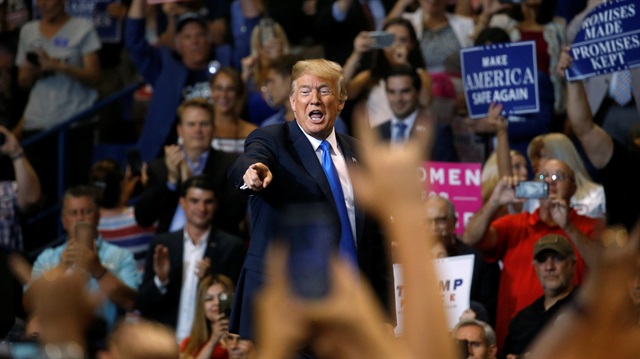
U.S. President Donald Trump
The U.S. administration misled the public in a report about poverty in the U.S., according to a new report.
State Department emails and documents obtained by Foreign Policy magazine and Coda Story, a non-profit news site, show data provided by the U.S. in its reply to a UN report on the stark levels of impoverishment by economists were deleted or watered down.
In December, Philip Alston, Special Rapporteur on extreme poverty and human rights, went to the U.S. on behalf of the UN to evaluate the government's policies and programs aimed at tackling poverty, and to see whether these policies were in line with the country's obligations to human rights.
White House economic adviser Larry Kudlow warned China after it announced retaliatory tariffs on $60 billion worth of U.S. goods on Friday, saying Beijing should not underestimate U.S. President Donald Trump's determination to act on trade.China unveils retaliatory tariffs on $60 billion of US goods"They better not underestimate the president," Kudlow said in an interview on Fox Business Network. 
Trump adviser Kudlow warns China after new tariffs announced
Alston said in his report that 40 million Americans are poor and over 5 million live in “Third World conditions.” The Donald Trump administration said that the findings were inaccurate.
The rebuttal by the Trump administration painted an optimistic picture of the country, even though that may not be the actual case.
The “Deal of the Century”, a backchannel U.S. Middle East peace plan, could be delayed until after November elections in the U.S., according to reports in the Israeli media.On Friday, Israel HaYom, an Israeli daily, quoted an unnamed source “close to the White House” as saying the deal would likely not be formally unveiled for “several more months” due to the upcoming congressional polls.A wide-ranging Middle East peace plan championed by U.S. President Donald Trump, few details of the so-called “Deal of the Century” have been made public.Palestinian prisoner enters 67th day on hunger strikeAccording to the source quoted by Israel HaYom, the Trump administration believes that Israeli Prime Minister Benjamin Netanyahu will be “unable to commit himself to the terms of the deal” in the period before the election.The deal, the same source added, will call for several “concessions” by Israel, which could, he said, have a negative impact on the electoral prospects of Republican candidates in the Nov. 6 polls.What’s more, the source asserted, Netanyahu will likely be unable to endorse certain aspects of the plan -- such as recognition of Jerusalem’s Abu Dis district as capital of a future Palestinian state -- because his political rivals in Israel would be able to use this against him.Top Hamas leader returns to Gaza“Arab sources” quoted by the same newspaper, meanwhile, said that Arab states involved in the deal -- namely, Egypt, Jordan and Saudi Arabia -- also preferred to unveil the deal’s terms following the U.S. midterm elections.Palestinian leaders, for their part, have repeatedly voiced their rejection of the deal, which, they say, fails to meet minimum Palestinian demands.
Trump’s Mideast peace plan delayed until after US polls
A draft of the U.S. reply read: “The U.S. is entering a new era of economic growth and prosperity.” An official with the White House Council of Economic Advisers said the line should be omitted, noting that this period of growth started long before Trump came into office and was soon to end.
The ultimate version ended up ignoring the suggestion altogether.
An official from the Council of Economic Advisers wrote a response to a line in the U.S.’s reply that suggested wages were increasing in the country.
New tariffs that the United States is threatening to impose on nearly half the goods imported from China would have a small impact on the Asian nation's economy and not lead to disaster, Commerce Secretary Wilbur Ross said on Thursday, as U.S. financial markets were set to open lower on the trade standoff."It's not something that's going to be cataclysmic," he said in an interview with Fox Business News, explaining that a 25 percent tariff on $200 billion of goods would only amount to $50 billion a year, equal to less than 1 percent of China's economy.Ross said President Donald Trump "now feels that it's potentially time to put more pressure on" China to "modify their behavior."Trade Representative Robert Lighthizer said on Wednesday that Trump directed the increase from a previously proposed 10 percent duty because China had refused to meet U.S. demands and had imposed retaliatory tariffs on U.S. goods.Trump's threats of higher tariffs also weighed on China's financial markets. But Wang Yi, the Chinese government's top diplomat, said U.S. efforts to pressure China would be in vain, urging its trade policymakers to "calm down."China urges US to return to reason on tradeTrump's overture to emerging Asia drowned out by trade warUS-China trade dispute hitting German companies
Possible new US tariffs on Chinese goods not 'cataclysmic', says Commerce Secretary
“Wages haven’t really picked up, other than for supervisors,” said the official. That line was deleted.
The office of the UN High Commissioner for Human Rights report condemned Trump’s economic policies, citing the “$1.5 trillion in tax cuts in December 2017 overwhelmingly benefited the wealthy and worsened inequality.”
While the UN report was based on poverty data, it received unprecedentedly harsh criticism from the U.S. administration.
Keith Harper, the former U.S. Ambassador to the Human Rights Council, told Foreign policy magazine and Coda Story that the U.S. response had the "kind of tone that I would expect from China or North Korea or Egypt or Bahrain.”