

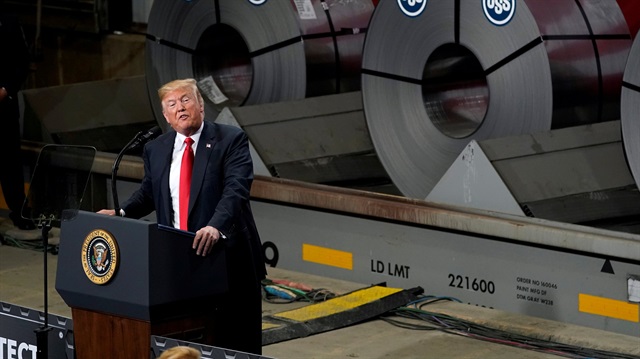
FILE PHOTO: U.S. President Donald Trump speaks about trade at the Granite City Works steel coil warehouse in Granite City, Illinois, U.S.
China on Friday announced retaliatory tariffs on $60 billion worth of U.S. goods ranging from liquefied natural gas (LNG) to some aircraft and warned of further measures, signalling that it won't back down in a protracted trade war with Washington.
China's finance ministry unveiled new sets of additional tariffs on 5,207 goods imported from the United States, ranging from 5 to 25 percent.
Timing will depend on the actions of the United States, the Chinese Commerce Ministry said in a separate statement.
The Trump administration ratcheted up pressure for trade concessions from Beijing this week by proposing a higher 25 percent tariff on $200 billion worth of Chinese imports. China immediately vowed to retaliate though at the same time urged the U.S. to act rationally and return to talks to resolve the dispute.
The United States and China implemented tariffs on $34 billion worth of each others' goods in July. Washington is expected to soon implement more tariffs on $16 billion in additional Chinese goods, which China has already announced it will match immediately.
Representatives for the White House and the U.S. Commerce Department did not immediately reply to a request for comment on China’s retaliatory move.
"The U.S. side has repeatedly escalated the situation against the interests of both enterprises and consumers," the Chinese Commerce Ministry said in its statement. "China has to take necessary countermeasures to defend its dignity and the interests of its people."
Among U.S. products targeted were a wide range of agricultural and energy products such as beef and LNG. LNG's inclusion marks a deployment by Beijing of one of its last major weapons from its energy and commodities arsenal in its fight with Washington.
The market is not large by value compared with the around $12 billion per year of U.S. crude that arrives in the country, but those levels could shoot up as Beijing forges ahead with its plan to switch millions of households to the fuel away from coal as part of its battle against smog.
Other U.S. goods targeted by China also included semiconductors, some helicopters, small-to-mid-sized aircraft, condoms, beef, steel products and coffee.
New tariffs that the United States is threatening to impose on nearly half the goods imported from China would have a small impact on the Asian nation's economy and not lead to disaster, Commerce Secretary Wilbur Ross said on Thursday, as U.S. financial markets were set to open lower on the trade standoff."It's not something that's going to be cataclysmic," he said in an interview with Fox Business News, explaining that a 25 percent tariff on $200 billion of goods would only amount to $50 billion a year, equal to less than 1 percent of China's economy.Ross said President Donald Trump "now feels that it's potentially time to put more pressure on" China to "modify their behavior."Trade Representative Robert Lighthizer said on Wednesday that Trump directed the increase from a previously proposed 10 percent duty because China had refused to meet U.S. demands and had imposed retaliatory tariffs on U.S. goods.Trump's threats of higher tariffs also weighed on China's financial markets. But Wang Yi, the Chinese government's top diplomat, said U.S. efforts to pressure China would be in vain, urging its trade policymakers to "calm down."China urges US to return to reason on tradeTrump's overture to emerging Asia drowned out by trade warUS-China trade dispute hitting German companies
Possible new US tariffs on Chinese goods not 'cataclysmic', says Commerce Secretary
China on Thursday urged the United States to return to reason after the Trump administration sought to ratchet up pressure for trade concessions by proposing a higher 25-percent tariff on $200 billion worth of Chinese imports.U.S. Trade Representative Robert Lighthizer said on Wednesday that President Donald Trump directed the increase from a previously proposed 10 percent duty because China has refused to meet U.S. demands and has imposed retaliatory tariffs on U.S. goods.Trump's threats of higher tariffs weighed on China's financial markets. But Chinese Foreign Ministry spokesman Geng Shuang reiterated at a regular news briefing that the United States' efforts at "blackmail" would fail."We would advise the United States to correct its attitude and not try to engage in blackmail. This won't work on China," Geng said.Trump's overture to emerging Asia drowned out by trade war"Secondly, we would advise the U.S. side to return to reason, and not blindly let emotions affect their decisions, because in the end this will harm themselves," Geng said.Chinese shares fell on Thursday, and so far this year, the Shanghai Composite Index has slumped more than 16 percent, the world's second-worst performing stock index.The Chinese yuan also ticked lower against the dollar, extending its year-to-date decline to more than 4.5 percent.There have been no formal talks between Washington and Beijing for weeks over Trump's demands that China make fundamental changes to its policies on intellectual property protection, technology transfers and subsidies for high technology industries.China says foreigners should not interfere in Cambodia after electionGeng said China's door to dialogue on the trade dispute is open, but that it had to be based on mutual respect and equality."The current unilateral threats and pressure from the United States will only backfire," he said.Two Trump administration officials told reporters on a conference call that Trump remains open to communications with Beijing and that through informal conversations the two countries are discussing whether a "fruitful negotiation" is possible.The higher tariff rate, if implemented, would apply to a list of goods valued at $200 billion identified by the USTR last month as a response to China's retaliatory tariffs on an initial round of U.S. tariffs on $34 billion worth of Chinese electronic components, machinery, autos and industrial goods.US-China trade dispute hitting German companiesTrump has ultimately threatened tariffs on over $500 billion in Chinese goods, covering virtually all U.S. imports from China.The USTR said it will extend a public comment period for the $200 billion list to Sept. 5 from Aug. 30 due to the possible tariff rate rise.The list, unveiled on July 10, hits American consumers harder than previous rounds, with targeted goods ranging from Chinese tilapia fish and dog food to furniture, lighting products, printed circuit boards and building materials.
China urges US to return to reason on trade
The escalating trade conflict between the United States and China is hitting German companies doing business in both countries, a survey by the DIHK Chambers of Industry and Commerce showed on Thursday.China has warned the United States it would hit back if the Trump administration takes further steps hindering trade as Washington considers slapping a 25 percent tariff on $200 billion worth of Chinese goods.The proposal would increase the potential tariff rate from 10 percent the U.S. administration had initially put forward on July 10 for that wave of duties in a bid to pressure Beijing into making trade concessions, a source familiar with the plan said on Tuesday.The U.S. tariffs target thousands of Chinese imports, including food products, chemicals, steel and aluminium and consumer goods ranging from dog food, furniture and carpets to car tires, bicycles, and baseball gloves and beauty products.The DIHK said a survey among its members doing business in China showed that 41 percent were already affected by the higher tariffs when exporting to the United States while 46 percent reported higher costs when importing from the United States.Among the German companies doing business in the United States, 57 percent said they already faced negative effects when exporting to China while 75 percent reported disadvantages such as higher costs when importing from China."The dangerous trade dispute between the U.S. and China is also hitting German companies doing business in the two countries," said Volker Treier, foreign trade chief at the DIHK."The impact is huge: nearly half of the imports from German companies are directly or indirectly affected by the new tariffs, for example because they source raw materials or components from the other country," Treier said.To avoid the higher costs caused by the tit-for-tat tariffs, many German firms doing business in the United States are considering the closure of production sites and relocation to other countries, the DIHK said.The DIHK survey showed that German companies producing at home were also hit by the U.S.-Chinese trade conflict due to their international network of suppliers and broad customer relationships around the globe."A further escalation of the dispute would be a threat to world trade as a whole," Treier said.The United States is Germany's biggest single export destination while China is the most important business partner in overall trade volumes for German companies.German companies have invested 400 billion euros ($466.60 billion) in the United States and 80 billion euros in China. They employ more than 850,000 people in the United States and some 700,000 in China, according to DIHK.Trump says attorney general should stop Mueller probe 'right now'China vows retaliation if Trump slaps 25 pct tariff on $200 bln of Chinese importsFacebook says it identifies campaign to meddle in 2018 US elections
US-China trade dispute hitting German companies