

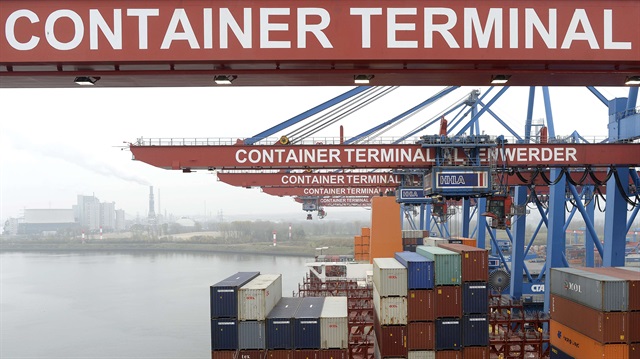
File Photo
The escalating trade conflict between the United States and China is hitting German companies doing business in both countries, a survey by the DIHK Chambers of Industry and Commerce showed on Thursday.
China has warned the United States it would hit back if the Trump administration takes further steps hindering trade as Washington considers slapping a 25 percent tariff on $200 billion worth of Chinese goods.
The proposal would increase the potential tariff rate from 10 percent the U.S. administration had initially put forward on July 10 for that wave of duties in a bid to pressure Beijing into making trade concessions, a source familiar with the plan said on Tuesday.
The U.S. tariffs target thousands of Chinese imports, including food products, chemicals, steel and aluminium and consumer goods ranging from dog food, furniture and carpets to car tires, bicycles, and baseball gloves and beauty products.
The DIHK said a survey among its members doing business in China showed that 41 percent were already affected by the higher tariffs when exporting to the United States while 46 percent reported higher costs when importing from the United States.
Among the German companies doing business in the United States, 57 percent said they already faced negative effects when exporting to China while 75 percent reported disadvantages such as higher costs when importing from China.
"The dangerous trade dispute between the U.S. and China is also hitting German companies doing business in the two countries," said Volker Treier, foreign trade chief at the DIHK.
"The impact is huge: nearly half of the imports from German companies are directly or indirectly affected by the new tariffs, for example because they source raw materials or components from the other country," Treier said.
To avoid the higher costs caused by the tit-for-tat tariffs, many German firms doing business in the United States are considering the closure of production sites and relocation to other countries, the DIHK said.
The DIHK survey showed that German companies producing at home were also hit by the U.S.-Chinese trade conflict due to their international network of suppliers and broad customer relationships around the globe.
"A further escalation of the dispute would be a threat to world trade as a whole," Treier said.
The United States is Germany's biggest single export destination while China is the most important business partner in overall trade volumes for German companies.
German companies have invested 400 billion euros ($466.60 billion) in the United States and 80 billion euros in China. They employ more than 850,000 people in the United States and some 700,000 in China, according to DIHK.
U.S. President Donald Trump on Wednesday called on Attorney General Jeff Sessions to end a federal criminal probe into Russian meddling in the 2016 presidential election and whether there was any cooperation by his campaign with Moscow.After a pair of tweets attacking the probe by Special Counsel Robert Mueller, Trump wrote: "This is a terrible situation and Attorney General Jeff Sessions should stop this Rigged Witch Hunt right now, before it continues to stain our country any further."Bob Mueller is totally conflicted," Trump continued. He provided no evidence that the team led by Mueller, a Republican appointed by Republicans, is biased against him.A Justice Department spokeswoman said the department had no immediate comment on the tweet.The first trial arising from the probe into Russia's efforts to put Trump in the White House, and any coordination with his campaign team, began this week. Trump's former campaign chairman, Paul Manafort, faces 18 counts of bank and tax fraud charges.Prosecutors portray Trump's ex-campaign chief as a liar and tax cheatThe Republican president has steadily attacked his attorney general for recusing himself from the Russia probe in March 2017. Sessions cited his role as a senior adviser to Trump's presidential campaign and appointed Deputy Attorney General Rod Rosenstein to oversee the investigation. Rosenstein in turn appointed Mueller.The man heading Trump's re-election campaign, Brad Parscale, has in recent months called on Trump to fire Sessions and end the Mueller probe.Moscow has denied it interfered in the 2016 election campaign, and Trump has denied any collusion by his campaign.
Trump says attorney general should stop Mueller probe 'right now'
China said on Wednesday that "blackmail" wouldn't work and that it would hit back if the United States takes further steps hindering trade, as the Trump administration considers slapping a 25 percent tariff on $200 billion worth of Chinese goods.The proposal would increase the potential tariff rate from 10 percent the administration had initially put forward on July 10 for that wave of duties in a bid to pressure Beijing into making trade concessions, a source familiar with the plan said on Tuesday.The tariffs target thousands of Chinese imports, including food products, chemicals, steel and aluminum and consumer goods ranging from dog food, furniture and carpets to car tires, bicycles, and baseball gloves and beauty products.While the duties would not be imposed until after a period of public comment, raising the proposed level to 25 percent would escalate the already bitter trade dispute between the world's two biggest economies.Trump to propose 25-pct tariff on $200 bln of Chinese importsThe source said President Donald Trump's administration could announce the tougher proposal as early as Wednesday in Washington. The plan to more than double the tariff rate was first reported by Bloomberg News.China, which has accused the United States of bullying, again vowed to retaliate if Trump proceeds with the measures, warning that pressure tactics would fail."U.S. pressure and blackmail won't have an effect. If the United States takes further escalatory steps, China will inevitably take countermeasures and we will resolutely protect our legitimate rights," Chinese Foreign Ministry spokesman Geng Shuang told a regular news briefing.Investors fear an escalating trade war between Washington and Beijing could hit global growth, and prominent U.S. business groups, while weary of what they see as China's mercantilist trade practices, have condemned Trump's aggressive tariffs.Representatives of U.S. Treasury Secretary Steven Mnuchin and Chinese Vice Premier Liu He have been speaking privately as they seek to restart negotiations to defuse the budding trade war, Bloomberg reported, citing sources.A spokeswoman for the U.S. Trade Representative's Office declined to comment on the proposed tariff rate increase or on whether any changes would alter the deadlines laid out for comment period before implementation.Asked about communication between the two countries on the dispute, Geng said China had "always upheld using dialogue and consultations to handle trade frictions", but that dialogue must be based on mutual respect and equality."Unilateral threats and pressure will only produce the opposite of the desired result," Geng said."AMERICANS' POCKETBOOKS"In early July, the U.S. government imposed 25 percent tariffs on an initial $34 billion of Chinese imports. Beijing retaliated with matching tariffs on the same amount of U.S. exports to China.Washington is preparing to also impose tariffs on an extra $16 billion of goods in coming weeks, and Trump has warned he may ultimately put them on over half a trillion dollars of goods - roughly the total amount of U.S. imports from China last year.The $200 billion list of goods targeted for tariffs - which also include Chinese tilapia fish, printed circuit boards and lighting products - would have a bigger impact on consumers than previous rounds of tariffs.Erin Ennis, senior vice president of the U.S.-China Business Council, said a 10 percent tariff on these products is already problematic, but more than doubling that to 25 percent would be much worse."Given the scope of the products covered, about half of all imports from China are facing tariffs, including consumer goods," Ennis said. "The cost increases will be passed on to customers, so it will affect most Americans' pocketbooks."Trump had said he would implement the $200 billion round as punishment for China's retaliation against the initial tariffs aimed at forcing change in China's joint venture, technology transfer and other trade-related policies.He also has threatened a further round of tariffs on $300 billion of Chinese goods.The U.S. Trade Representative's office initially had set a deadline for final public comments on the proposed 10 percent tariffs to be filed by Aug. 30, with public hearings scheduled for Aug. 20-23.It typically has taken several weeks after the close of public comments for the tariffs to be activated.
China vows retaliation if Trump slaps 25 pct tariff on $200 bln of Chinese imports
Facebook Inc said on Tuesday it had identified a new coordinated political influence campaign to mislead its users and sow dissension among voters ahead of November's U.S. congressional elections.It said it had removed 32 pages and accounts from Facebook and Instagram, part of an effort to combat foreign meddling in U.S. elections.The company stopped short of identifying the source of the misinformation. But members of Congress who had been briefed by Facebook on the matter said the methodology of the influence campaign suggested Russian involvement.“I can say I think with pretty high confidence I think this is Russian-related,” Senator Mark Warner, the top Democrat on the Senate Intelligence Committee, told reporters at the U.S. Capitol.Two U.S. intelligence officials told Reuters there was not sufficient evidence to conclude that Russia was behind the Facebook campaign, but one noted that “the similarities, aims and methodology relative to the 2016 Russian campaign are quite striking."A Russian propaganda arm tried to tamper in the 2016 U.S. election by posting and buying ads on Facebook, according to the company and U.S. intelligence agencies. In February, the U.S. Justice Department indicted 13 Russian nationals, and the St. Petersburg-based Internet Research Agency, for interfering in the 2016 U.S. election.Moscow has denied involvement.Facebook has been on the defensive about influence activity on its site and concerns over user privacy tied to long-standing agreements with developers that allowed them access to private user data.'ARMS RACE'The Atlantic Council’s Digital Forensics Research Lab, which was shown the suspended pages ahead of the takedown, said they showed similarities in language and approach to previously fake accounts from the Internet Research Agency, which is known as the “troll factory” because it stirs up public opinion on social media sites.The lab cited “consistent mistranslation, as well as an overwhelming focus on polarizing issues at the top of any given news cycle.” It said, for example, the posts on the year-old, feminist Resisters page “took a liberal or left-wing stance on issues around gender, race, immigration, and human rights.” Other pages promoted racial pride among minority groups.The group said the Resisters page was alarming because it was pushing for confrontation at multiple protests, including against "Unite the Right 2," with a potential for violence.A man who identified himself as an administrator of Resisters, Washington activist Brendan Orsinger, said on a video call with Reuters that he had been invited to help operate the page by someone he knew only through Facebook messages."I definitely had concerns, because people don't usually invite me to accounts unless they know me," Orsinger said. "But at the same time, this was an account we could use."He said that more than a dozen legitimate activist groups were still supporting the counter-rally and would now have to work harder to reconnect with people who had been following it through the Resisters page.Orsinger said he was not yet sure that the account that had involved him was Russian, but that if it was, he was concerned about he and fellow activists being infiltrated and influenced.Sheryl Sandberg, Facebook's chief operating officer, said on a call with reporters that the attempts to manipulate public opinion would likely become more sophisticated to evade Facebook’s scrutiny, calling it an "arms race."The White House said the administration was supportive of Facebook's actions."We applaud efforts by our private-sector partners to combat an array of threats that occur in cyberspace, including malign influence," said Garrett Marquis, a spokesman for the National Security Council.U.S. President Donald Trump has come under fire for discounting the threat of interference in the congressional elections.During his summit with Russian President Vladimir Putin in Helsinki earlier this month, Trump appeared to state that he believed Russia was no longer trying to influence the U.S. election process.Trump later amended that, saying he was "very concerned" about Russian interference in the election. On Friday, Trump held a meeting with his national security advisers on election security.DIVISIVE ISSUESFacebook identified influence activity around at least two issues, including the counter-protest to the Unite the Right 2 rally set next week in Washington. The other was the #AbolishICE social media campaign aimed at the U.S. Immigration and Customs Enforcement agency.In an online post, Facebook said it was disclosing the influence effort now in part because of the rally. A previous event last year in Charlottesville, Virginia, led to violence by white supremacists."This kind of behavior is not allowed on Facebook because we don't want people or organizations creating networks of accounts to mislead others about who they are, or what they’re doing," the company said.More than 290,000 accounts followed at least one of the pages and about $11,000 had been spent on about 150 ads, Facebook said. The pages had created about 30 events since May 2017.Facebook officials on a call with reporters said one known account from Russia's Internet Research Agency was a co-administrator of one of the fake pages for seven minutes, but the company did not believe that was enough evidence to attribute the campaign to the Russian government.The company previously said 126 million Americans may have seen Russian-backed political content on Facebook over a two-year period, and that 16 million may have been exposed to Russian information on the Instagram photo-sharing app.Over the past several months, the company has taken steps meant to reassure U.S. and European lawmakers that further regulation is unnecessary. Chief Executive Officer Mark Zuckerberg says the company has 20,000 people working to police and protect the site.
Facebook says it identifies campaign to meddle in 2018 US elections