

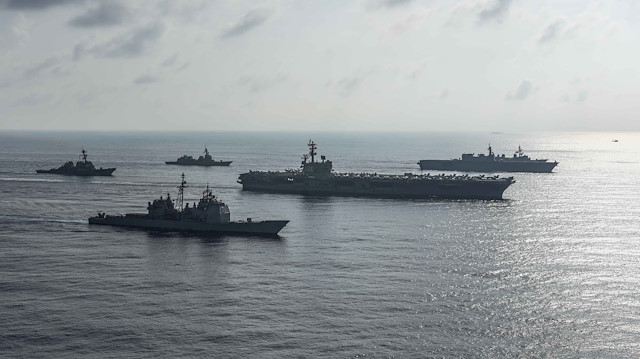
The Ronald Reagan Strike Group ship's the aircraft carrier USS Ronald Reagan (CVN 76), the guided-missile cruiser USS Antietam (CG 54) and the guided-missile destroyer USS Milius (DDG 69) conduct a photo exercise with the Japan Maritime Self-Defense Force ship's the helicopter destroyer JS Kaga (DDH 184), the destroyer JS Inazuma (DD 105) and the destroyer JS Suzutsuki (DD 117) in the South China Sea August 31, 2018.
Standing side by side, top U.S. officials urged their Chinese counterparts on Friday to halt militarization of the disputed South China Sea, drawing a rebuke from the Chinese for sending U.S. warships close to islands claimed by Beijing.
During a round of high-level talks in Washington, the two sides aired in sometimes blunt terms many of their main differences, including a bitter trade dispute, freedom of navigation in Asia-Pacific waters, self-ruled Taiwan, and China’s crackdown on its Muslim minority in Xinjiang.
Two visiting senior Chinese officials also seized the opportunity to warn publicly that a trade war between the world’s two largest economies would end up hurting both sides and to call for keeping channels of communication open to resolve an issue that has unsettled global financial markets.
Despite the airing of grievances, the talks appeared aimed at controlling the damage to relations that has worsened in recent months and at paving the way for an encounter between U.S. President Donald Trump and Chinese President Xi Jinping at the Group of 20 summit in Argentina at the end of November.
Chinese broadcasters and online entertainment sites should avoid celebrity hype and crack down on fake audience and click-through rates, state media quoted the National Radio and Television Administration as saying.The edict comes after Beijing ordered A-list movie star Fan Bingbing to pay about 884 million yuan ($129 million) in taxes and fines, spurring widespread discussion on the moral health of China's film industry.Some programmes overpaid celebrities, destroying industry order and leading teenagers into worshipping stars and money, Xinhua news agency said, citing the administration.Radio and television stations, along with online audio-visual service providers, should scrap vulgar content, promote core socialist values and keep children away from entertainment and reality shows, it said.The providers should also cut down on game shows, reality shows and singing contests that feature celebrities.In a letter posted on her official account on the Twitter-like platform Weibo last month, Fan said she would overcome "all difficulties" to pay her penalties."I'm ashamed of my behaviour and I apologise here to everyone," Fan wrote. "Every bit of my achievement is inseparable from the support of the state and the people. Without the good policies of the Communist Party and the state, without the love of the people, there is no Fan Bingbing." 
China cracks down on celebrity hype and fake click
"The United States is not pursuing a Cold War or containment policy with respect to China," U.S. Secretary of State Mike Pompeo told a joint news conference.
Even as the United States and China confront difficult challenges, “cooperation remains essential on many issues,” he said, citing efforts to persuade North Korea to abandon its nuclear program.
The meeting paired Pompeo and Defense Secretary Jim Mattis with Chinese Politburo member Yang Jiechi and Defense Minister Wei Fenghe. The annual U.S.-China Diplomatic and Security Dialogue was originally set for Beijing last month but had been called off amid rising tensions.
Pompeo took aim at China over its continued building of military installations on artificial islands and reefs in the South China Sea, where China insists it has sovereignty despite competing claims from some smaller neighbors.
German Foreign Minister Heiko Maas will raise human rights issues in Xinjiang province of China on his upcoming visit to the country, his spokesperson said on Friday.“From our point of view, the situation in Xinjiang is worrying. Foreign Minister Maas will raise the issue with his Chinese counterpart,” Maria Adebahr told a news conference in Berlin.Adebahr said during the visit beginning on Sunday, delegations will also review preparations for the next human rights dialogue meeting between Germany and China, which is scheduled for December.Muslims in Xinjiang face repression: German parliamentOn Thursday, German lawmakers called on China to end repressive policies against Uighur Muslims in northwestern Xinjiang, an autonomous region of the country.During a debate at the parliament, lawmakers from opposition parties and Chancellor Angela Merkel’s coalition government, urged Chinese authorities to end massive surveillance in the region, and abolish arbitrary detention of up to one million people in internment camps.
German FM to raise Uighur concerns on China visit
“We have continued concerns about China's activities and militarization in the South China Sea,” Pompeo said following the talks. “We pressed China to live up to its past commitments in this area."
Yang said China was committed to "non-confrontation” but that Beijing had the right to build "necessary defense facilities" on what it considers its own territory and urged Washington to stop sending warships and military planes close to the islands that Beijing claims.
Mattis made clear that this demand go unheeded by Washington, which insists it is acting under international law to preserve access for it and others to the South China Sea.
In a statement on Saturday, China's Foreign Ministry described the talks as "frank, constructive and very fruitful."
China paraded industrial and military clout and sent deliberate signals to Western rivals that its aerospace and arms industries aim to catch them up on world markets, while playing down trade tensions at the nation's largest air show this week.The biennial event in the coastal city of Zhuhai has traditionally been used by Beijing to show off its growing aviation capability, but is also keenly watched by the global industry for clues on where it faces obstacles.Beijing not only showed off a range of new military kit for export, but unveiled progress in civil wide-body and regional jet programmes and deeper cooperation with Russia in a message to the West, industry watchers said."You get a real sense of the scale and speed of the development of the past 25 years. They have covered an enormous amount of ground in a really short space of time in terms of defence and aerospace," said Douglas Barrie, senior fellow for military aerospace at the London-based IISS thinktank.Video: China's cutting-edge military equipment, aircraft highlighted at Zhuhai Airshow"Everything we have been shown here is pretty much for the export market. You then wonder what isn't being shown; what are they keeping for themselves in terms of capability?"On display in the sprawling 'weaponry hall' and on other stages to military visitors from Africa to Southeast Asia were ground vehicles, drones ranging from miniature to aircraft-sized and new anti-ship ballistic missiles.China's new J-20 stealth jet performed a five-minute-long demonstration - in contrast to a prudent 60-second debut two years ago - though the jet is not expected to be sold overseas.China's choreographed trade expo more 'theatre' than deal clincherNO NEED FOR THE WESTThe show has been taking place against a backdrop of a tariff spat with the United States and U.S. accusations of espionage by China's state aerospace apparatus.Chinese President Xi Jinping said weeks before the show that Russia and China should work together to oppose protectionism and what he called unilateral approaches to international problems, a veiled reference to U.S. foreign policy.The two countries unveiled a mock-up of the CR929 wide-body civil jet, widely seen as a high-level initiative, and signed a helicopter sale in one of the few deals.A senior executive at Russian state conglomerate Rostec told Reuters both countries were keen to develop their civil aircraft building capabilities to reduce their dependence on the Western companies that currently dominate the supply chain.US accuses China of violating bilateral anti-hacking deal"The Chinese-Russian aircraft is showing that they have a choice, that they don't have to buy (aircraft) from the West and that if there are any problems on trade they can develop perfectly adequately in cooperation with Russia," said aerospace analyst Sash Tusa of Britain-based Agency Partners.Helping efforts to showcase the strides China is making in aviation was Commercial Aircraft Corporation of China (COMAC), which wants to become a serious competitor to Boeing and Airbus and regional jet players Canada and Brazil.Three of its self-developed ARJ-21 regional jets, decorated in the liveries of customers including Genghis Khan Airlines, flew demonstrations in a performance some analysts said indicated that the problematic programme was turning a corner.COMAC's General Manager Zhao Yuerang told a news conference attended by Chinese government officials that the company now plans to deliver 100 ARJ-21 planes within the next five years."We have smoothly passed the difficult teething period that every new plane model has to face," he said.NO-SHOWSSome industry executives, however, said it was difficult to ignore some glaring holes in China's carefully orchestrated show of strength, noting attendance numbers appeared to have fallen.It took place in the same week as a Shanghai import expo, viewed as one of China's most important foreign policy events for the year. Hong Kong's South China Morning Post (SCMP) reported, citing military insiders, that organisers had scaled back the Zhuhai event due to trade tensions and reduced funding.There were also a number of no-shows among the range of domestic products that China was expected to put on display.In a separate report, the SCMP reported the WS-15 Emei engine for the J-20 fighter was not used as had been expected.COMAC did not bring its banner product, the narrowbody C919, which has been in flight tests for over a year. COMAC officials said its two C919 planes were busy flight testing.A senior industry executive called this a deliberate "PR strategy" to focus attention on the CR929 and its wider political message of joint Chinese-Russian resilience to U.S. pressure. But others said it was hard to escape the narrower explanation that the programme itself was under strain."This does not reflect terribly well for the country’s broader ambitions in this field," Tusa said.
With Russian support, China broadcasts export ambitions at air show
TAIWAN
Responding sharply to Pompeo's mention of Taiwan, which China considers a wayward province but which is armed by Washington, Wei said Beijing would defend its claim on the island "at any cost."
But Wei and Mattis agreed on the need to lower U.S.-China military tensions to avoid unintended clashes, with the Chinese general saying confrontation "will spell disaster to all." Washington has protested to Beijing about recent behavior by its warships that the U.S. Navy considered unsafe.
While Pompeo spoke little about trade in his public comments, Yang said he hoped the two sides would find a mutually acceptable solution on the issue “before long.”
China and the United States have slapped tariffs on hundreds of billions of dollars of each other's goods, jolting global financial markets, and Trump has threatened to set tariffs on the remainder of China's $500 billion-plus exports to the United States if the trade dispute cannot be resolved.
German car maker Volkswagen AG signed what looked like a meaty deal with one of its China joint ventures this week at a huge new trade show in Shanghai to ship almost $9 billion worth of cars and parts to China next year.But it turns out the "Memorandum of Cooperation", one of hundreds of deals inked at the China International Import Expo that wraps up on Saturday, represents business as usual for VW.Two sources close to the company and its FAW-Volkswagen tie-up said the joint venture would have imported the cars and parts with or without the expo to support its day-to-day manufacturing and sales operations, as it does every year. FAW-Volkswagen did not have an immediate comment.While the giant import fair is a key part of China's response to growing complaints about its commercial policies, critics said the tightly choreographed event was more show than substance that failed to address core issues at the heart of the festering U.S.-China trade war.US accuses China of violating bilateral anti-hacking deal"I don't think we're holding out high hopes for the expo in terms of improving China's trade relationship with the rest of the world," said Duncan Innes-Ker, regional director for Asia at the Economist Intelligence Unit."People really want to see a generalised improvement in the fairness of the operating environment, not a specific commitment to importing more in this particular year or whatever."State media has lavished praise on the event, which was headlined by President Xi Jinping, who provided few specifics in his opening speech about how China would address complaints on issues like market access and intellectual property rights protection."The Shanghai expo will act as a demonstration before billions of global observers that China is letting the market play the decisive role in its business operations," the Global Times newspaper said.How Mattis is trying to keep US-China tensions from boiling overThe expo's organisers were less laissez faire, and the heavy hand of the state, from stifling security to pressure on state-owned enterprises to do deals, was ever-present.Schools were closed across Shanghai, a city of more than 24 million people, on the first two days of the expo and cars without special passes were blocked from approaching the enormous clover-shaped exhibition hall.Inside, guards and police blanketed the venue and lined walkways to and from the subway. Participants were required to undergo airport-level security and a long list of items, from daggers to Frisbees, were banned."I'm not sure what they are trying to protect with all of this security," one foreign industry VIP said.Hundreds of student volunteers in red blazers offered directions around the venue, which boasts an exhibition area roughly the size of 40 football pitches and a multi-storey maze of roads, meeting rooms, offices and restaurants.One Reuters journalist clocked more than 17,000 steps of walking at the expo in one day, or roughly 12 km.ACTORS AND OLD DEALSMany of the deals touted at the fair, like Volkswagen's, appeared to be either business agreements that would not ordinarily warrant publicity, or the announcement of previously agreed contracts, according to executives.After one signing, a foreign participant told Reuters that he had nothing to do with the company he was representing."Everything you saw at the signing ceremony was theatre or farce. I'm essentially an actor, hired for the duration of the expo, in order to give the impression of international cooperation," the person said, asking not to be named.Chinese companies have been known to hire foreigners to impersonate executives at events, presumably to lend an air of international legitimacy.On Wednesday at the expo, China's state-run offshore oil and gas company CNOOC Ltd signed 20 deals with foreign businesses, including Siemens, Caterpillar and Schlumberger.Two people involved in the signings said the deals were non-binding "memoranda of understanding", or letters of intent, with existing partners. CNOOC executives declined to provide details.Merck Group's CEO for performance materials, Kai Beckmann, said deals aren't everything."For us as a global company, any signal that promotes free trade and global collaboration is highly appreciated and welcome, and this platform was used for that purpose," he said."In the old days, these kinds of exhibitions and trade fairs were used to sign deals. But now you do the deals through e-commerce and you don't need trade fairs for that."The strategy for some of the more than 180 American companies at the expo seemed to be to wait and see."We will continue to do what we are doing and hopefully that will resolve itself between both of our governments," said Henry Irizarry, a vice president at Jeanerette, Louisiana-based Metal Shark Boats, referring to the China-U.S. trade war.At the media centre, a robot on wheels named 'Xiao Bao', or Little Leopard, scooted to and fro, showing reporters to the bathroom and answering basic questions.Asked where Xi Jinping was, Xiao Bao could give a rundown of news of the day involving the Chinese leader.It was unable to respond when asked multiple times how the China-U.S. trade conflict could be resolved. 
China's choreographed trade expo more 'theatre' than deal clincher
Trump's administration has also accused China of meddling in U.S. politics ahead of this week’s congressional elections, charges China strongly denies.
Reflecting growing U.S. concerns about the Chinese cyber threat, a senior U.S. intelligence official on Thursday accused China of violating a 2015 agreement aimed at stopping cyber espionage through the hacking of government and corporate data.
Pompeo also reiterated U.S. criticism of China's "repression of religious groups," citing treatment of Buddhists in Tibet and minority Uighur Muslims in the Xinjiang region that has drawn condemnation from human rights groups.
Yang defended China's policies in Xinjiang as measures against "ethnic separatist activities and violent terrorist crimes" but said it was a Chinese internal affair and foreign governments should not interfere.