

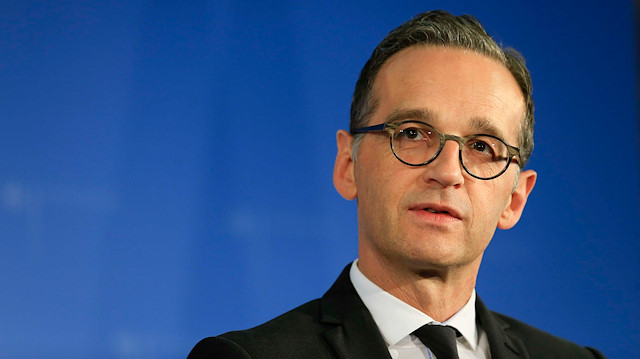
Heiko Maas
German Foreign Minister Heiko Maas will raise human rights issues in Xinjiang province of China on his upcoming visit to the country, his spokesperson said on Friday.
“From our point of view, the situation in Xinjiang is worrying. Foreign Minister Maas will raise the issue with his Chinese counterpart,” Maria Adebahr told a news conference in Berlin.
Adebahr said during the visit beginning on Sunday, delegations will also review preparations for the next human rights dialogue meeting between Germany and China, which is scheduled for December.
Government and opposition lawmakers urged China on Thursday to end repressive policies against Uighur Muslims in northwestern Xinjiang, an autonomous region of the country.The opposition Green Party accused Chinese authorities of severe human rights violations, forced political indoctrination and massive surveillance in the region.“An estimated one million people have been arbitrarily detained in internment camps in China's northwestern Xinjiang region,” Green lawmaker Margarete Bause said during a parliamentary debate on the human rights situation in Xinjiang.She heavily criticized authorities for their clampdown on freedom of religion.“Praying is prohibited, mosques are demolished. The goal of all these measures is to systematically eliminate the culture and identity of the Muslim minority in Xinjiang,” she said.Stefan Liebich from the opposition Left Party said the detention of around one million people in internment camps in Xinjiang was “unacceptable”.China triples spending to expand detention camps for Uighur MuslimsLiebich acknowledged that China’s concerns over stability and the threat of terrorism were understandable.“But these cannot justify mass surveillance, spying, internment camps and torture,” he stressed.Michael Brand, a senior lawmaker from Chancellor Angela Merkel’s Christian Democratic Union, promised that the government would continue to raise human rights issues in talks with Chinese officials.“Under the pretext of the fight against terrorism, brutal repression and human rights violations continue in Xinjiang,” he said.Brand criticized Chinese authorities for claiming that the internment camps were in fact “vocational education centers” and stressed that such explanations were far from being plausible.Chancellor Merkel’s coalition partner the Social Democrat Party (SPD) backed calls on China to close the camps.“When we read the reports of Human Rights Watch, we get the impression that Xinjiang has become an open-air prison,” SPD lawmaker Frank Schwabe said.“We want full transparency. We want to have the opportunity for all UN bodies to be able to visit Xinjiang. We are calling on China to close these camps,” he added.
Muslims in Xinjiang face repression: German parliament
On Thursday, German lawmakers called on China to end repressive policies against Uighur Muslims in northwestern Xinjiang, an autonomous region of the country.
During a debate at the parliament, lawmakers from opposition parties and Chancellor Angela Merkel’s coalition government, urged Chinese authorities to end massive surveillance in the region, and abolish arbitrary detention of up to one million people in internment camps.