

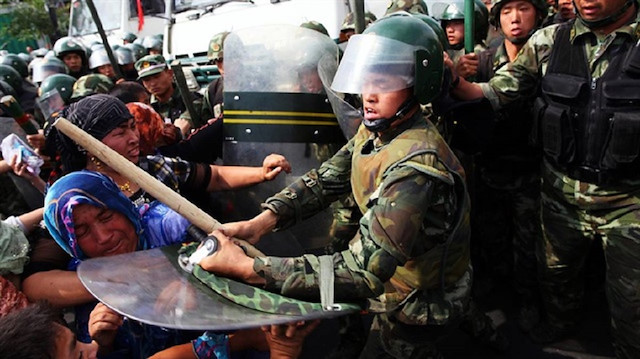
File photo
Government and opposition lawmakers urged China on Thursday to end repressive policies against Uighur Muslims in northwestern Xinjiang, an autonomous region of the country.
The opposition Green Party accused Chinese authorities of severe human rights violations, forced political indoctrination and massive surveillance in the region.
“An estimated one million people have been arbitrarily detained in internment camps in China's northwestern Xinjiang region,” Green lawmaker Margarete Bause said during a parliamentary debate on the human rights situation in Xinjiang.
She heavily criticized authorities for their clampdown on freedom of religion.
“Praying is prohibited, mosques are demolished. The goal of all these measures is to systematically eliminate the culture and identity of the Muslim minority in Xinjiang,” she said.
Stefan Liebich from the opposition Left Party said the detention of around one million people in internment camps in Xinjiang was “unacceptable”.
China has stepped up construction of detention camps for the Muslim Uighur minority as the country’s security spending on its “open air prisons” increased by nearly threefold over last year’s figures.Meanwhile, Chinese spending on security-related construction spiked by nearly 20 billion yuan ($2.9bn), according to a report by the U.S.-based think tank Jamestown Institute.It constituted a 213 percent increase over last year’s spending figures.Many refer to China’s Xinjiang Uighur Autonomous Region -- home to many ethnic minority groups, including Turkic Uighur people -- as East Turkestan.They believe that the Uighur are among a number of Turkic tribes that inhabit the region, and consider it to be part of Central Asia, not China.Camps are being expandedSince the start of 2017, China has expanded its concentration camps to cover an additional 2 million square meters, according to a report by the Australian Strategic Policy Institution (ASPI).Established under the pretext of “political reeducation” for China’s Muslim population, Beijing has amped up its construction of detention camps in the past three months, expanding them by an additional 700,000 square meters, according to satellite imagery.China’s Muslim incarceration camps have attracted heavy criticism from the international community as Beijing continually denied their existence and repeatedly rejected allegations of abuses against the country’s Uighur minority for years, opting to call them “vocational camps” instead.Xinjiang region is home to around 10 million Uighurs. The Turkic Muslim group which makes up around 45 percent of the population of Xinjiang, has long accused China’s authorities for cultural, religious and economic discrimination.
China triples spending to expand detention camps for Uighur Muslims
Liebich acknowledged that China’s concerns over stability and the threat of terrorism were understandable.
“But these cannot justify mass surveillance, spying, internment camps and torture,” he stressed.
Michael Brand, a senior lawmaker from Chancellor Angela Merkel’s Christian Democratic Union, promised that the government would continue to raise human rights issues in talks with Chinese officials.
“Under the pretext of the fight against terrorism, brutal repression and human rights violations continue in Xinjiang,” he said.
Brand criticized Chinese authorities for claiming that the internment camps were in fact “vocational education centers” and stressed that such explanations were far from being plausible.
Chancellor Merkel’s coalition partner the Social Democrat Party (SPD) backed calls on China to close the camps.
“When we read the reports of Human Rights Watch, we get the impression that Xinjiang has become an open-air prison,” SPD lawmaker Frank Schwabe said.
“We want full transparency. We want to have the opportunity for all UN bodies to be able to visit Xinjiang. We are calling on China to close these camps,” he added.