

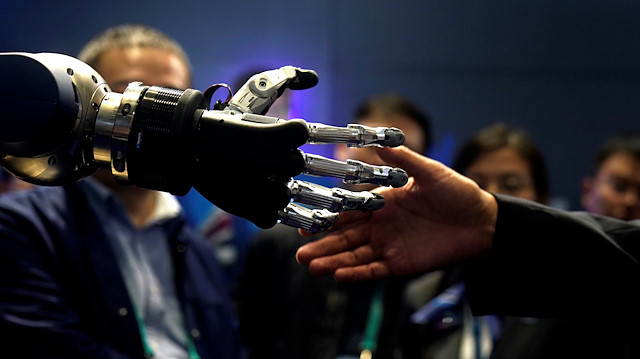
A man tries to shake hands with SCHUNK 5-finger anthropomorphic gripper hand during the China International Import Expo (CIIE), at the National Exhibition and Convention Center in Shanghai, China November 6, 2018.
German car maker Volkswagen AG signed what looked like a meaty deal with one of its China joint ventures this week at a huge new trade show in Shanghai to ship almost $9 billion worth of cars and parts to China next year.
But it turns out the "Memorandum of Cooperation", one of hundreds of deals inked at the China International Import Expo that wraps up on Saturday, represents business as usual for VW.
Two sources close to the company and its FAW-Volkswagen tie-up said the joint venture would have imported the cars and parts with or without the expo to support its day-to-day manufacturing and sales operations, as it does every year. FAW-Volkswagen did not have an immediate comment.
While the giant import fair is a key part of China's response to growing complaints about its commercial policies, critics said the tightly choreographed event was more show than substance that failed to address core issues at the heart of the festering U.S.-China trade war.
China has been violating an agreement with the United States aimed at stopping cyber espionage through the hacking of government and corporate data, a senior U.S. intelligence official said on Thursday.When asked if China was violating the 2015 agreement between then President Barack Obama and Chinese President Xi Jinping, National Security Agency official Rob Joyce said: "We think they are."But he added that the quantity and number of attacks had dropped "dramatically" since the agreement."While it's not black and white, (China) met the agreement or they didn't meet the agreement, it's clear that they are well beyond the bounds today of the agreement that was forged between our countries," Joyce said.How Mattis is trying to keep US-China tensions from boiling overSpeaking in Beijing on Friday, Chinese Foreign Ministry spokeswoman Hua Chunying rejected the U.S. allegations."The U.S. accusations lack factual basis. China firmly opposes them," she told a daily news briefing.China and the United States have important shared interests in cyberspace, Hua said."We urge the U.S. side to cease its baseless criticism of China, and meet China halfway in jointly safeguarding the two countries' momentum for cooperation and communication in the realm of cybersecurity," she said.In September 2015, Obama announced he had reached a "common understanding" with China's Xi on curbing economic cyber espionage, but threatened to impose U.S. sanctions on Chinese hackers who persist in committing cyber crimes.Russia clashes with Western oil buyers over new deals as sanctions loomThe two leaders said they agreed that neither government would knowingly support cyber theft of corporate secrets or business information.The agreement, however, stopped short of any promise to refrain from traditional government-to-government cyber spying for intelligence purposes.That could include the massive hack of the U.S. federal government's personnel office this year that compromised the data of more than 20 million people. U.S. officials have traced that back to China, but have not said whether they believe the Chinese government was responsible.The United States and China will hold a delayed top-level security dialogue on Friday, the latest sign of a thaw in the countries' strained relations amid an ongoing trade row ahead of a planned meeting between U.S. President Donald Trump and Chinese President Xi at the Group of 20 summit meeting in Argentina at the end of November. 
US accuses China of violating bilateral anti-hacking deal
"I don't think we're holding out high hopes for the expo in terms of improving China's trade relationship with the rest of the world," said Duncan Innes-Ker, regional director for Asia at the Economist Intelligence Unit.
"People really want to see a generalised improvement in the fairness of the operating environment, not a specific commitment to importing more in this particular year or whatever."
State media has lavished praise on the event, which was headlined by President Xi Jinping, who provided few specifics in his opening speech about how China would address complaints on issues like market access and intellectual property rights protection.
"The Shanghai expo will act as a demonstration before billions of global observers that China is letting the market play the decisive role in its business operations," the Global Times newspaper said.
When the United States imposed sanctions on China's military this fall, China retaliated by canceling Defense Secretary Jim Mattis' plans to meet his counterpart in Beijing. But just days later, a Chinese general visited the Pentagon with a reassuring message: Beijing valued the importance of military ties between the two countries.In the previously unreported visit, Huang Xueping arrived on Oct. 10 to see Mattis' aides, but the secretary briefly met him in the hallway with a message for Chinese Defense Minister Wei Fenghe. The two were still going to be at a security conference in Singapore later in October, and Mattis told Huang he looked forward to meeting Wei there, said Randall Schriver, the Pentagon's top Asia policy official.Relations between the world's two largest economies have plumbed new depths under President Donald Trump amid a bitter trade war and disagreements over Taiwan, the South China Sea, and other geopolitical flashpoints.Arab League, China to increase energy, gas cooperationWorried that weak ties between major militaries can lead to misunderstandings that snowball into conflict amid tense relations, U.S. officials said Mattis is attempting to forge a relationship with Chinese military leaders.He appears to be getting traction. On Friday, he is set to hold a third meeting with Wei in less than five months, an unusual intensity of top-level contact. Mattis' trip to China in June was the first by a U.S. defense secretary since 2014.Schriver said U.S.-China talks in Washington on Friday will include "risk reduction" efforts that the two countries can undertake, which aim to drive down the chance of an inadvertent clash."We want to make sure that as we compete that it's a benign type of competition (and) doesn't result in something catastrophic," he said.Respect our choices, China's Xi says ahead of Trump G20 meetingRISK OF MISHAPNew military data and recent incidents involving U.S. military activity in the South China Sea and the Taiwan Strait show the defense secretary is walking a fine line. Even as Mattis tries to forge ties to contain crises, the Pentagon is ramping up activity that irritates the Chinese government.In the 12 months ending on Sept. 30, for example, there were six so-called "Freedom of Navigation" operations in the South China Sea, compared with four in the same period of the previous year, a U.S. official told Reuters.Such operations involve sending warships into international waters if they are claimed by other countries. China claims most of the South China Sea and has been militarizing islands there.China triples spending to expand detention camps for Uighur MuslimsThe six operations are equivalent to what the Navy did during the last two years of President Barack Obama's administration.The Pentagon is also running warships through the Taiwan Strait with greater frequency and this year weighed sending an aircraft carrier through the narrow waterway, U.S. officials said. China claims Taiwan as its own and sees U.S overtures to self-ruled Taiwan as meddling in its internal affairs.Susan Thornton, who until July was the State Department's top Asia adviser, said the increased military activity is ratcheting up the risks."We are doing things that are frankly more aggressive, and the Chinese are pushing back harder than they ever have before," Thornton said. "The risk of a mishap is growing."Schriver acknowledged that it was hard to predict how resilient U.S.-Chinese military ties would be in an actual crisis. "I guess we won't know until there's a crisis, and it's tested," he said.Moody’s sees escalation of US-China trade war, dip in global growth"WISE MAN"China is becoming more assertive militarily. On Sept. 30, for example, a Chinese ship came within 45 yards of a U.S. Navy destroyer in international waters in the South China Sea. The Chinese ship put bumpers on its side, suggesting it expected a possible collision when it ran the maneuver."You don't do that when you're out in the middle of the ocean, unless you're intending to run into something," Mattis told reporters last month.At the same time, China's defense ministry has said it hopes the military relationship can become a "stabilizer" for overall ties, and officials have suggested that Beijing has more confidence in Mattis than some other top Trump administration officials.One Chinese official said Beijing regards Mattis as a "wise man," experienced enough in war to know that it is best to avoid armed conflict.The Chinese defense ministry did not respond to a request for comment.China pledges $150 million aid to El Salvador as relationship deepensCOMPETITOR, NOT ENEMYThornton said Mattis' China contacts, while helpful, would not be enough to bridge gaps elsewhere in the Trump administration in the event of a crisis. Further, if Mattis were to leave, his successor would need time to come up to speed, a dangerous prospect at a time of heightened tensions, she said.Mattis' departure from the cabinet has been the subject of media speculation, although both Mattis and Trump have dismissed the idea.When Mattis flew to Beijing in June, he got an earful from China's military about the Pentagon's decision to describe China as a "strategic competitor" militarizing the South China Sea in a key Pentagon policy document.In his closed-door talks, Mattis defended the description, saying the Pentagon chose those words carefully, knowing they would be scrutinized in Beijing, said the U.S. officials who heard the exchange."Competitor is not adversary. It's not enemy," Schriver said, explaining Mattis' position.The two sides have met on other occasions as well for confidence-building measures. The top U.S. general, Joe Dunford, said this week that the U.S. and China held a "table-top" exercise about four months ago, where the two sides discussed various potential crisis scenarios.The goal of the exercise, Dunford said, was to reduce the risk of miscalculation during a crisis.Speaking at a Washington event last week, Mattis said, "I think that 15 years from now we will be remembered most for: How did we set the conditions for a positive relationship with China?"
How Mattis is trying to keep US-China tensions from boiling over
The expo's organisers were less laissez faire, and the heavy hand of the state, from stifling security to pressure on state-owned enterprises to do deals, was ever-present.
Schools were closed across Shanghai, a city of more than 24 million people, on the first two days of the expo and cars without special passes were blocked from approaching the enormous clover-shaped exhibition hall.
Inside, guards and police blanketed the venue and lined walkways to and from the subway. Participants were required to undergo airport-level security and a long list of items, from daggers to Frisbees, were banned.
"I'm not sure what they are trying to protect with all of this security," one foreign industry VIP said.
Hundreds of student volunteers in red blazers offered directions around the venue, which boasts an exhibition area roughly the size of 40 football pitches and a multi-storey maze of roads, meeting rooms, offices and restaurants.
One Reuters journalist clocked more than 17,000 steps of walking at the expo in one day, or roughly 12 km.
ACTORS AND OLD DEALS
Many of the deals touted at the fair, like Volkswagen's, appeared to be either business agreements that would not ordinarily warrant publicity, or the announcement of previously agreed contracts, according to executives.
After one signing, a foreign participant told Reuters that he had nothing to do with the company he was representing.
"Everything you saw at the signing ceremony was theatre or farce. I'm essentially an actor, hired for the duration of the expo, in order to give the impression of international cooperation," the person said, asking not to be named.
Chinese companies have been known to hire foreigners to impersonate executives at events, presumably to lend an air of international legitimacy.
On Wednesday at the expo, China's state-run offshore oil and gas company CNOOC Ltd signed 20 deals with foreign businesses, including Siemens, Caterpillar and Schlumberger.
Two people involved in the signings said the deals were non-binding "memoranda of understanding", or letters of intent, with existing partners. CNOOC executives declined to provide details.
Merck Group's CEO for performance materials, Kai Beckmann, said deals aren't everything.
"For us as a global company, any signal that promotes free trade and global collaboration is highly appreciated and welcome, and this platform was used for that purpose," he said.
"In the old days, these kinds of exhibitions and trade fairs were used to sign deals. But now you do the deals through e-commerce and you don't need trade fairs for that."
The strategy for some of the more than 180 American companies at the expo seemed to be to wait and see.
"We will continue to do what we are doing and hopefully that will resolve itself between both of our governments," said Henry Irizarry, a vice president at Jeanerette, Louisiana-based Metal Shark Boats, referring to the China-U.S. trade war.
At the media centre, a robot on wheels named 'Xiao Bao', or Little Leopard, scooted to and fro, showing reporters to the bathroom and answering basic questions.
Asked where Xi Jinping was, Xiao Bao could give a rundown of news of the day involving the Chinese leader.
It was unable to respond when asked multiple times how the China-U.S. trade conflict could be resolved.