

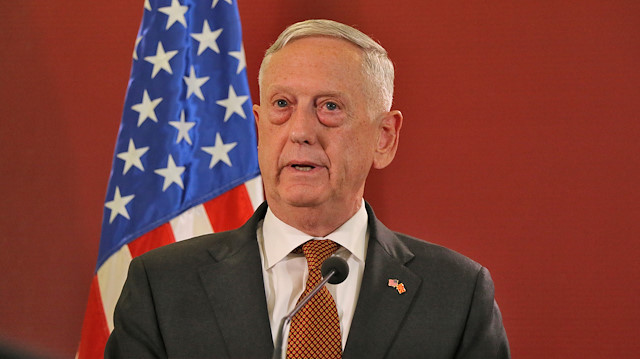
U.S. Defense Secretary Jim Mattis
When the United States imposed sanctions on China's military this fall, China retaliated by canceling Defense Secretary Jim Mattis' plans to meet his counterpart in Beijing. But just days later, a Chinese general visited the Pentagon with a reassuring message: Beijing valued the importance of military ties between the two countries.
In the previously unreported visit, Huang Xueping arrived on Oct. 10 to see Mattis' aides, but the secretary briefly met him in the hallway with a message for Chinese Defense Minister Wei Fenghe. The two were still going to be at a security conference in Singapore later in October, and Mattis told Huang he looked forward to meeting Wei there, said Randall Schriver, the Pentagon's top Asia policy official.
Relations between the world's two largest economies have plumbed new depths under President Donald Trump amid a bitter trade war and disagreements over Taiwan, the South China Sea, and other geopolitical flashpoints.
The Arab League and China agreed to strengthen cooperation in the field of natural gas, renewables and energy efficiency on the basis of mutual interest and experience sharing, a joint statement announced on Thursday.According to the joint statement issued after the Arab-China Cooperation Conference in Egypt's capital Cairo, which is currently running between Nov. 5 and 8, the Arab Union and China agreed to strengthen cooperation in electricity, natural gas and renewable energy.Both parties agreed to strengthen cooperation for energy efficiency and support small and medium-sized institutions working in this area. They also decided to increase energy security and reduce the environmental impact of energy consumption, according to the statement."The importance of strengthening mutual cooperation is emphasized by the fact that Arab countries have about half of the world's oil reserves and China has modern technologies in oil exploration, transportation, refining and manufacturing," the statement read.By end of 2019 TurkStream will be operational: GazpromArab countries are the most important source of crude oil for Beijing.In 2016, the bilateral trade volume between Arab countries and China totaled $171 billion. China's exports to the Arab countries accounted for $101 billion, while the volume of Arab countries' exports to China was $70 billion.Beijing, in its efforts to attain a more prominent global role, launched 'Belt and Road' initiative (BRI), which aims at creating trade routes and relations from China to deep in Europe similar to Silk Road. China invested billions of dollars and promised to pour more to mainly infrastructure, transport and other projects to link the destination countries to its trade centers.The cooperation with the Arab countries is in line with its policy of projecting power and creating clout trough direct and indirect investments.Respect our choices, China's Xi says ahead of Trump G20 meetingChina's great investment in Middle EastIn recent years, Beijing has boosted cooperation with Arab countries given the important role they play in BRI. Arab countries, as natural partners of the BRI, link several countries. Therefore, the region is critical to the BRI’s success and in order to contribute to the region’s stability, China puts emphasis on its development.According to international media, Chinese President Xi Jinping at the Beijing Summit in July in which 21 Arab countries participated, pledged a package of $20 billion in loans, and about $106 million in financial aid, as part of what he called an "oil and gas plus" model to spur economic growth in the region.Xi also underlined at the summit that Beijing sought to increase cooperation in the field of renewable energy and hydrocarbons.
Arab League, China to increase energy, gas cooperation
Worried that weak ties between major militaries can lead to misunderstandings that snowball into conflict amid tense relations, U.S. officials said Mattis is attempting to forge a relationship with Chinese military leaders.
He appears to be getting traction. On Friday, he is set to hold a third meeting with Wei in less than five months, an unusual intensity of top-level contact. Mattis' trip to China in June was the first by a U.S. defense secretary since 2014.
Schriver said U.S.-China talks in Washington on Friday will include "risk reduction" efforts that the two countries can undertake, which aim to drive down the chance of an inadvertent clash.
"We want to make sure that as we compete that it's a benign type of competition (and) doesn't result in something catastrophic," he said.
China wants to resolve problems with the United States through talks but it must respect China's choice of development path and interests, President Xi Jinping said on Thursday ahead of a meeting with the U.S. leader in Argentina.China and the United States have put tariffs on hundreds of billions of dollars of each other's goods and U.S. President Donald Trump has threatened to set tariffs on the remainder of China's $500 billion-plus exports to the United States if their blistering trade dispute cannot be resolved.Trump's administration has also accused China of interfering in U.S. politics, charges China strongly denies, and the two have sparred over the disputed South China Sea and self-ruled Taiwan, which China claims.Still, Trump and Xi plan to meet on the sidelines of a G20 summit, which is being held in Argentina at the end of November and early December, for high-stakes talks as the two countries try tentatively to get ties back on track.Moody’s sees escalation of US-China trade war, dip in global growthMeeting former U.S. Secretary of State Henry Kissinger in Beijing, Xi said he and Trump would have a "deep exchange of views" in Argentina, the official Xinhua news agency reported.China and the United States should correctly judge each other's strategic intentions, and while China wanted to resolve problems via talks, the United States should respect China's choice of development path and legitimate interests, Xi added.Xi said attention should be paid to "the increase in negative voices related to China in the United States", without elaborating.Speaking earlier, the Chinese government's top diplomat, State Councillor Wang Yi, said Xi and Trump reached an important consensus on the healthy and stable development of bilateral ties in a telephone call last week.China pledges $150 million aid to El Salvador as relationship deepensTheir meeting at the G20 summit would be of "great significance" in resolving bilateral problems, Wang said."That will be of great significance for both sides to manage differences effectively and resolve issues in a practical way," Wang told reporters.Wang said China stood ready to work with the United States to remove disruptions, build trust and prepare fully for the meeting."We believe that meeting will help chart the course for China-U.S. relations," he said, following talks with Australian Foreign Minister Marise Payne.Wang added that the more complex the situation is, the more important it is for both sides to remain "level-headed".Senior China diplomat says US, China can resolve trade dispute through talksXI-TRUMP CALLRelations between the two countries have warmed since the Xi-Trump telephone call, laying the ground for their G20 meeting.In a further sign of improving ties, Chinese Politburo member Yang Jiechi and Defence Minister Wei Fenghe are set to hold a security and diplomatic dialogue with U.S. officials in Washington on Friday.Meeting U.S. national security adviser John Bolton in Washington ahead of those talks, Yang said on Wednesday that the two sides should "properly manage differences and carefully prepare to ensure positive results in the Argentina meeting", China's Foreign Ministry said in a statement."China is committed to working with the U.S. to achieve a no-confrontational, conflict-free, mutually respectful co-operation in which both sides win," added Yang, who heads the ruling Communist Party's foreign affairs commission and outranks Wang.However, speaking in Singapore at a forum on Wednesday, former U.S. Treasury Secretary Henry Paulson said there was a risk of an economic "Iron Curtain" falling between China and the United States unless China carried out reforms and that some people in the United States would like to "divorce" China.Beijing can help avoid this happening by ending practices like forced technology transfers, and providing better protection for intellectual property, and by also genuinely allowing market forces to drive key decisions."If China doesn't move quickly, I suspect the calls for divorce will intensify," Paulson said. 
Respect our choices, China's Xi says ahead of Trump G20 meeting
RISK OF MISHAP
New military data and recent incidents involving U.S. military activity in the South China Sea and the Taiwan Strait show the defense secretary is walking a fine line. Even as Mattis tries to forge ties to contain crises, the Pentagon is ramping up activity that irritates the Chinese government.
In the 12 months ending on Sept. 30, for example, there were six so-called "Freedom of Navigation" operations in the South China Sea, compared with four in the same period of the previous year, a U.S. official told Reuters.
Such operations involve sending warships into international waters if they are claimed by other countries. China claims most of the South China Sea and has been militarizing islands there.
China has stepped up construction of detention camps for the Muslim Uighur minority as the country’s security spending on its “open air prisons” increased by nearly threefold over last year’s figures.Meanwhile, Chinese spending on security-related construction spiked by nearly 20 billion yuan ($2.9bn), according to a report by the U.S.-based think tank Jamestown Institute.It constituted a 213 percent increase over last year’s spending figures.Many refer to China’s Xinjiang Uighur Autonomous Region -- home to many ethnic minority groups, including Turkic Uighur people -- as East Turkestan.They believe that the Uighur are among a number of Turkic tribes that inhabit the region, and consider it to be part of Central Asia, not China.Camps are being expandedSince the start of 2017, China has expanded its concentration camps to cover an additional 2 million square meters, according to a report by the Australian Strategic Policy Institution (ASPI).Established under the pretext of “political reeducation” for China’s Muslim population, Beijing has amped up its construction of detention camps in the past three months, expanding them by an additional 700,000 square meters, according to satellite imagery.China’s Muslim incarceration camps have attracted heavy criticism from the international community as Beijing continually denied their existence and repeatedly rejected allegations of abuses against the country’s Uighur minority for years, opting to call them “vocational camps” instead.Xinjiang region is home to around 10 million Uighurs. The Turkic Muslim group which makes up around 45 percent of the population of Xinjiang, has long accused China’s authorities for cultural, religious and economic discrimination.
China triples spending to expand detention camps for Uighur Muslims
The six operations are equivalent to what the Navy did during the last two years of President Barack Obama's administration.
The Pentagon is also running warships through the Taiwan Strait with greater frequency and this year weighed sending an aircraft carrier through the narrow waterway, U.S. officials said. China claims Taiwan as its own and sees U.S overtures to self-ruled Taiwan as meddling in its internal affairs.
Susan Thornton, who until July was the State Department's top Asia adviser, said the increased military activity is ratcheting up the risks.
"We are doing things that are frankly more aggressive, and the Chinese are pushing back harder than they ever have before," Thornton said. "The risk of a mishap is growing."
Schriver acknowledged that it was hard to predict how resilient U.S.-Chinese military ties would be in an actual crisis. "I guess we won't know until there's a crisis, and it's tested," he said.
Credit rating agency Moody’s warned on Thursday that global economic growth was likely to slow in the next two years and that it expected the trade war between the United States and China to escalate further."We expect global growth to slow to under 3.0 percent in 2019 and 2020, from an estimated 3.3 percent in 2017-18," the agency said in a new report.It added that the recently imposed tariffs on $200 billion worth of Chinese goods were likely to rise to 25 percent in January from their current 10 percent level."In both countries, the overall direct macro impact on growth will be manageable. However, persistent and broadening tensions between the two largest economies globally are increasingly likely to have widespread negative implications by undermining investment," Moody's said. China pledges $150 million aid to El Salvador as relationship deepensSenior China diplomat says US, China can resolve trade dispute through talks
Moody’s sees escalation of US-China trade war, dip in global growth
"WISE MAN"
China is becoming more assertive militarily. On Sept. 30, for example, a Chinese ship came within 45 yards of a U.S. Navy destroyer in international waters in the South China Sea. The Chinese ship put bumpers on its side, suggesting it expected a possible collision when it ran the maneuver.
"You don't do that when you're out in the middle of the ocean, unless you're intending to run into something," Mattis told reporters last month.
At the same time, China's defense ministry has said it hopes the military relationship can become a "stabilizer" for overall ties, and officials have suggested that Beijing has more confidence in Mattis than some other top Trump administration officials.
One Chinese official said Beijing regards Mattis as a "wise man," experienced enough in war to know that it is best to avoid armed conflict.
The Chinese defense ministry did not respond to a request for comment.
China will give El Salvador $150 million to spur development of social and technological projects, the Salvadoran president said on Wednesday, the latest sign of deepening ties between the countries that has alarmed the United States.Salvadoran President Salvador Sanchez Ceren is returning from his first trip to China since the countries established diplomatic ties in August. Speaking on local television, Ceren said he met with Chinese President Xi Jinping during the visit and agreed to 13 joint projects, without providing details.The donation marks China's latest gambit to make inroads in Central America, a campaign that has drawn the ire of the United States.Earlier this year, El Salvador cut diplomatic ties with Taiwan in favor of China, following the Dominican Republic and Panama. The United States promptly recalled its ambassadors in the region."This historic meeting between the governments of the People's Republic of China and the Republic of El Salvador has produced excellent results," Ceren said. "This confirms that the establishment of diplomatic relations with China is my government's most important decision in foreign policy."Senior China diplomat says US, China can resolve trade dispute through talksSpeaking in Beijing, Chinese Foreign Ministry spokeswoman Hua Chunying said the two countries had agreed to a series of cooperation projects, including in infrastructure and education, when the two presidents met in China last week."The friendly cooperation between China and El Salvador is developing smoothly and rapidly," Hua told a daily news briefing."China is willing to provide what help it can for El Salvador's economic and social development. The relevant help will be focused on people's pressing welfare needs in El Salvador," she added.The date when the funds will be received has not been set, a spokesman for the Salvadoran government said.China will also donate three thousand tons of rice to support Salvadorans who are reeling from a drought in July and floods in October, Ceren said.The White House warned in August that China was luring countries with incentives that "facilitate economic dependence and domination, not partnership."Self-ruled Taiwan has formal relations with a dwindling number of countries, almost all of them small and less developed nations in Central America and the Pacific. 
China pledges $150 million aid to El Salvador as relationship deepens
COMPETITOR, NOT ENEMY
Thornton said Mattis' China contacts, while helpful, would not be enough to bridge gaps elsewhere in the Trump administration in the event of a crisis. Further, if Mattis were to leave, his successor would need time to come up to speed, a dangerous prospect at a time of heightened tensions, she said.
Mattis' departure from the cabinet has been the subject of media speculation, although both Mattis and Trump have dismissed the idea.
When Mattis flew to Beijing in June, he got an earful from China's military about the Pentagon's decision to describe China as a "strategic competitor" militarizing the South China Sea in a key Pentagon policy document.
In his closed-door talks, Mattis defended the description, saying the Pentagon chose those words carefully, knowing they would be scrutinized in Beijing, said the U.S. officials who heard the exchange.
"Competitor is not adversary. It's not enemy," Schriver said, explaining Mattis' position.
The two sides have met on other occasions as well for confidence-building measures. The top U.S. general, Joe Dunford, said this week that the U.S. and China held a "table-top" exercise about four months ago, where the two sides discussed various potential crisis scenarios.
The goal of the exercise, Dunford said, was to reduce the risk of miscalculation during a crisis.
Speaking at a Washington event last week, Mattis said, "I think that 15 years from now we will be remembered most for: How did we set the conditions for a positive relationship with China?"