

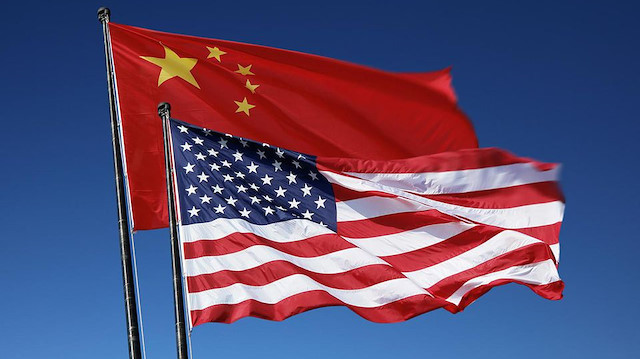
File photo
China has been violating an agreement with the United States aimed at stopping cyber espionage through the hacking of government and corporate data, a senior U.S. intelligence official said on Thursday.
When asked if China was violating the 2015 agreement between then President Barack Obama and Chinese President Xi Jinping, National Security Agency official Rob Joyce said: "We think they are."
But he added that the quantity and number of attacks had dropped "dramatically" since the agreement.
"While it's not black and white, (China) met the agreement or they didn't meet the agreement, it's clear that they are well beyond the bounds today of the agreement that was forged between our countries," Joyce said.
When the United States imposed sanctions on China's military this fall, China retaliated by canceling Defense Secretary Jim Mattis' plans to meet his counterpart in Beijing. But just days later, a Chinese general visited the Pentagon with a reassuring message: Beijing valued the importance of military ties between the two countries.In the previously unreported visit, Huang Xueping arrived on Oct. 10 to see Mattis' aides, but the secretary briefly met him in the hallway with a message for Chinese Defense Minister Wei Fenghe. The two were still going to be at a security conference in Singapore later in October, and Mattis told Huang he looked forward to meeting Wei there, said Randall Schriver, the Pentagon's top Asia policy official.Relations between the world's two largest economies have plumbed new depths under President Donald Trump amid a bitter trade war and disagreements over Taiwan, the South China Sea, and other geopolitical flashpoints.Arab League, China to increase energy, gas cooperationWorried that weak ties between major militaries can lead to misunderstandings that snowball into conflict amid tense relations, U.S. officials said Mattis is attempting to forge a relationship with Chinese military leaders.He appears to be getting traction. On Friday, he is set to hold a third meeting with Wei in less than five months, an unusual intensity of top-level contact. Mattis' trip to China in June was the first by a U.S. defense secretary since 2014.Schriver said U.S.-China talks in Washington on Friday will include "risk reduction" efforts that the two countries can undertake, which aim to drive down the chance of an inadvertent clash."We want to make sure that as we compete that it's a benign type of competition (and) doesn't result in something catastrophic," he said.Respect our choices, China's Xi says ahead of Trump G20 meetingRISK OF MISHAPNew military data and recent incidents involving U.S. military activity in the South China Sea and the Taiwan Strait show the defense secretary is walking a fine line. Even as Mattis tries to forge ties to contain crises, the Pentagon is ramping up activity that irritates the Chinese government.In the 12 months ending on Sept. 30, for example, there were six so-called "Freedom of Navigation" operations in the South China Sea, compared with four in the same period of the previous year, a U.S. official told Reuters.Such operations involve sending warships into international waters if they are claimed by other countries. China claims most of the South China Sea and has been militarizing islands there.China triples spending to expand detention camps for Uighur MuslimsThe six operations are equivalent to what the Navy did during the last two years of President Barack Obama's administration.The Pentagon is also running warships through the Taiwan Strait with greater frequency and this year weighed sending an aircraft carrier through the narrow waterway, U.S. officials said. China claims Taiwan as its own and sees U.S overtures to self-ruled Taiwan as meddling in its internal affairs.Susan Thornton, who until July was the State Department's top Asia adviser, said the increased military activity is ratcheting up the risks."We are doing things that are frankly more aggressive, and the Chinese are pushing back harder than they ever have before," Thornton said. "The risk of a mishap is growing."Schriver acknowledged that it was hard to predict how resilient U.S.-Chinese military ties would be in an actual crisis. "I guess we won't know until there's a crisis, and it's tested," he said.Moody’s sees escalation of US-China trade war, dip in global growth"WISE MAN"China is becoming more assertive militarily. On Sept. 30, for example, a Chinese ship came within 45 yards of a U.S. Navy destroyer in international waters in the South China Sea. The Chinese ship put bumpers on its side, suggesting it expected a possible collision when it ran the maneuver."You don't do that when you're out in the middle of the ocean, unless you're intending to run into something," Mattis told reporters last month.At the same time, China's defense ministry has said it hopes the military relationship can become a "stabilizer" for overall ties, and officials have suggested that Beijing has more confidence in Mattis than some other top Trump administration officials.One Chinese official said Beijing regards Mattis as a "wise man," experienced enough in war to know that it is best to avoid armed conflict.The Chinese defense ministry did not respond to a request for comment.China pledges $150 million aid to El Salvador as relationship deepensCOMPETITOR, NOT ENEMYThornton said Mattis' China contacts, while helpful, would not be enough to bridge gaps elsewhere in the Trump administration in the event of a crisis. Further, if Mattis were to leave, his successor would need time to come up to speed, a dangerous prospect at a time of heightened tensions, she said.Mattis' departure from the cabinet has been the subject of media speculation, although both Mattis and Trump have dismissed the idea.When Mattis flew to Beijing in June, he got an earful from China's military about the Pentagon's decision to describe China as a "strategic competitor" militarizing the South China Sea in a key Pentagon policy document.In his closed-door talks, Mattis defended the description, saying the Pentagon chose those words carefully, knowing they would be scrutinized in Beijing, said the U.S. officials who heard the exchange."Competitor is not adversary. It's not enemy," Schriver said, explaining Mattis' position.The two sides have met on other occasions as well for confidence-building measures. The top U.S. general, Joe Dunford, said this week that the U.S. and China held a "table-top" exercise about four months ago, where the two sides discussed various potential crisis scenarios.The goal of the exercise, Dunford said, was to reduce the risk of miscalculation during a crisis.Speaking at a Washington event last week, Mattis said, "I think that 15 years from now we will be remembered most for: How did we set the conditions for a positive relationship with China?"
How Mattis is trying to keep US-China tensions from boiling over
Speaking in Beijing on Friday, Chinese Foreign Ministry spokeswoman Hua Chunying rejected the U.S. allegations.
"The U.S. accusations lack factual basis. China firmly opposes them," she told a daily news briefing.
China and the United States have important shared interests in cyberspace, Hua said.
"We urge the U.S. side to cease its baseless criticism of China, and meet China halfway in jointly safeguarding the two countries' momentum for cooperation and communication in the realm of cybersecurity," she said.
In September 2015, Obama announced he had reached a "common understanding" with China's Xi on curbing economic cyber espionage, but threatened to impose U.S. sanctions on Chinese hackers who persist in committing cyber crimes.
Russian energy majors are putting pressure on Western oil buyers to use euros instead of dollars for payments and introducing penalty clauses in contracts as Moscow seeks protection against possible new U.S. sanctions.Seven industry sources told Reuters that Western oil majors and trading houses have clashed with Russia's third and fourth biggest producers, Gazprom Neft and Surgutneftegaz, over 2019 oil sales contract terms during unusually tough annual renegotiation in recent weeks.The development mirrors a similar stand-off between Western buyers and Russia's top oil producer, Rosneft.Earlier this week, trading sources told Reuters that Rosneft wants Western oil buyers to pay penalties from 2019 if they fail to pay for supplies in the event that new U.S. sanctions disrupt sales.Arab League, China to increase energy, gas cooperationNow sources have told Reuters that Surgutneftegaz and Gazprom Neft have also clashed with their buyers over penalties and the use of euros and other currencies to replace the dollar in contracts."It is part of the same trend - the Russian oil industry is working on mitigating new sanctions risks. The buyers in turn argue they cannot carry those risks so we are trying to find compromises," said one source with a Western buyer involved in negotiations, asking not to be named as the talks are confidential.Russia has been under U.S. and EU sanctions since 2014 when it invaded Ukraine's Crimean peninsula. The sanctions have been repeatedly widened to include new companies and sectors, making it tough for Russian oil firms to borrow money abroad, raise new capital or develop Arctic and unconventional deposits.President Vladimir Putin's administration has been hoping for a thaw in relations with the United States since President Donald Trump came to power but Washington has imposed new sanctions instead, including on some of Russia's richest people.Turkey can benefit from US sanctions on Iran: DiplomatRussian businesses are preparing for a new wave of sanctions expected in the coming weeks. The firms are trying to diversify away from dollar payments and tapping Asia for more of their financing and technology needs.According to four industry sources, Surgutneftegaz asked buyers to be prepared to switch from dollar to euro payments in contracts, and insisted on buyers being effectively responsible for any losses arising from sanctions."They basically said - sanctions don't matter. Buyers have to find a way to pay, or to return purchased goods, or pay penalties," a source with a big trading house said.Gazprom Neft has also asked buyers to use euros in payments and bear financial responsibility for contract breaches in the case of new sanctions, according to three sources.Gazprom Neft refused to comment. Surgutneftegaz did not immediately respond to a Reuters request for comment.Norwegian oil, gas plants shut after tanker, frigate collide"JUST LIKE IRAN"Russia supplies over 10 percent of global oil, so drastic sanctions against it could lead to a steep spike in oil prices.All global oil majors rely on Russia to feed their refineries, especially in Europe and Asia, and hence they cannot just walk away from annual contract negotiations if they are unhappy with terms.Talks with both Gazprom Neft and Surgutneftegaz have been progressing slowly and painfully, according to trading sources.Several Western buyers have managed to agreed compromises with Surgutneftegaz and Gazprom Neft, but others are still in tough talks with the producers, the sources said.All Surgutneftegaz's contracts are bespoke and are negotiated individually in the Siberian town of Surgut by the firm's management and visiting Western trading bosses.The sources declined to name companies that have already reached compromise deals.In one such compromise, a large European buyer agreed to the use of euros in payments in exchange for Surgutneftegaz dropping its demand for penalties from buyers who fail to pay for cargoes."We have been arguing that if sanctions make it impossible to pay for an oil cargo, how on earth are we supposed to pay penalties," one trading source said."So we have agreed that the payment remains suspended for the entire duration of sanctions - just like it works with Iran," he added. 
Russia clashes with Western oil buyers over new deals as sanctions loom
The two leaders said they agreed that neither government would knowingly support cyber theft of corporate secrets or business information.
The agreement, however, stopped short of any promise to refrain from traditional government-to-government cyber spying for intelligence purposes.
That could include the massive hack of the U.S. federal government's personnel office this year that compromised the data of more than 20 million people. U.S. officials have traced that back to China, but have not said whether they believe the Chinese government was responsible.
The United States and China will hold a delayed top-level security dialogue on Friday, the latest sign of a thaw in the countries' strained relations amid an ongoing trade row ahead of a planned meeting between U.S. President Donald Trump and Chinese President Xi at the Group of 20 summit meeting in Argentina at the end of November.