

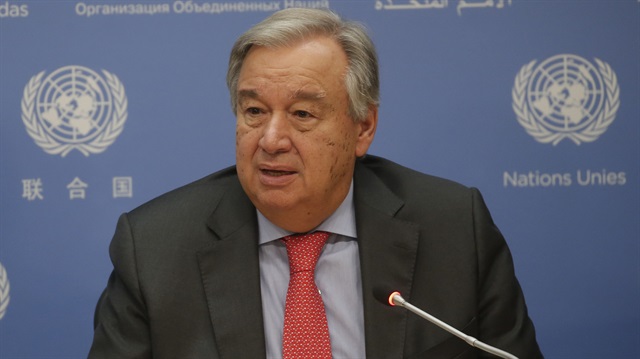
Antonio Guterres
The UN on Thursday called for the full implementation of a Turkish-Russian agreement that would avert widespread violence in northwestern Syria's Idlib province.
"If properly implemented, this could save 3 million civilians – including 1 million children – from catastrophe," Secretary General Antonio Guterres told reporters at the UN's New York headquarters.
"I call on all the parties to implement the agreement with a strong commitment to the protection of civilians, and to ensure humanitarian access, adhere to international humanitarian law and work urgently for greater progress in the Geneva process, in particular supporting my special envoy in the creation of a constitutional committee," Guterres added.
Turkey will continue its counter-terrorism activities in Syria, according to a declaration issued by the country’s National Security Council's Thursday.According to the declaration, Turkey is determined to continue its increasing activities to “eliminate terrorism in Syria’s other regions.”It called on international community to fulfill its political and humanitarian responsibilities more quickly and effectively.Turkey expects the implementations of an agreed roadmap to clear Syrian city of Manbij from the terrorist organization, it said.On Tuesday, a U.S. military spokesman said Washington is sticking to its agreement with Turkey on a roadmap for the northern Syrian city of Manbij, and not including the PKK/YPG.Col. Sean J. Ryan, the spokesman for the U.S.-led Combined Joint Task Force, emphasized there are little elements of the YPG left in the area."As far as I'm tracking, there's very little YPG if any at all. And we are adhering to that agreement that the YPG will not be part of Manbij," Ryan told Anadolu Agency.Turkey and the U.S. conducted more than 40 rounds of separate coordinated patrols in the region between areas liberated by Turkey's Operation Euphrates Shield and Manbij, according to Turkish officials.Separate patrols by Turkish and U.S. troops in the region began June 18, however, joint patrols have yet to be conducted.The YPG is a Syrian branch of the terrorist organization PKK and the focus of Turkey's counter-terrorist Operation Olive Branch in Afrin, Syria, near the border with Turkey.In its more than 30-year terror campaign against Turkey, the PKK -- listed as a terrorist organization by Turkey, the U.S. and the EU -- has been responsible for the death of some 40,000 people, including those of women and children.The declaration also pointed out the importance of Turkey-Russia agreement that called for demilitarization of the Syrian city of Idlib.Syria’s Idlib under siege by foreign terroristsTurkey’s presidency submits motion on Iraq, SyriaRussia says Israel must provide more data on plane downing near SyriaTurkish foundation ready for Syrian migration waveIsrael to improve coordination with Moscow over Syria after plane crashUK thanks Turkey for its 'longstanding role' in Syria
Turkey to continue anti-terror activities in Syria
Ankara and Moscow signed an agreement Monday that calls for the demilitarization of Idlib, following a summit in Russia's coastal Black Sea town of Sochi.
Opposition groups in Idlib will remain in areas in which they are already present, while Russia and Turkey will conduct joint patrols in the area with a view to preventing any renewal of fighting.
Turkish and Russian military forces, meanwhile, will conduct joint patrols along the zone's perimeter.
Iran has at least 120,000 foreign terrorists fighting in alliance with the Bashar al-Assad regime in Syria since the civil war began in 2011. Some 22 groups surrounded Idlib from three directions, and are currently present in 232 points. For a long time, the Assad regime has been conducting its military operations against the opponents in Syria not through its own army, but mainly through Iran-backed foreign forces. These groups are stationed predominantly in Idlib, Damascus, Homs, the countryside of Deir-Ez Zor and particularly on the Lebanese border. According to the information compiled by Anadolu Agency reporters from media outlets of Iran-backed foreign terrorist groups, Iranian media and opponents in Syria; the Tehran administration started sending militias to Syria in the first months of 2014. Details of Turkish-Russian Idlib deal revealedSyrian opponents also fought with Iran-backed Hezbollah militias before. Hezbollah first gave support to the regime during its operations near the Lebanese border late 2012. Six months later, the group announced its entity and support to the regime in al-Qusayr district of the countryside of Homs. During this period, commanders of the Iranian Revolutionary Guards were regarded as “consultants” in conflict zones and military educations fields, while the soldiers of the guards were regarded as “fighters.”Apart from being involved in the war physically, the Revolutionary Guards provided training and logistic support to militias fighting in Syria. UK thanks Turkey for its 'longstanding role' in SyriaIran’s involvement increase after opponents take Idlib The involvement of the Iranian forces to the conflict field on the side of the Assad regime has intensified after the Syrian opponents took complete control of Idlib and came close to Latakia in early 2015. Early 2015, Bashar al-Assad confessed that his army was in a difficult situation and the numbers of the soldiers decreased. The Iranian army and intelligence, which wanted to keep the regime alive, had tens of thousands of terrorist fighters -- brought from Iraq, Lebanon, Afghanistan, and Pakistan -- enter Syria. These forces actually took the active role in Madaya, al-Zabadani and Barada Valley -- where deaths occurred from starvation and tens of thousands of civilians were blockaded. The militias planted mines near residential areas, depriving civilians from humanitarian aid. As the humanitarian tragedy was beyond endurance, locals and civilian opponents had to flee the region. Thus, the mandatory evacuation process started. Turkish-made drones to monitor implementation of Idlib agreementMost conflicts erupted in Aleppo Iran-backed forces conducted their most intensive attacks on Aleppo, where they were settled since early 2014. The forces surrendered Aleppo to the regime following a 4 month-tragedy, where hundreds of thousands of people were living under siege. The forces evacuated the entire Homs, Eastern Ghouta, Dara and Quneitra regions within 4 months, via the attack-blockade-deportation method. Iran-backed foreign terrorist groups then headed towards Idlib. The groups piling up for the last three months blockaded Idlib from the east, west and the south. Syrians ‘still need our help’: UN aid coordinatorHalf of Iran-backed groups in Syria focused on IdlibIt is known that more than 120,000 Iran-backed groups exist in Syria. Nearly half of these forces are already stationed around Idlib. 22 Iran-backed foreign terrorist groups surrounding Idlib’s de-escalation zone from three directions are present in 232 different points. 12 groups stationed in the east of Idlib and western Aleppo are as follows:Afghan-origin Fatemiyoun and Pakistan-origin Zainabiyoun brigades, Iraqi-origin al-Nujaba movement, Badr Forces, Imam Ali and Imam Hossein Brigades, Lebanese Hezbollah, Bakr Brigades, Iranian-origin Quds forces and Mahdi Army, Syrian Galibiyyun Brigades and Owner of Rights Units. Demilitarization agreement heartens civilians in IdlibIn Syria, there are other groups as well; such as Iranian-origin Basij Brigades, Liwa Zainebiyoun Brigades, Palestinian-origin Quds Brigades, Iranian Revolutionary Guards and its special forces. According to the sources speaking to an Anadolu Agency correspondent in Idlib, these groups, which are deployed in Homs and Damascus will also come to Idlib in case of a possible military operation.Iran’s losses Iran lost senior figures during the operations conducted against the Syrian opponents. According to the information compiled by Anadolu Agency from Iranian official and semi-official media outlets, at least 15 generals were killed since Feb. 2013. Iran’s heaviest toll in Syria was Hossein Hamadani, an Iranian Revolutionary Guard commander, who was killed in Aleppo in 2015.Syria has been locked in a vicious civil war since early 2011 when the Assad regime cracked down on protesters with unexpected ferocity. Since then, hundreds of thousands of people are believed to have been killed and millions more displaced by the conflict.
Syria’s Idlib under siege by foreign terrorists
Guterres thanked Turkish President Recep Tayyip Erdogan and Russian President Vladimir Putin for their efforts.
Located near the Turkish border, Idlib is home to more than 3 million Syrians, many of whom fled to other cities following attacks by Assad regime forces.
Last month, the regime announced plans to launch a major military offensive in Idlib, Syria’s last opposition stronghold.
The details of the memorandum of stabilization of the situation in Syria’s Idlib signed between Turkey and Russia in the resort town of Sochi have emerged. The agreement is comprised of 10 articles, and notes that Idlib will be a demilitarized de-escalation zone in which Turkish and Russian armed forces will conduct patrols.Located near the Turkish border, Idlib is home to more than three million Syrians, many of whom fled from other cities following attacks by regime forces.The Syrian regime announced plans last month to launch a major military offensive in the area, long controlled by various armed opposition groups.Breakthrough agreementA bilateral meeting between Turkish President Recep Tayyip Erdoğan and Russian President Vladimir Putin yielded the stabilization agreement, relieving millions of civilians who fled from the Assad regime’s brutal attacks and took refuge in Idlib.The agreement reached between Turkey and Russia was a breakthrough after a trilateral summit including Iran failed to deliver a ceasefire deal.Sochi deal gives hope to Idlib residentsThe announcement of a demilitarized zone in Idlib, Syria’s last opposition stronghold, has become a beacon of hope for residents.UK thanks Turkey for its 'longstanding role' in SyriaResidents were grappling with an atmosphere of crippling fear as talks of a looming offensive would lead to the "worst humanitarian catastrophe in the 21st century,” according to the UN.Only Turkey considers needs of locals“We see the results of the agreement as a good sign. Our hopes of returning to areas we were displaced from have been revived,” said Bedir Kaysi, who fled to Turkey from Homs as a result of regime attacks.Abdusselam Hasan, the director of a hospital in Idlib, noted that Turkey was the only country which was taking into account the needs of the locals.“We trust Turkey”“The results of Sochi have been reflected positively on the field too. Locals have organized demonstrations of support in Binnish and Maarratmisrin,” says local Ahmet Zerzur, adding that both the Turkish and Free Syrian Army (FSA) flags would be unfurled at the rallies.“The FSA flag is a sign of the continuation of the people’s revolt, and the Turkish flag is a sign of trust. We trust Turkey. We feel comfortable when Turkey is present in the region,” Zerzur stated.Win-win for Turkey and RussiaAnton Mardasov, a non-resident expert at the Russian International Affairs Council (RIAC), dubbed the agreement reached in Sochi as a victory for both Erdoğan and Russia.“This agreement is a victory for the stance of Erdoğan who did not let a military operation target Idlib. On the other hand, it is also a victory for Russia, which did not want to join a large scale military operation,” Mardasov said.Turkish-made drones to monitor implementation of Idlib agreementSochi deal proves Turkey-Russia allianceDenis Korkodinov, Russian military expert and political scientist, said that the Sochi deal ensured that radical groups would not threaten the Syria peace process.“By forming a demilitarized zone, Ankara and Moscow have shown their alliance, which is based on high level political values,” he said.UN aid coordinator hails Idlib stabilization deal“The Sochi agreement is extremely important and definitely a step in the right direction,” Panos Moumtzis, the UN’s humanitarian coordinator for the Syria crisis said, adding that it is “very important” to avoid military escalation, protect civilians, respect freedoms, and make sure humanitarian work and access is allowed in Syria.Syria has been locked in a vicious civil war since early 2011 when the Assad regime cracked down on pro-democracy protests with unexpected ferocity.Since then, hundreds of thousands of people have been killed and more than 10 million others were displaced, according to UN officials.Syrians ‘still need our help’: UN aid coordinatorDemilitarization agreement heartens civilians in Idlib
Details of Turkish-Russian Idlib deal revealed