

Turkish-Russian Idlib deal gives Syrians hope
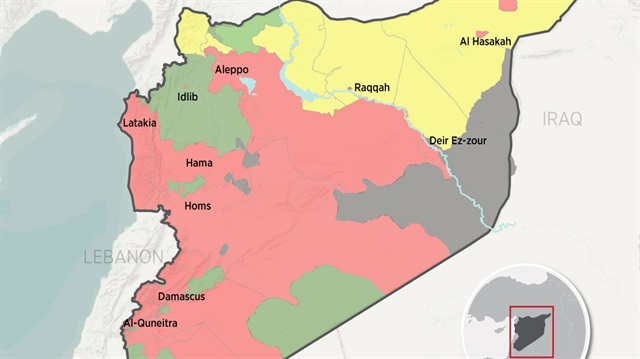
The details of the memorandum of stabilization of the situation in Syria’s Idlib signed between Turkey and Russia in the resort town of Sochi have emerged. The agreement is comprised of 10 articles, and notes that Idlib will be a demilitarized de-escalation zone in which Turkish and Russian armed forces will conduct patrols.
Located near the Turkish border, Idlib is home to more than three million Syrians, many of whom fled from other cities following attacks by regime forces.
The Syrian regime announced plans last month to launch a major military offensive in the area, long controlled by various armed opposition groups.

Breakthrough agreement
A bilateral meeting between Turkish President Recep Tayyip Erdoğan and Russian President Vladimir Putin yielded the stabilization agreement, relieving millions of civilians who fled from the Assad regime’s brutal attacks and took refuge in Idlib.
The agreement reached between Turkey and Russia was a breakthrough after a trilateral summit including Iran failed to deliver a ceasefire deal.
Sochi deal gives hope to Idlib residents
The announcement of a demilitarized zone in Idlib, Syria’s last opposition stronghold, has become a beacon of hope for residents.
The UK officially thanked Turkey on Wednesday for responding to the Syrian refugee crisis and maintaining regional security.The gesture came during a visit to Turkey by British Minister for the Middle East Alistair Burt.“Turkey is an important and longstanding friend of the UK, and I was pleased that I was able to offer the UK’s thanks to our partners in the Turkish government for their frontline role in tackling the Syrian refugee crisis,” Burt said in a statement on the British government’s website.Burt, who visited Gaziantep, Istanbul and Ankara, met with representatives of the Turkish government to discuss efforts to prevent a humanitarian disaster in Syria’s Idlib province.“We are encouraged by this week’s agreement between Turkey and Russia to avoid a military offensive by the Syrian regime and its allies,” Burt said.“This agreement, if implemented in accordance with international humanitarian law, will help to avoid a humanitarian catastrophe,” he added.Burt met with Ibrahim Kalin, chief advisor to President Recep Tayyip Erdogan, and Deputy Interior Minister Ismail Çatakli, the statement said.“He thanked the Turkish government for its important role in supporting over 3.5 million Syrians displaced by the conflict and discussed ways that the UK and Turkey can continue to work closely together,” it added.Burt also met members of the White Helmets, a Nobel Peace Prize-nominated civilian defense group that works tirelessly to protect the lives of civilians caught in the conflict, according to the statement. “During my visit, I had the privilege of meeting members of the White Helmets, and we thank them for their service, courage and sacrifice which has saved over 115,000 Syrian lives,” he said.“They must be able to continue their vital work without being targeted by the Assad regime.”Burt said he was also deeply impressed by the innovative work of Hala Systems, “a UK aid funded initiative that can offer Syrian civilians valuable minutes to get to safety ahead of airstrikes and which has seen a 27 percent reduction in the number of casualties in areas under heavy bombardment”, he added. Hala Systems provides early warning of incoming airstrikes through WhatsApp and on social media.
UK thanks Turkey for its 'longstanding role' in Syria
Residents were grappling with an atmosphere of crippling fear as talks of a looming offensive would lead to the "worst humanitarian catastrophe in the 21st century,” according to the UN.
Only Turkey considers needs of locals
“We see the results of the agreement as a good sign. Our hopes of returning to areas we were displaced from have been revived,” said Bedir Kaysi, who fled to Turkey from Homs as a result of regime attacks.
Abdusselam Hasan, the director of a hospital in Idlib, noted that Turkey was the only country which was taking into account the needs of the locals.
“We trust Turkey”
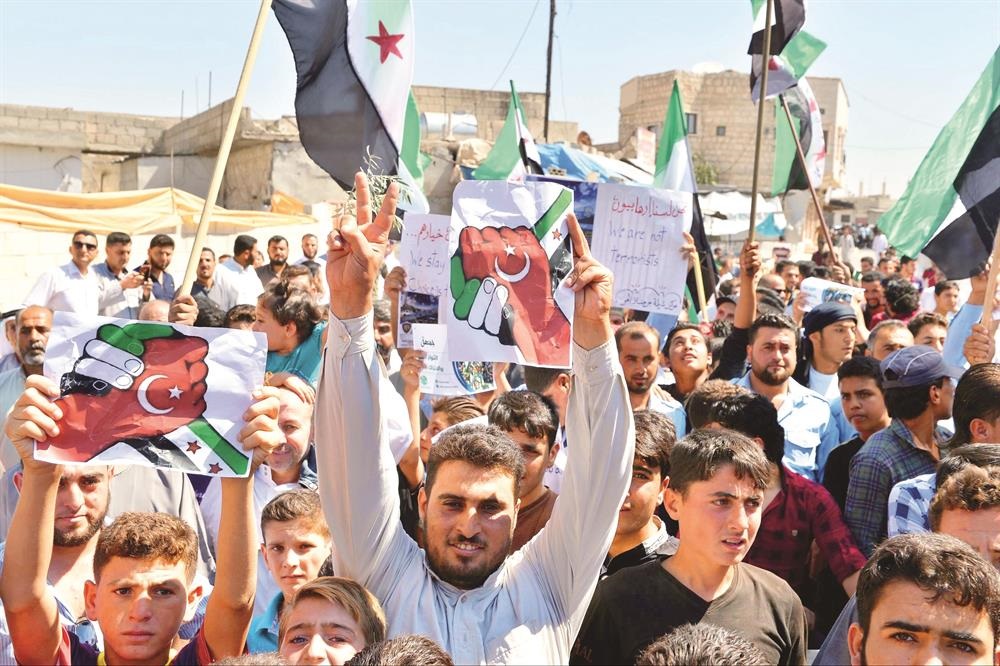
“The results of Sochi have been reflected positively on the field too. Locals have organized demonstrations of support in Binnish and Maarratmisrin,” says local Ahmet Zerzur, adding that both the Turkish and Free Syrian Army (FSA) flags would be unfurled at the rallies.
“The FSA flag is a sign of the continuation of the people’s revolt, and the Turkish flag is a sign of trust. We trust Turkey. We feel comfortable when Turkey is present in the region,” Zerzur stated.
Win-win for Turkey and Russia
Anton Mardasov, a non-resident expert at the Russian International Affairs Council (RIAC), dubbed the agreement reached in Sochi as a victory for both Erdoğan and Russia.
“This agreement is a victory for the stance of Erdoğan who did not let a military operation target Idlib. On the other hand, it is also a victory for Russia, which did not want to join a large scale military operation,” Mardasov said.
As Turkey’s diplomatic efforts averted catastrophe in Syria’s Idlib, Turkish-made drones are set to play a major role in monitoring the implementation of the agreement brokered with Russia to demilitarize the flashpoint northwestern Syrian region.Both countries will monitor from the airAccording to Defense Industry Researcher Turan Oğuz, unmanned air vehicles (UAVs), also known as drones, will contribute to the peace deal in Idlib as both Turkey and Russia will be monitoring the scene from the air instantaneously in accordance with the agreement reached in Sochi.“Both ANKA and Bayraktar drones will be vital to the process in Idlib. It will be a huge advantage to monitor the scene from the air 24/7 in a complex region with several hostile groups on the ground. Commanders will be able to receive live images from the air in real-time on their tablets as drones operate over the area.”Oğuz stated that Turkey will be able to monitor any possible transgression against its soldiers in real-time and will be capable of punishing the assailants instantaneously.“Our monitoring airpower will be able to gather intelligence and under circumstances where action needs to be taken, targets will be neutralized. Combat drones will be deployed if the rules of engagement between Turkey and Russia allow it.”"Drones will rotate shifts" Oğuz stressed that Turkey’s domestically-produced drones will be a major advantage when it comes to monitoring the field. “Due to the fact that we manufacture our own drones, we face no problems when it comes to the number of vehicles we dispatch. In the past, we used to try to accomplish tasks using our limited capabilities. Now we can have 15 drones in the air simultaneously, which allow us to rotate shifts between them, enabling us to monitor the region uninterruptedly.”"Evidence will be of great value"The establishment of a joint operations room comprised of soldiers from different countries is a vital matter, explained Oğuz. Owing to the fact that it produces its own drones, Turkey’s hand will be strengthened both during negotiations and on the field. Footage captured by drones will be presented as evidence to the other side in the case of any violation, continued Oğuz."Turkish and Russian soldiers can manage the process from a joint operations room"“Both we [Turks] and the Russians will be closely following developments. For that reason, a swap of intelligence and live footage will surely take place. A joint air control center will be established by Turkish and Russian military officials to manage the process. These types of joint spaces are critical for coordination,” concluded Oğuz. The Turkish and Russian leaders agreed Monday to establish a demilitarized zone in Idlib, Syria’s last opposition stronghold, during a bilateral meeting in Sochi, Russia.Ankara and Moscow also signed a memorandum of understanding calling for the “stabilization” of Idlib's de-escalation zone, in which acts of aggression are expressly prohibited.According to the understanding, opposition groups in Idlib will remain in areas in which they are already present, while Russia and Turkey will conduct joint patrols in the area with a view to preventing renewed fighting.'Turkey will continue its military actions in Idlib in coordination with Russia'UN sends 29 trucks of humanitarian aid to Syria's IdlibEU demands humanitarian protection under Idlib dealGermany welcomes Turkey-Russia agreement on Idlib
Turkish-made drones to monitor implementation of Idlib agreement
Sochi deal proves Turkey-Russia alliance
Denis Korkodinov, Russian military expert and political scientist, said that the Sochi deal ensured that radical groups would not threaten the Syria peace process.
“By forming a demilitarized zone, Ankara and Moscow have shown their alliance, which is based on high level political values,” he said.
UN aid coordinator hails Idlib stabilization deal
“The Sochi agreement is extremely important and definitely a step in the right direction,” Panos Moumtzis, the UN’s humanitarian coordinator for the Syria crisis said, adding that it is “very important” to avoid military escalation, protect civilians, respect freedoms, and make sure humanitarian work and access is allowed in Syria.
Syria has been locked in a vicious civil war since early 2011 when the Assad regime cracked down on pro-democracy protests with unexpected ferocity.
Since then, hundreds of thousands of people have been killed and more than 10 million others were displaced, according to UN officials.
The UN’s humanitarian coordinator for the Syria crisis on Tuesday voiced approval for the recent agreement between Turkey and Russia to demilitarize Syria's northwestern Idlib province, the last major stronghold of the Syrian opposition.Supporting opposite sides of the conflict, Ankara and Moscow signed the agreement on Monday in Russia's Black Sea resort town of Sochi.Speaking to Anadolu Agency during a regular visit to Ankara to discuss the situation in Idlib with Turkish officials, Panos Moumtzis said it is “very important” to avoid military escalation, protect civilians, respect freedoms, and make sure humanitarian work and access is allowed in Syria.“The Sochi agreement is extremely important and definitely a step in the right direction,” he added.Moumtzis cited a key issue of his visit as implementation of the deal, which envisages a disarmament zone of 15-20 kilometers (9.3-12.4 miles) on either side of Idlib’s southern and eastern borders.Video: Syrians ‘still need our help’: UN aid coordinator“What we’re really interested in is to have full and unhindered access to people in need,” he said, adding that it is also critical to ensure the free movement of civilians to cross the frontier and make sure civilian areas are not targeted in case of conflict.Referring to Turkey’s “very active” role in hosting Syrian refugees and facilitating aid provision to civilians across its border, Moumtzis expressed appreciation for the “respect” and “dignity” Syrians have gotten in Turkey.Turkey currently hosts some 3.5 million Syrian refugees, more than any other country in the world.Over 6.2 million internally displaced persons remain in the continuing humanitarian “emergency” of Syria, according to Moumtzis, with 40 percent of UN and affiliated aid being provided from across the border.“The people of Syria still need our help. Our support is still continuing, and there is still a road to be pursued to what we all hope is peace and stability for all Syrians, wherever they are,” he added'Turkey will continue its military actions in Idlib in coordination with Russia'UN sends 29 trucks of humanitarian aid to Syria's IdlibTurkish-made drones to monitor implementation of Idlib agreementTurkish FM discusses Syria with US counterpart on phoneDr. Oz recounts his visits to Syrian refugee camps
Syrians ‘still need our help’: UN aid coordinator
A recent agreement between Ankara and Moscow to demilitarize Syria's northwestern Idlib province has given hope to the region’s civilians for a brighter future.Idlib residents shared their views about the agreement -- and about their future plans -- with Anadolu Agency.“We trust Turkey; we feel comfortable when Turkey is strong and active in the region. We wave Free Syrian Army (FSA) and Turkish flags at our demonstrations,” Ahmad Zarzur said.“The FSA flag is a symbol of our resistance and the Turkish flag is a symbol of our confidence and trust,” he added.“We see this agreement as a good thing for us. We hope it will bring good results for the people of Idlib,” Zarzur said.Bedir Kaysi, who recently moved to Idlib from Homs, said: “We thank Turkey and it’s people so much because they didn’t abandon us.”Abdussalem Hassan, the manager of a hospital in Idlib, said: “We want Turkey to provide confidence to the region. We also call for the help of aid organizations.”On Monday, Ankara and Moscow signed an agreement calling for the demilitarization of Idlib.According to the agreement, opposition groups in Idlib will remain in areas in which they are already present, while Russia and Turkey will conduct joint patrols in the area with a view to preventing any renewal of fighting.Turkish and Russian military forces, meanwhile, will conduct joint patrols along the zone's perimeter. Located near the Turkish border, Idlib is home to more than three million Syrians, many of whom fled other cities following attacks by Assad regime forces.Last month, the Syrian regime announced plans to launch a major military offensive in Idlib, Syria’s last opposition stronghold.But the UN warned that such a move could lead to the “worst humanitarian catastrophe of the 21st century”. Syria has only just begun to emerge from a devastating conflict that began in 2011 when the Assad regime cracked down on demonstrators with unexpected ferocity.'Turkey will continue its military actions in Idlib in coordination with Russia'UN sends 29 trucks of humanitarian aid to Syria's IdlibEU demands humanitarian protection under Idlib deal'Russia, Iran planning to declare victory over Idlib'Germany welcomes Turkey-Russia agreement on Idlib'Turkey-Russia deal on Idlib ends Assad dream to regain control over Syria'
Demilitarization agreement heartens civilians in Idlib