

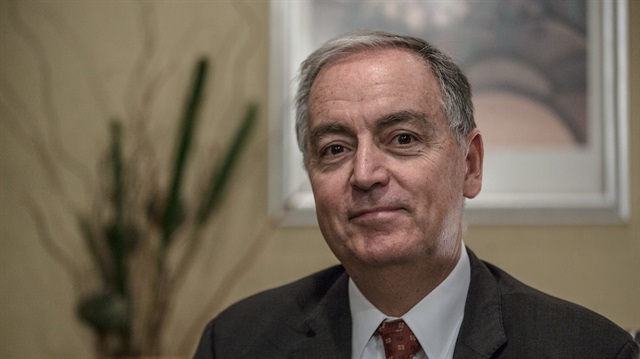
UN Regional Humanitarian Coordinator for the Syria crisis, Moumtzis
The UN’s humanitarian coordinator for the Syria crisis on Tuesday voiced approval for the recent agreement between Turkey and Russia to demilitarize Syria's northwestern Idlib province, the last major stronghold of the Syrian opposition.
Supporting opposite sides of the conflict, Ankara and Moscow signed the agreement on Monday in Russia's Black Sea resort town of Sochi.
Speaking to Anadolu Agency during a regular visit to Ankara to discuss the situation in Idlib with Turkish officials, Panos Moumtzis said it is “very important” to avoid military escalation, protect civilians, respect freedoms, and make sure humanitarian work and access is allowed in Syria.
“The Sochi agreement is extremely important and definitely a step in the right direction,” he added.
Moumtzis cited a key issue of his visit as implementation of the deal, which envisages a disarmament zone of 15-20 kilometers (9.3-12.4 miles) on either side of Idlib’s southern and eastern borders.
The UN's humanitarian coordinator for the Syria crisis on Tuesday voiced approval for the recent agreement between Turkey and Russia to demilitarize Syria's northwestern Idlib province, the last major stronghold of the Syrian opposition. During a regular visit to Ankara to discuss the situation in Idlib with Turkish officials, Panos Moumtzis said it is “very important” to avoid military escalation, protect civilians, respect freedoms, and make sure humanitarian work and access is allowed in Syria'.
Syrians ‘still need our help’: UN aid coordinator
“What we’re really interested in is to have full and unhindered access to people in need,” he said, adding that it is also critical to ensure the free movement of civilians to cross the frontier and make sure civilian areas are not targeted in case of conflict.
Referring to Turkey’s “very active” role in hosting Syrian refugees and facilitating aid provision to civilians across its border, Moumtzis expressed appreciation for the “respect” and “dignity” Syrians have gotten in Turkey.
Turkey currently hosts some 3.5 million Syrian refugees, more than any other country in the world.
Over 6.2 million internally displaced persons remain in the continuing humanitarian “emergency” of Syria, according to Moumtzis, with 40 percent of UN and affiliated aid being provided from across the border.
“The people of Syria still need our help. Our support is still continuing, and there is still a road to be pursued to what we all hope is peace and stability for all Syrians, wherever they are,” he added
Turkey will continue its military actions in Syria's Idlib in coordination with Russia, Defense Minister Hulusi Akar said on Tuesday."The Sochi agreement with Russia is an important achievement for both countries involved and the people of the region," Akar said.Turkey and Russia on Monday agreed to turn Idlib into a demilitarized zone after a meeting between President Recep Tayyip Erdoğan and his counterpart Vladimir Putin in Russia's coastal city of Sochi.Turkey, US continue patrols in Syria's ManbijAnkara and Moscow signed a memorandum of understanding calling for the stabilization of the situation in Idlib's de-escalation zone, in which acts of aggression are prohibited.The demilitarized zone will extend between 15 to 20 kilometers (9-12 miles) deep into Idlib by Oct. 15. The establishment of the zone will be accompanied by the withdrawal of armed groups, including the al-Nusra Front.Erdoğan said Russia and Turkey will conduct joint patrols along the zone's perimeter, and the two countries will restore transit routes between Syria's Aleppo, Latakia, Hama by the end of 2018.Russia will take necessary measures to protect Idlib de-escalation zone: FMForeign troops reach significant numbers in Syria and Iraq 'Turkey-Russia deal on Idlib ends Assad dream to regain control over Syria'US welcomes efforts to reduce violence in Syria
'Turkey will continue its military actions in Idlib in coordination with Russia'
The UN has sent 29 trucks of humanitarian aid to Syria’s northwestern Idlib province on Tuesday.The convoy passed through the Cilvegozu border gate in southern Hatay’s Reyhanli district.Some 580 tons of humanitarian aid will be distributed to people in need in Idlib and its rural areas.Located near the Turkish border, Idlib province is home to more than 3 million Syrians, many of whom fled from other cities following attacks by regime forces.EU demands humanitarian protection under Idlib dealThe Syrian regime had announced plans last month to launch a major military offensive to the area, long controlled by various armed opposition groups.The UN warned that such an offensive would lead to the "worst humanitarian catastrophe in the 21st century".On Monday, Turkish President Recep Tayyip Erdoğan and Russian leader Vladimir Putin agreed to establish a demilitarized zone in Syria's Idlib province.Video: UN sends 29 trucks of humanitarian aid to IdlibTurkey hopes no more blood will be shed in Syria: FM'Russia, Iran planning to declare victory over Idlib'Opening Pandora’s box in Idlib
UN sends 29 trucks of humanitarian aid to Syria's Idlib
As Turkey’s diplomatic efforts averted catastrophe in Syria’s Idlib, Turkish-made drones are set to play a major role in monitoring the implementation of the agreement brokered with Russia to demilitarize the flashpoint northwestern Syrian region.Both countries will monitor from the airAccording to Defense Industry Researcher Turan Oğuz, unmanned air vehicles (UAVs), also known as drones, will contribute to the peace deal in Idlib as both Turkey and Russia will be monitoring the scene from the air instantaneously in accordance with the agreement reached in Sochi.“Both ANKA and Bayraktar drones will be vital to the process in Idlib. It will be a huge advantage to monitor the scene from the air 24/7 in a complex region with several hostile groups on the ground. Commanders will be able to receive live images from the air in real-time on their tablets as drones operate over the area.”Oğuz stated that Turkey will be able to monitor any possible transgression against its soldiers in real-time and will be capable of punishing the assailants instantaneously.“Our monitoring airpower will be able to gather intelligence and under circumstances where action needs to be taken, targets will be neutralized. Combat drones will be deployed if the rules of engagement between Turkey and Russia allow it.”"Drones will rotate shifts" Oğuz stressed that Turkey’s domestically-produced drones will be a major advantage when it comes to monitoring the field. “Due to the fact that we manufacture our own drones, we face no problems when it comes to the number of vehicles we dispatch. In the past, we used to try to accomplish tasks using our limited capabilities. Now we can have 15 drones in the air simultaneously, which allow us to rotate shifts between them, enabling us to monitor the region uninterruptedly.”"Evidence will be of great value"The establishment of a joint operations room comprised of soldiers from different countries is a vital matter, explained Oğuz. Owing to the fact that it produces its own drones, Turkey’s hand will be strengthened both during negotiations and on the field. Footage captured by drones will be presented as evidence to the other side in the case of any violation, continued Oğuz."Turkish and Russian soldiers can manage the process from a joint operations room"“Both we [Turks] and the Russians will be closely following developments. For that reason, a swap of intelligence and live footage will surely take place. A joint air control center will be established by Turkish and Russian military officials to manage the process. These types of joint spaces are critical for coordination,” concluded Oğuz. The Turkish and Russian leaders agreed Monday to establish a demilitarized zone in Idlib, Syria’s last opposition stronghold, during a bilateral meeting in Sochi, Russia.Ankara and Moscow also signed a memorandum of understanding calling for the “stabilization” of Idlib's de-escalation zone, in which acts of aggression are expressly prohibited.According to the understanding, opposition groups in Idlib will remain in areas in which they are already present, while Russia and Turkey will conduct joint patrols in the area with a view to preventing renewed fighting.'Turkey will continue its military actions in Idlib in coordination with Russia'UN sends 29 trucks of humanitarian aid to Syria's IdlibEU demands humanitarian protection under Idlib dealGermany welcomes Turkey-Russia agreement on Idlib
Turkish-made drones to monitor implementation of Idlib agreement
Turkish Foreign Minister Mevlüt Çavuşoğlu and U.S. Secretary of State Mike Pompeo spoke over the phone about the latest situation in Syria’s Idlib province, a Turkish diplomatic source said Tuesday.Cavusoglu and Pompeo discussed an agreement between Turkey and Russia to establish a demilitarized zone in Idlib, said the source, who spoke on condition of anonymity due to restrictions on talking to the media.Cavusoglu also held phone conversations with his French counterpart Jean-Yves Le Drian, German counterpart Heiko Maas and EU Foreign Policy chief Federica Mogherini, according to Turkish diplomatic sources.Following a meeting in the Russian city of Sochi between Turkish President Recep Tayyip Erdogan and his Russian counterpart Vladimir Putin, the two countries agreed Monday to establish a demilitarized zone in Idlib, Syria’s last opposition stronghold.Ankara and Moscow also signed a memorandum of understanding calling for the “stabilization” of Idlib's de-escalation zone, in which acts of aggression are expressly prohibited.According to the MoU, opposition groups in Idlib will remain in areas in which they are already present while Russia and Turkey will conduct joint patrols in the area with a view to preventing renewed fighting.Located near the Turkish border, Idlib province is home to more than 3 million Syrians, many of whom fled from other cities following attacks by regime forces.The Syrian regime had announced plans last month to launch a major military offensive in the area, which has long been controlled by various armed opposition groups.The UN warned that such an offensive would lead to the "worst humanitarian catastrophe in the 21st century".Turkish military reinforcements reach Syrian border'Turkey will continue its military actions in Idlib in coordination with Russia'Pentagon says YPG not part of Manbij roadmap
Turkish FM discusses Syria with US counterpart on phone
Turkish-American surgeon and talk show host Dr. Mehmet Oz said he was greatly moved by his visits in July to refugee camps in Turkey and Syria, noting it was something he would never forget."I had the opportunity to visit Syrian refugee camps along the Syria-Turkey border with the help of [Turkey’s Disaster and Emergency Management Authority] AFAD and [the Turkish Red Crescent] Kizilay."Despite the hardships the people we met have endured, their stories of resilience are inspiring - this is a trip that has forever changed me," Oz said Monday in a post on his Twitter account.Oz -- who is widely known for his television program The Dr. Oz Show, which has won several Daytime Emmy Awards -- visited refugee camps in Turkey's southeastern Gaziantep province and Syria's northwestern Azaz region in July.He shared footage on his Twitter account of war-devastated Homs city in western Syria as well as his visits to the camps."I had never been to a refugee camp. I had no idea what to expect. The first thing that struck me was the hospitality,” Oz said in video footage captured in a refugee camp in Turkey.Highlighting the efforts of Turkish authorities, Oz said: "I sat talking with the children as they painted, aware that many suffered PTSD [post-traumatic stress disorder] and had lost almost everything. I was most surprised by their ability to hide their pain."He then traveled across the Syrian border into the Azaz region north of Aleppo, where he visited another refugee camp."Entering the health clinic, I was shocked and dismayed to find vastly inadequate technology, a lack of supplies, unairconditioned facilities, and for the 11,000 people living in this camp, I found only one doctor working the shift.”During his visit to the camp, he was approached by a man on behalf of his 12-year-old daughter, who needed medical attention. The man invited Oz to his home. "We met with Zaynab. She was born with a heart defect. But before doctors could operate, the war broke out. The family ended up here. They are desperate. I looked at her echocardiograms and examined her… Zaynab's blood does not carry enough oxygen, so she turns blue. She’s thin and frail, and tires easily. Left untreated, she will not survive into adulthood.”
Dr. Oz recounts his visits to Syrian refugee camps