

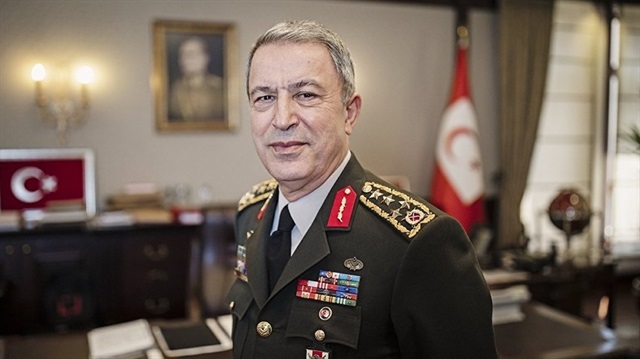
Turkish Defense Minister Hulusi Akar
Turkey will continue its military actions in Syria's Idlib in coordination with Russia, Defense Minister Hulusi Akar said on Tuesday.
"The Sochi agreement with Russia is an important achievement for both countries involved and the people of the region," Akar said.
Turkey and Russia on Monday agreed to turn Idlib into a demilitarized zone after a meeting between President Recep Tayyip Erdoğan and his counterpart Vladimir Putin in Russia's coastal city of Sochi.
Turkish and U.S. troops continued their patrols on Tuesday in northern Syrian city Manbij, as part of a deal to rid the area of the YPG/PKK terror group.In a statement, the Turkish General Staff said forces of both countries conducted 47th round of separate coordinated patrols in the region between areas liberated by Turkey's Operation Euphrates Shield and Manbij.Patrols by Turkish and U.S. troops in the region began on June 18.The Manbij deal between Turkey and the U.S. focuses on the withdrawal of the PKK-affiliated YPG terror group from the city in order to stabilize the region.In its more than 30-year terror campaign against Turkey, the PKK has taken some 40,000 lives, including many women and children. The YPG is its Syrian branch.Should the Manbij model prove a success, Turkey will push for a similar arrangement in eastern Syria.Turkey has said the presence of terror forces near its border constitutes a threat and has launched military operations and other efforts to rid the region of terrorists.Russia will take necessary measures to protect Idlib de-escalation zone: FM'Russia, Iran planning to declare victory over Idlib'Foreign troops reach significant numbers in Syria and Iraq UN hails 'important' Erdoğan-Putin meeting on Syria
Turkey, US continue patrols in Syria's Manbij
Ankara and Moscow signed a memorandum of understanding calling for the stabilization of the situation in Idlib's de-escalation zone, in which acts of aggression are prohibited.
The demilitarized zone will extend between 15 to 20 kilometers (9-12 miles) deep into Idlib by Oct. 15. The establishment of the zone will be accompanied by the withdrawal of armed groups, including the al-Nusra Front.
Erdoğan said Russia and Turkey will conduct joint patrols along the zone's perimeter, and the two countries will restore transit routes between Syria's Aleppo, Latakia, Hama by the end of 2018.
Russia will take the necessary measures to protect the de-escalation zone in Syria's Idlib, Turkish Foreign Minister Mevlüt Çavuşoğlu said on Tuesday.Ankara hopes for stability in Syria and wants no more blood to be shed there, Çavuşoğlu stated, a day after Ankara and Moscow reached an agreement on Syria.Turkey's President Recep Tayyip Erdoğan and his Russian counterpart Vladimir Putin announced an agreement on Monday that Russian and Turkish troops will enforce a new demilitarized zone in the Idlib region."The borders of Idlib will be protected under the memorandum of understanding signed in Sochi. There would be no change in the status of Idlib," Çavuşoğlu said.'Russia, Iran planning to declare victory over Idlib'Turkey will reinforce troop deployments in Idlib after agreeing a demilitarized zone which it will jointly patrol with Russia, Çavuşoğlu said."Russia and Turkey will carry out joint, coordinated patrols here, around the Idlib border. We will need to make additional troop deployments here," Çavuşoğlu told a news conference.He said the M4 and M5 highways, which run east to west and north to south through the Idlib region, linking the government-held city of Aleppo with Damascus and the Mediterranean coast, would be open to traffic by the end of the year.Opening Pandora’s box in IdlibThe minister said heavy weapons will be removed from demilitarized zone in Idlib, adding: "Civilians will stay, only terrorist groups will be removed."He added heavy weapons will be removed from demilitarized zone in Idlib by Oct. 15. Çavuşoğlu said the region would be cleared off from "radicals" and cease-fire would be ensured. Israel publishes satellite photos of Assad’s palace in DamascusForeign troops reach significant numbers in Syria and Iraq 
Russia will take necessary measures to protect Idlib de-escalation zone: FM
Hundreds of thousands of foreign troops, including militias, who were deployed to the region under the pretext of fighting Daesh or supposedly providing humanitarian relief still maintain their military presence in Iraq and Syria.The U.S., Russia, Italy, Germany, UK, Iran and France lead the military presence in both countries. US seeks to deliver Kirkuk to Peshmerga in cooperation with PKK terroristsIraq deploys forces along Turkey border to thwart PKK infiltrationForeign involvement in IraqApproximately 6,000 American troops are present in Iraq and the U.S. uses the oil resources in the region as a guise. The Washington administration also deployed Kurdistan Worker’s Party (PKK) terrorists along with Peshmerga forces who are tasked with ensuring the security of the oil-wells.Here are the approximate numbers for the foreign involvement in Iraq:Iran: Tehran has no soldiers in Iraq but commands and controls more than 100,000 Hashd al-Shaabi soldiers. Hashd al-Shaabi is also known as the Popular Mobilization Forces (PMF).Germany: 200 military personnel.UK: The British presence in Iraq is thought to be between 400 and 1,000 troops.France: 500 to 1,000 soldiers.Germany: Approximately 200 troops.Italy: 500 troops.Netherlands, Denmark, Norway and Sweden are also among the countries who are present in Iraq, even though they have few soldiers – a total 200 troops – as part of the Global Coalition against Daesh.Turkey, Russia cooperation to be ‘hope’ for regionUS leads foreign military presence in SyriaThe countries that are involved in Iraq are also present in Syria.There are about 5,000 U.S. troops in Syria, positioned in 22 separate bases that control over 50,000 PKK/PYD terrorists in the region.Russia deployed 2,000 troops in four separate bases that are thought to be dispatched to counter the the Global Coalition against Daesh. Iran has positioned 1,000 soldiers in Syria to train militias and Assad’s forces. Iran extends its presence with between 60,000 and 70,000 Tehran-backed militias, who are also in alliance with the Syrian regime. France maintains it presence with between 500 and 1,000 troops, and Germany follows with 100 to 200 military personnel.Israel’s current precise number of troops are unknown that are dispatched to Golan Heights.Turkish responseThe military presence of foreign powers in Iraq and Syria can be evaluated as a threat to Turkey, which is a neighbor to both countries. As a result, Turkey is also increasing its military presence in these countries in order to defend Iraq and Syria against those who seek to target their territorial integrity.Through operations Euphrates Shield and Olive Branch, Turkey protected locals and cleared northern Syria of terror elements.Turkey has launched anti-terror operations in both Qandil and Sinjar regions in northern Iraq.'Turkey-Russia deal on Idlib ends Assad dream to regain control over Syria'
Foreign troops reach significant numbers in Syria and Iraq
A deal brokered between Turkey and Russia over Syria's northwestern Idlib region puts an end to President Bashar al-Assad's dream of regaining full control over the country, a Free Syrian Army (FSA) commander said on Tuesday.The buffer zone agreed to in Idlib will save civilian lives and protect the area from Syrian army bombing and create a "geographic area" under the control of the FSA that is capable of pushing for a post-Assad political transition in Syria."The Idlib deal preserves lives of civilians and their direct targeting by the regime. It buries Assad's dreams of imposing his full control over Syria," prominent FSA commander Mustafa Sejari said.Erdoğan's aide hails Ankara-Moscow deal on IdlibTurkey, Russia agree on 'weapons-free zone' in IdlibThe deal has "practically excluded" a Syrian government offensive in the region, the spokesman for the opposition Syrian Negotiations Commission told Reuters.The "scenario of attack is practically excluded, at least for a period of time that is not small, and we hope that it will be permanent," Yahya al-Aridi. Aridi said the deal announced on Monday had safeguarded the lives of millions of Syrians and was an indication that the "path of peace" must now be opened.Turkey and Russia on Monday agreed to turn Idlib into a demilitarized zone after a meeting between President Recep Tayyip Erdoğan and his counterpart Vladimir Putin in Russia's coastal city of Sochi.Ankara and Moscow signed a memorandum of understanding calling for the stabilization of the situation in Idlib's de-escalation zone, in which acts of aggression are prohibited."We have agreed on the establishment of a weapons-free zone between the opposition- and [Assad] regime-controlled areas," Erdoğan said in a news conference with Putin in the Black Sea coastal city of Sochi, following a meeting between the two leaders.Iran welcomes Turkey-Russia deal over IdlibPutin said the demilitarized zone will extend between 15 to 20 kilometers (9-12 miles) deep into Idlib by Oct. 15. He added that the establishment of the zone would be accompanied by the withdrawal of armed groups, including the al-Nusra Front.Putin said all heavy weapons had to be withdrawn from the zone by Oct. 10, according to Erdoğan’s proposal. This includes tanks, rocket launchers, guns and mortars of all opposition groups.Erdoğan said Russia and Turkey will conduct joint patrols along the zone's perimeter, and the two countries will restore transit routes between Syria's Aleppo, Latakia, Hama by the end of 2018.
'Turkey-Russia deal on Idlib ends Assad dream to regain control over Syria'
The United States welcomes any "sincere effort" to reduce violence in Syria, a State Department official said Monday."We are encouraged that Turkey and Russia appear to have taken steps to avert a military offensive by the Assad regime and its allies in Idlib and welcome any sincere effort to reduce the violence in Syria. We hope de-escalation is made permanent," the official told Anadolu Agency, speaking on condition of anonymity.The official added that the U.S. was not involved in the negotiations between the Turkish and Russian governments in the Russian city of Sochi over the future of Syria’s northwestern Idlib province."As we have noted before, an offensive by the Assad regime and its allies against the densely populated Idlib province would be a reckless escalation and would have serious consequences for Syria and the surrounding region," the official added.The official said Washington remains "concerned by the Assad regime’s pattern of destabilizing actions in Idlib and elsewhere”, noting that the U.S. will continue to watch the situation and the regime's actions closely."We reiterate something that both President [Donald] Trump and President [Vladimir] Putin agreed to in Da Nang, Vietnam: There is no military solution to this conflict," the official said, adding that all parties should "redirect their energies to forging a durable political resolution in Syria"."As the United Nations Security Council has long emphasized, ending the conflict will require a political solution based on UNSCR 2254 and the Geneva process," the official said."The United States supports any credible efforts that prevent a resurgence of violence and protects civilians. Civilians must be allowed freedom of movement, including the right to return home, and provided access to immediate humanitarian assistance and medical care," the official added.Speaking to Anadolu Agency, Pentagon spokesman Cmdr. Sean Robertson also affirmed U.S. support for the “de-escalation of violence in Syria, unhindered humanitarian access, an enduring defeat of ISIS and other terrorists and progress toward a credible political resolution”. He was referring to the Islamic State of Iraq and Syria, another name for Daesh.“We continue to support the UN-led Geneva peace process to resolve the hostilities in Syria under the auspices of United Nations Security Council Resolution 2254," he added.
US welcomes efforts to reduce violence in Syria