

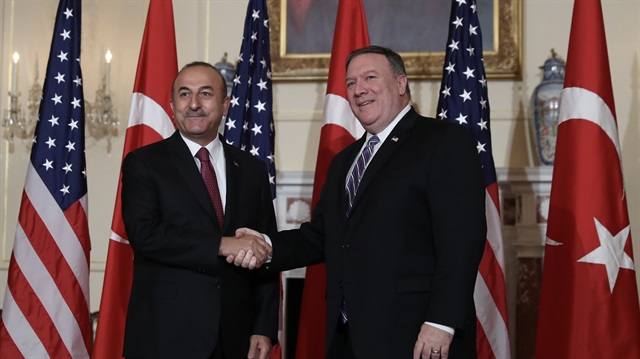
File photo: Turkish FM Cavuşoglu in Washington
Turkish Foreign Minister Mevlüt Çavuşoğlu and U.S. Secretary of State Mike Pompeo spoke over the phone about the latest situation in Syria’s Idlib province, a Turkish diplomatic source said Tuesday.
Cavusoglu and Pompeo discussed an agreement between Turkey and Russia to establish a demilitarized zone in Idlib, said the source, who spoke on condition of anonymity due to restrictions on talking to the media.
Cavusoglu also held phone conversations with his French counterpart Jean-Yves Le Drian, German counterpart Heiko Maas and EU Foreign Policy chief Federica Mogherini, according to Turkish diplomatic sources.
Following a meeting in the Russian city of Sochi between Turkish President Recep Tayyip Erdogan and his Russian counterpart Vladimir Putin, the two countries agreed Monday to establish a demilitarized zone in Idlib, Syria’s last opposition stronghold.
Ankara and Moscow also signed a memorandum of understanding calling for the “stabilization” of Idlib's de-escalation zone, in which acts of aggression are expressly prohibited.
According to the MoU, opposition groups in Idlib will remain in areas in which they are already present while Russia and Turkey will conduct joint patrols in the area with a view to preventing renewed fighting.
Located near the Turkish border, Idlib province is home to more than 3 million Syrians, many of whom fled from other cities following attacks by regime forces.
The Syrian regime had announced plans last month to launch a major military offensive in the area, which has long been controlled by various armed opposition groups.
The UN warned that such an offensive would lead to the "worst humanitarian catastrophe in the 21st century".
Turkish military reinforcements on Tuesday reached a key area near Turkey’s southern border with Syria.The military convoy came into Reyhanli in the southern Hatay province with soldiers, tanks, howitzers, and armored vehicles, according to an Anadolu Agency correspondent in the area.Twelve-ton bulletproof concrete blocks with four meters (13 feet) height were also sent to Turkish military forces near the border.Video: Turkey deploys more armored vehicles to Syrian borderTurkey and Russia on Monday reached a landmark agreement to establish a demilitarized zone around Syria's opposition-held Idlib to head off a regime offensive on the region.After the announcement of the agreement, Turkish President Recep Tayyip Erdogan said that Turkey will fortify its current observation points in Idlib, which borders Hatay.
Turkish military reinforcements reach Syrian border
Turkey will continue its military actions in Syria's Idlib in coordination with Russia, Defense Minister Hulusi Akar said on Tuesday."The Sochi agreement with Russia is an important achievement for both countries involved and the people of the region," Akar said.Turkey and Russia on Monday agreed to turn Idlib into a demilitarized zone after a meeting between President Recep Tayyip Erdoğan and his counterpart Vladimir Putin in Russia's coastal city of Sochi.Turkey, US continue patrols in Syria's ManbijAnkara and Moscow signed a memorandum of understanding calling for the stabilization of the situation in Idlib's de-escalation zone, in which acts of aggression are prohibited.The demilitarized zone will extend between 15 to 20 kilometers (9-12 miles) deep into Idlib by Oct. 15. The establishment of the zone will be accompanied by the withdrawal of armed groups, including the al-Nusra Front.Erdoğan said Russia and Turkey will conduct joint patrols along the zone's perimeter, and the two countries will restore transit routes between Syria's Aleppo, Latakia, Hama by the end of 2018.Russia will take necessary measures to protect Idlib de-escalation zone: FMForeign troops reach significant numbers in Syria and Iraq 'Turkey-Russia deal on Idlib ends Assad dream to regain control over Syria'US welcomes efforts to reduce violence in Syria
'Turkey will continue its military actions in Idlib in coordination with Russia'
A U.S. military spokesman said Tuesday Washington is sticking to its agreement with Turkey on a roadmap for the northern Syrian city of Manbij, and not including the PKK/YPG.Speaking via video conferencing at a news conference at the Pentagon, Col. Sean J. Ryan, the spokesman for the U.S.-led Combined Joint Task Force, emphasized there are little elements of the YPG left in the area."As far as I'm tracking, there's very little YPG if any at all. And we are adhering to that agreement that the YPG will not be part of Manbij," Ryan told Anadolu Agency.He also highlighted the success of coordinated patrols between Washington and Ankara, which he said have routed any Daesh elements from the region.Turkey, US continue patrols in Syria's ManbijBoth countries conducted more than 40 rounds of separate coordinated patrols in the region between areas liberated by Turkey's Operation Euphrates Shield and Manbij, according to Turkish officials.Separate patrols by Turkish and U.S. troops in the region began June 18, however, joint patrols have yet to be conducted.In response to a question by Anadolu Agency, the spokesman said training is ongoing for these joint patrols, but there is no timeline on when it will start."There's stability there, the shops are open, people are moving around freely, there's very few signs of any ISIS [Daesh] or any other malign actors in that area," Ryan added.Ryan went on to say in the Manbij agreement to issue the joint patrols, the remaining YPG elements within the area would need to leave the city.The YPG is a Syrian branch of the terrorist organization PKK and the focus of Turkey's counter-terrorist Operation Olive Branch in Afrin, Syria, near the border with Turkey.In its more than 30-year terror campaign against Turkey, the PKK -- listed as a terrorist organization by Turkey, the U.S. and the EU -- has been responsible for the death of some 40,000 people, including those of women and children.*Umar Farooq contributed to this story
Pentagon says YPG not part of Manbij roadmap