

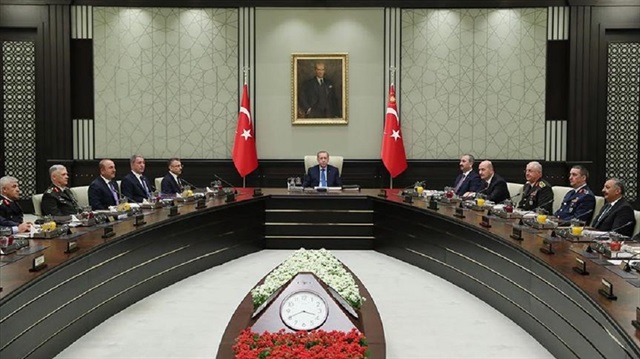
File photo
Turkey will continue its counter-terrorism activities in Syria, according to a declaration issued by the country’s National Security Council's Thursday.
According to the declaration, Turkey is determined to continue its increasing activities to “eliminate terrorism in Syria’s other regions.”
It called on international community to fulfill its political and humanitarian responsibilities more quickly and effectively.
Turkey expects the implementations of an agreed roadmap to clear Syrian city of Manbij from the terrorist organization, it said.
On Tuesday, a U.S. military spokesman said Washington is sticking to its agreement with Turkey on a roadmap for the northern Syrian city of Manbij, and not including the PKK/YPG.
Col. Sean J. Ryan, the spokesman for the U.S.-led Combined Joint Task Force, emphasized there are little elements of the YPG left in the area.
"As far as I'm tracking, there's very little YPG if any at all. And we are adhering to that agreement that the YPG will not be part of Manbij," Ryan told Anadolu Agency.
Turkey and the U.S. conducted more than 40 rounds of separate coordinated patrols in the region between areas liberated by Turkey's Operation Euphrates Shield and Manbij, according to Turkish officials.
Separate patrols by Turkish and U.S. troops in the region began June 18, however, joint patrols have yet to be conducted.
The YPG is a Syrian branch of the terrorist organization PKK and the focus of Turkey's counter-terrorist Operation Olive Branch in Afrin, Syria, near the border with Turkey.
In its more than 30-year terror campaign against Turkey, the PKK -- listed as a terrorist organization by Turkey, the U.S. and the EU -- has been responsible for the death of some 40,000 people, including those of women and children.
The declaration also pointed out the importance of Turkey-Russia agreement that called for demilitarization of the Syrian city of Idlib.
Iran has at least 120,000 foreign terrorists fighting in alliance with the Bashar al-Assad regime in Syria since the civil war began in 2011. Some 22 groups surrounded Idlib from three directions, and are currently present in 232 points. For a long time, the Assad regime has been conducting its military operations against the opponents in Syria not through its own army, but mainly through Iran-backed foreign forces. These groups are stationed predominantly in Idlib, Damascus, Homs, the countryside of Deir-Ez Zor and particularly on the Lebanese border. According to the information compiled by Anadolu Agency reporters from media outlets of Iran-backed foreign terrorist groups, Iranian media and opponents in Syria; the Tehran administration started sending militias to Syria in the first months of 2014. Details of Turkish-Russian Idlib deal revealedSyrian opponents also fought with Iran-backed Hezbollah militias before. Hezbollah first gave support to the regime during its operations near the Lebanese border late 2012. Six months later, the group announced its entity and support to the regime in al-Qusayr district of the countryside of Homs. During this period, commanders of the Iranian Revolutionary Guards were regarded as “consultants” in conflict zones and military educations fields, while the soldiers of the guards were regarded as “fighters.”Apart from being involved in the war physically, the Revolutionary Guards provided training and logistic support to militias fighting in Syria. UK thanks Turkey for its 'longstanding role' in SyriaIran’s involvement increase after opponents take Idlib The involvement of the Iranian forces to the conflict field on the side of the Assad regime has intensified after the Syrian opponents took complete control of Idlib and came close to Latakia in early 2015. Early 2015, Bashar al-Assad confessed that his army was in a difficult situation and the numbers of the soldiers decreased. The Iranian army and intelligence, which wanted to keep the regime alive, had tens of thousands of terrorist fighters -- brought from Iraq, Lebanon, Afghanistan, and Pakistan -- enter Syria. These forces actually took the active role in Madaya, al-Zabadani and Barada Valley -- where deaths occurred from starvation and tens of thousands of civilians were blockaded. The militias planted mines near residential areas, depriving civilians from humanitarian aid. As the humanitarian tragedy was beyond endurance, locals and civilian opponents had to flee the region. Thus, the mandatory evacuation process started. Turkish-made drones to monitor implementation of Idlib agreementMost conflicts erupted in Aleppo Iran-backed forces conducted their most intensive attacks on Aleppo, where they were settled since early 2014. The forces surrendered Aleppo to the regime following a 4 month-tragedy, where hundreds of thousands of people were living under siege. The forces evacuated the entire Homs, Eastern Ghouta, Dara and Quneitra regions within 4 months, via the attack-blockade-deportation method. Iran-backed foreign terrorist groups then headed towards Idlib. The groups piling up for the last three months blockaded Idlib from the east, west and the south. Syrians ‘still need our help’: UN aid coordinatorHalf of Iran-backed groups in Syria focused on IdlibIt is known that more than 120,000 Iran-backed groups exist in Syria. Nearly half of these forces are already stationed around Idlib. 22 Iran-backed foreign terrorist groups surrounding Idlib’s de-escalation zone from three directions are present in 232 different points. 12 groups stationed in the east of Idlib and western Aleppo are as follows:Afghan-origin Fatemiyoun and Pakistan-origin Zainabiyoun brigades, Iraqi-origin al-Nujaba movement, Badr Forces, Imam Ali and Imam Hossein Brigades, Lebanese Hezbollah, Bakr Brigades, Iranian-origin Quds forces and Mahdi Army, Syrian Galibiyyun Brigades and Owner of Rights Units. Demilitarization agreement heartens civilians in IdlibIn Syria, there are other groups as well; such as Iranian-origin Basij Brigades, Liwa Zainebiyoun Brigades, Palestinian-origin Quds Brigades, Iranian Revolutionary Guards and its special forces. According to the sources speaking to an Anadolu Agency correspondent in Idlib, these groups, which are deployed in Homs and Damascus will also come to Idlib in case of a possible military operation.Iran’s losses Iran lost senior figures during the operations conducted against the Syrian opponents. According to the information compiled by Anadolu Agency from Iranian official and semi-official media outlets, at least 15 generals were killed since Feb. 2013. Iran’s heaviest toll in Syria was Hossein Hamadani, an Iranian Revolutionary Guard commander, who was killed in Aleppo in 2015.Syria has been locked in a vicious civil war since early 2011 when the Assad regime cracked down on protesters with unexpected ferocity. Since then, hundreds of thousands of people are believed to have been killed and millions more displaced by the conflict.
Syria’s Idlib under siege by foreign terrorists
The Turkish Presidency on Thursday submitted a motion to Turkish parliament to extend the state’s authority to launch cross-border military operations in northern Iraq and Syria for one more year.The motion, which was submitted by Turkish President Recep Tayyip Erdogan's government, had previously allowed the Turkish military to carry out cross-border operations from Oct. 31, 2017 until Oct. 30, 2018.The motion stated that Turkey attaches great importance to the protection of Iraq's territorial integrity, national unity and stability."However, the existence of PKK and Daesh in Iraq, poses a direct threat to regional peace, stability and the security of our country," it added.Turkey will protect its energy rights in MediterraneanThe parliament will debate the motion after the opening of new legislative year on Oct. 1.During the parliamentary session, the deputies will debate whether the same motion should be extended, or a new motion should be drafted.In its more than 30-year terror campaign against Turkey, the PKK -- listed as a terrorist organization by Turkey, the U.S. and the EU -- has been responsible for the deaths of nearly 40,000 people, including women and children.On Jan. 20, Turkey launched Operation Olive Branch to remove YPG/PKK and Daesh terrorists from Afrin. On March 18, Turkish troops and the Free Syrian Army liberated the Afrin district center.Turkish foundation ready for Syrian migration waveThe presidency also submitted a motion calling for extending the deployment of Turkish troops to the Central African Republic (CAR) and Mali as part of a UN-approved EU peacekeeping mission.The extensions will be effective as of Oct. 31, 2018 for another year.In September 2014, the 12,000-troop UN peacekeeping force Multidimensional Integrated Stabilization Mission in the Central African Republic (MINUSCA) began their deployment in the troubled Central African country.The UN Security Council adopted a resolution in 2012 that authorized the deployment of the African-led International Support Mission to Mali, known as AFISMA.In early 2013, France sent troops to the West African country and, with the help of Chadian and other African forces, flushed out militants from the country's main northern cities.
Turkey’s presidency submits motion on Iraq, Syria
Israel must provide Moscow with more information about the downing of a Russian military aircraft near the Syrian coast earlier this week, Russia's Foreign Ministry said in a statement on Thursday, the Interfax news agency reported.Fifteen Russian crew were killed when the IL-20 surveillance plane crashed near Latakia in northern Syria on Monday. Russia has said Syria shot the plane down shortly after Israeli jets hit the area, and accused Israel of creating the dangerous conditions by failing to give sufficient advance notice.Israel dispatched its air force chief to brief Moscow about the incident on Thursday. Israel to improve coordination with Moscow over Syria after plane crashIsraeli air force chief to visit Moscow amid Syria row
Russia says Israel must provide more data on plane downing near Syria
Turkiye Diyanet Foundation (TDV) General Director Mehmet Savaş Polat said Thursday they had taken all measures for a possible migration movement in Syria's northwestern Idlib."As TDV teams, we have taken all measures in case of a possible migration movement in Idlib," Polat said in a statement.Polat said teams were coordinating in Syria for preparations on measures to take before the potential migration movements reached the border.He said 2,000 children were receiving education in Idlib with the foundation's support. All stationery expenses of the pupils are covered by TDV and 100 teachers are employed at these schools.The TDV has opened four shops distributing free clothes in Idlib. It also hands out 70,000 loaves of bread a day to families in need, Polat said.Polat also said that 15,000 hot meals and loaves of bread for 90,000 people are provided daily to the families living in camps in Syria's northwestern Azaz and al-Bab.He said there were three outlets distibuting free clothes operating in these areas.Polat added that Turkey's top religious authority Diyanet and TDV had restored 113 mosques in Syria's northwestern Afrin and al-Bab, which were damaged by terror groups' attacks.The statement also said that since the start of Syrian civil war, TDV has provided aid worth 200 million Turkish liras ($32 million) and sent 1,850 aid trucks to the region.Mental health center for refugees opens in AnkaraIsraeli air force chief to visit Moscow amid Syria rowDetails of Turkish-Russian Idlib deal revealed
Turkish foundation ready for Syrian migration wave
Israel said on Thursday it would not halt strikes on Syria but would do more to "deconflict" them with Russian forces, after Moscow accused it of "irresponsible and unfriendly actions" that led to Syrian ground fire mistakenly downing a Russian plane.Fifteen Russian crew were killed when the IL-20 surveillance plane crashed near Latakia in northern Syria on Monday. Russia has said Syria shot the plane down shortly after Israeli jets hit the area, and accused Israel of creating the dangerous conditions by failing to give sufficient advance notice.Although Russian President Vladimir Putin initially described the downing as "tragic chance", Moscow has made its anger clear."Moscow views as irresponsible and unfriendly actions of Israeli Air Force, which exposed Russian Il-20 aircraft to danger and led to death of 15 servicemen," the Russian embassy in Tel Aviv said on Twitter in English, adding that Russia would "take all necessary measures to eliminate threat to life and security of our military fighting against terrorism".Israeli air force chief to visit Moscow amid Syria rowIsrael has struck Syria scores of times during its seven-year civil war to prevent what it says are transfers of weapons to Hezbollah fighters and other Iranian allies. Russia has largely overlooked the sorties, which the Israelis say pose no direct threat to Moscow's ally, President Bashar al-Assad.Israel dispatched its air force chief to brief Moscow about the incident on Thursday. Expressing regret at the loss of life, Israel denied wrongdoing and blamed what it called wanton Syrian anti-aircraft fire after its jets had withdrawn back over the border.Speaking to Army Radio, Defence Minister Avigdor Lieberman made clear that Israel would not halt attacks in Syria."We will do whatever is necessary to safeguard the security of Israel's citizens ... and we will not hold these discussions over the airwaves," he said.Gulf Arab states should be party to proposed Iran treaty talks: UAE officialBut when pressed during the interview, Lieberman avoided asserting Israeli "freedom of action" over Syria, a term he has used in the past.Naftali Bennett, another member of Prime Minister Benjamin Netanyahu's security cabinet, said "deconfliction mechanisms" would be improved, referring to a Russian-Israeli hotline designed to avoid inadvertent clashes with forces Moscow sent to Syria as part of a military intervention mounted in 2015."We will of course strengthen these mechanisms. We will do everything so as not to harm anyone we do not intend to, God forbid," Bennett told Army Radio in a separate interview.Ron Ben-Yishai, a veteran Israeli military commentator, predicted a more patient air force approach in future strikes."It is possible that, next time, they will say, 'Okay let's wait until the (Russian) plane goes back to its base, and then we will carry out the attack,'" Ben-Yishai told Ynet TV.Lebanon's Hezbollah guerrillas, who like their patron Iran have been helping Assad militarily in Syria, said Israeli strikes there would not prevent them getting advanced weaponry."No matter what you do to cut the route, the matter is over and the resistance possesses precision and non-precision rockets and weapons capabilities," Hezbollah leader Hassan Nasrallah said in a speech. 
Israel to improve coordination with Moscow over Syria after plane crash
The UK officially thanked Turkey on Wednesday for responding to the Syrian refugee crisis and maintaining regional security.The gesture came during a visit to Turkey by British Minister for the Middle East Alistair Burt.“Turkey is an important and longstanding friend of the UK, and I was pleased that I was able to offer the UK’s thanks to our partners in the Turkish government for their frontline role in tackling the Syrian refugee crisis,” Burt said in a statement on the British government’s website.Burt, who visited Gaziantep, Istanbul and Ankara, met with representatives of the Turkish government to discuss efforts to prevent a humanitarian disaster in Syria’s Idlib province.“We are encouraged by this week’s agreement between Turkey and Russia to avoid a military offensive by the Syrian regime and its allies,” Burt said.“This agreement, if implemented in accordance with international humanitarian law, will help to avoid a humanitarian catastrophe,” he added.Burt met with Ibrahim Kalin, chief advisor to President Recep Tayyip Erdogan, and Deputy Interior Minister Ismail Çatakli, the statement said.“He thanked the Turkish government for its important role in supporting over 3.5 million Syrians displaced by the conflict and discussed ways that the UK and Turkey can continue to work closely together,” it added.Burt also met members of the White Helmets, a Nobel Peace Prize-nominated civilian defense group that works tirelessly to protect the lives of civilians caught in the conflict, according to the statement. “During my visit, I had the privilege of meeting members of the White Helmets, and we thank them for their service, courage and sacrifice which has saved over 115,000 Syrian lives,” he said.“They must be able to continue their vital work without being targeted by the Assad regime.”Burt said he was also deeply impressed by the innovative work of Hala Systems, “a UK aid funded initiative that can offer Syrian civilians valuable minutes to get to safety ahead of airstrikes and which has seen a 27 percent reduction in the number of casualties in areas under heavy bombardment”, he added. Hala Systems provides early warning of incoming airstrikes through WhatsApp and on social media.
UK thanks Turkey for its 'longstanding role' in Syria