

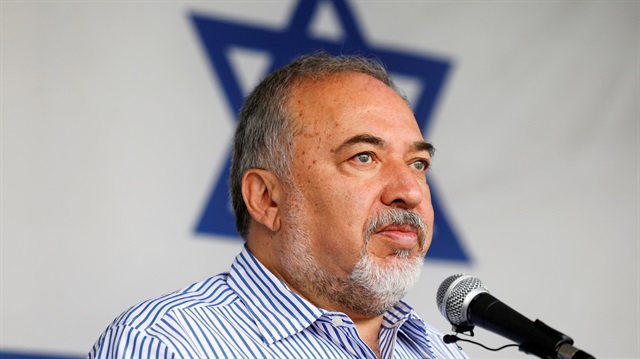
Israeli Defense Minister Avigdor Lieberman
Israel said on Thursday it would not halt strikes on Syria but would do more to "deconflict" them with Russian forces, after Moscow accused it of "irresponsible and unfriendly actions" that led to Syrian ground fire mistakenly downing a Russian plane.
Fifteen Russian crew were killed when the IL-20 surveillance plane crashed near Latakia in northern Syria on Monday. Russia has said Syria shot the plane down shortly after Israeli jets hit the area, and accused Israel of creating the dangerous conditions by failing to give sufficient advance notice.
Although Russian President Vladimir Putin initially described the downing as "tragic chance", Moscow has made its anger clear.
"Moscow views as irresponsible and unfriendly actions of Israeli Air Force, which exposed Russian Il-20 aircraft to danger and led to death of 15 servicemen," the Russian embassy in Tel Aviv said on Twitter in English, adding that Russia would "take all necessary measures to eliminate threat to life and security of our military fighting against terrorism".
A delegation led by Israeli Air Force (IAF) Commander Amikan Norkan will visit Moscow later today to discuss the downing earlier this week of a Russian military plane by Syrian air defenses, the Israeli army has said. According to an army statement, Norkan and members of his delegation will present an extensive report on the incident, including pre-mission data and the findings of an Israeli army inquiry. “The IAF commander will be joined by the head of the International Cooperation Unit, Brigadier-General Erez Maisel, along with officers of the Intelligence Directorate, the IAF and the Operations Directorate,” the statement read. Members of the delegation, it added, planned to present their Russian interlocutors with evidence of what the army described as “continuous Iranian attempts to transfer strategic weapons to the Hezbollah terror organization and establish an Iranian military presence in Syria”. Russia plane downing in Syria causes Russia-Israel riftIn the early hours of Tuesday, Israeli F-16s entered Syrian airspace with a view to striking Syrian military targets in the northwestern Latakia province.Israeli officials later claimed the intended target was an arms factory, weapons from which were meant to be transferred to Lebanon’s Hezbollah, an ally of Syria’s Assad regime and a bitter enemy of Israel.When Syria’s Russian-built S-200 air-defense system responded to the airspace breach, a Russian Il-20 military plane was struck by a missile, destroying the aircraft and killing all 15 servicemen on board.The Russian Defense Ministry held Israel “solely responsible” for the incident, accusing it of committing “irresponsible actions” over Syrian territory.“By hiding behind the Russian plane, Israeli pilots put it in the line of fire,” read a ministry statement issued after the incident.
Israeli air force chief to visit Moscow amid Syria row
Israel has struck Syria scores of times during its seven-year civil war to prevent what it says are transfers of weapons to Hezbollah fighters and other Iranian allies. Russia has largely overlooked the sorties, which the Israelis say pose no direct threat to Moscow's ally, President Bashar al-Assad.
Israel dispatched its air force chief to brief Moscow about the incident on Thursday. Expressing regret at the loss of life, Israel denied wrongdoing and blamed what it called wanton Syrian anti-aircraft fire after its jets had withdrawn back over the border.
Speaking to Army Radio, Defence Minister Avigdor Lieberman made clear that Israel would not halt attacks in Syria.
"We will do whatever is necessary to safeguard the security of Israel's citizens ... and we will not hold these discussions over the airwaves," he said.
Washington's Gulf Arab allies should be included in proposed treaty negotiations with Iran over its ballistic missile programme and regional behaviour, a senior Emiriati official said on Thursday.Brian Hook, U.S. special envoy for Iran, said on Wednesday the United States is seeking to negotiate a treaty with Iran to include Tehran's ballistic missiles and its regional behaviour.Iran has rejected U.S. attempts to hold high-level talks since President Donald Trump tore up a nuclear deal between Tehran and six world powers earlier this year.Anwar Gargash, United Arab Emirates Minister of State for Foreign Affairs, described Hook's comments as "important".Iran asks UN to condemn Israeli threats"It is essential that the Gulf Arab states be a party to the proposed negotiations. It is prudent for Tehran to avoid sanctions and to take these proposals seriously," he tweeted.The UAE, Saudi Arabia and Bahrain swiftly backed Trump's decision in May to withdraw from the nuclear accord and reimpose sanctions on Tehran. The Sunni Muslim-ruled states are at loggerheads with Shi'ite Iran, fighting a proxy war that has influenced conflicts in Iraq, Syria, Lebanon and Yemen.The Gulf Arab states were not party to the nuclear accord, and while they were consulted by Western powers during the talks that led up to it, they played no direct role in those negotiations.Secretary of State Mike Pompeo listed a dozen demands in May that he said could make up a new agreement, although Hook referred to a treaty, which would have to be approved by the U.S. Senate. US seeks to negotiate a treaty with Iran
Gulf Arab states should be party to proposed Iran treaty talks: UAE official
But when pressed during the interview, Lieberman avoided asserting Israeli "freedom of action" over Syria, a term he has used in the past.
Naftali Bennett, another member of Prime Minister Benjamin Netanyahu's security cabinet, said "deconfliction mechanisms" would be improved, referring to a Russian-Israeli hotline designed to avoid inadvertent clashes with forces Moscow sent to Syria as part of a military intervention mounted in 2015.
"We will of course strengthen these mechanisms. We will do everything so as not to harm anyone we do not intend to, God forbid," Bennett told Army Radio in a separate interview.
Ron Ben-Yishai, a veteran Israeli military commentator, predicted a more patient air force approach in future strikes.
"It is possible that, next time, they will say, 'Okay let's wait until the (Russian) plane goes back to its base, and then we will carry out the attack,'" Ben-Yishai told Ynet TV.
Lebanon's Hezbollah guerrillas, who like their patron Iran have been helping Assad militarily in Syria, said Israeli strikes there would not prevent them getting advanced weaponry.
"No matter what you do to cut the route, the matter is over and the resistance possesses precision and non-precision rockets and weapons capabilities," Hezbollah leader Hassan Nasrallah said in a speech.