

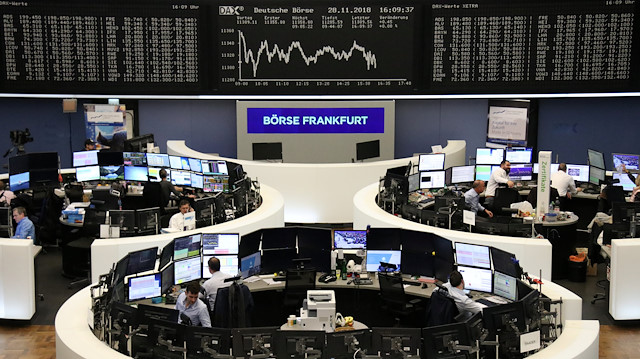
The German share price index DAX graph is pictured at the stock exchange in Frankfurt, Germany.
European shares opened higher on Tuesday as a fresh whiff of optimism over the Sino-U.S. trade dispute lifted sentiment after a burst of political risk and worries about global growth hit world markets during the previous session.
The Euro zone STOXXE index was up 0.7 percent at 0838 GMT with Germany's DAX, the most sensitive to China due to its big exporters, up 0.8 percent.
Earlier, Asian shares got a bounce after reports that Chinese and U.S. trade officials spoke by phone, a sign that discussions between the world's top two economies continue even after the arrest of Huawei's CFO.
"Remember this isn't the first time these backroom negotiations have dangled a carrot in front of the markets," said Oanda trader Stephen Innes.
"And while I view this development as a positively significant in the broader context, a trade war is far from over, and these are little more than a preliminary step in what should be a long and winding road fraught with peril," he added.
France's CAC 40 was up 0.8 percent after French president Emmanuel Macron pledged late on Monday to raise the minimum wage and cut taxes in a bid to prevent more violent protests that have rocked the euro zone's second largest economy.
Britain's FTSE 100 was up 0.5 percent with the pound stabilising after Monday's Brexit-related slide to 20-month lows after Prime Minister Theresa May postponed a key vote on how Britain will leave the European Union.
Among top performers was British advertising giant WPP , which rose 4.9 percent after announcing plans to spend 300 million pounds and cut 2,500 jobs - part of new boss Mark Read's plans to return the world's biggest advertising group to growth.
Shares in Ashtead jumped 6.4 percent as the equipment rental firm said it expected full-year results ahead of expectations.
German Chancellor Angela Merkel on Monday hailed the adoption of UN migration pact, stressing that it would ensure human rights for all, including refugees and migrants.“This is a very important day. We agreed for the first time at global level on a comprehensive political compact for migration,” Merkel said at the Intergovernmental Conference on Global Compact for Migration in Marrakech, Morocco.UN member states adopted a global migration agreement -- namely “The Global Compact for Safe, Orderly and Regular Migration (GCM)” in a UN conference on Monday.German railworkers to go on strike from MondayItaly's League leader faces friendly fire over budgetShe underlined that the pact would be a very good signal for millions of migrants and refugees around the world, ensuring that the “universal human rights apply to each and everyone, in each and every country”.Merkel also stressed that the pact would strengthen efforts to make migration more orderly and safer around the world, and contribute to the fight against illegal migration.Many countries participating in the UN conference refused to sign the non-binding charter, notably Austria, Poland, the Czech Republic, Estonia, Bulgaria, Croatia, the U.S., Hungary, Australia and Israel.The agreement stirred debate in various European countries recently and led to the collapse of coalition government in Belgium.The UN General Assembly is expected to endorse the agreement on December 19.Kramp-Karrenbauer seeks to unite German CDU after leadership battleGermany sees no new EU sanctions on Russia for now
Merkel hails adoption of UN migration pact
German Chancellor Angela Merkel's conservatives gained support in a poll published on Monday after her Christian Democrats (CDU) chose centrist Annegret Kramp-Karrenbauer as the new party leader.Kramp-Karrenbauer, often dubbed "mini Merkel", narrowly beat the more conservative Friedrich Merz in a run-off vote of party delegates. Another conservative, Health Minister Jens Spahn, lost out in a first round.The conservative bloc - made up of the CDU and their Bavarian CSU sister party - has slumped in polls since last year's federal election but picked up 3 percentage points to hit 32 percent in the Forsa poll for broadcasters RTL and n-tv.The survey of 1,506 people was conducted after Kramp-Karrenbauer's election. The previous Forsa poll was published on Dec. 7, the day of the CDU vote.The new support appeared to come at the expense of the Greens who dipped 3 percentage points while support for all other parties was unchanged.German railworkers to go on strike from MondayGermany sees no new EU sanctions on Russia for nowThe poll found half of voters (46 percent) thought the choice of Kramp-Karrenbauer was "a good solution" while around a quarter (24 percent) would have preferred Merz.Almost two-thirds (62 percent) of CDU supporters thought Kramp-Karrenbauer was a good choice while 55 percent of those who back the Social Democrats (SPD) - Merkel's junior coalition partner - were pleased.Merkel needs Kramp-Karrenbauer to unite the CDU to help steady her awkward alliance with the SPD that has come close to collapse several times since being formed in March.The poll showed almost two-thirds (63 percent) of Germans wanted Merkel to remain chancellor until the legislative period ends in 2021 while around a third think she should leave office early.Merkel has said she is prepared to remain chancellor until 2021.The poll showed the SPD on 14 percent while both the pro-business Free Democrats and the hardline Left were unchanged at 8 percent. The far-right Alternative for Germany was on 13 percent. German president reminds young Chinese of 'havoc' caused by MarxismGermany’s CDU set to elect successor to Merkel
New leader nets German conservatives a 3-point poll gain
Simmering tensions between the U.S. and China dented European shares on Monday as investors fled risk at the start of a highly uncertain week with Britain's parliamentary vote on Brexit looming.The pan-European STOXX 600 index fell 0.8 percent to hit a two-year low once more by 0830 GMT, with Britain's FTSE 100 down 0.3 percent. Germany's DAX, the most sensitive to China due to its big exporters, fell 0.9 percent. Shares in BASF fell 4.3 percent after the German chemicals firm slashed its forecast for 2018 profits on Friday.It said the decline was mainly due to its chemicals segment while low water levels on the Rhine and weak automotive demand especially in China were also to blame.Spanish PM warns European socialists about far-rightBASF peer Symrise also tumbled 3.6 percent, helping drag the pan-European chemicals sector down 2.3 percent, the worst-performing.Autos stocks also fell 1.8 percent as trade tensions took their toll.Chipmakers AMS, Siltronic, STMicro also fell 2.9 to 5.1 percent as investors ditched the tech sector.Politics drove some of the biggest moves.French retail, hotel, and transport stocks tumbled anew after a fourth weekend of "yellow vest" protests which are disrupting the economy.British energy utilities Centrica and SSE both fell around 3 percent as investors held their breath ahead of a crucial vote on Brexit on Tuesday.Housebuilders Berkeley Group, Persimmon, Taylor Wimpey and Barratt Development fell 1.5 to 2.5 percent as nerves built and Peel Hunt cut its ratings.Outside large-cap moves, shares in Interserve plunged 71 percent after the embattled British outsourcer said it was in talks with its debt holders and considering converting debt to equity.'Yellow vest protests show Europe has failed on democracy, human rights, and freedom'Round 11 of Turkish Airlines EuroLeague concludes
European stocks tumble as investors shun risk, BASF hit by profit warning