

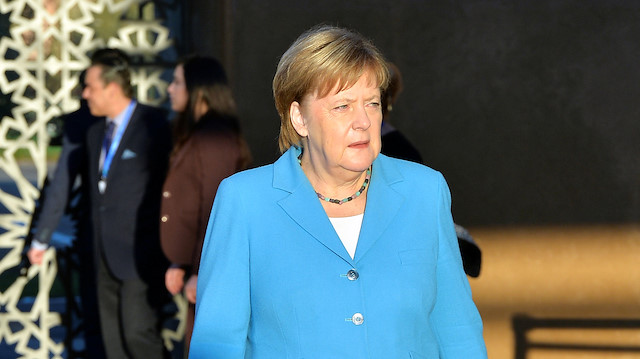
German Chancellor Angela Merkel
German Chancellor Angela Merkel on Monday hailed the adoption of UN migration pact, stressing that it would ensure human rights for all, including refugees and migrants.
“This is a very important day. We agreed for the first time at global level on a comprehensive political compact for migration,” Merkel said at the Intergovernmental Conference on Global Compact for Migration in Marrakech, Morocco.
UN member states adopted a global migration agreement -- namely “The Global Compact for Safe, Orderly and Regular Migration (GCM)” in a UN conference on Monday.
Germany's EVG railway workers' union will start strikes on Monday that will hit local, regional and long-distance trains nationwide after wage talks with rail operator Deutsche Bahn broke down, two union sources said on Sunday.One person familiar with the preparations told Reuters the union did not want to limit itself to just a few routes or one form of transport although some regions would be worse hit than others.The union, which represents most railway industry workers and professionals, had said on Saturday that warning strikes would be unavoidable, raising fears that Christmas travel could be disrupted.The EVG wants a 7.5 percent wage increase and has also made demands on working hours and holidays.Deutsche Bahn, also in talks with the smaller train drivers' union GDL, said it had offered a 5.1 percent wage rise in two stages and a one-off payment of 500 euros ($568.80). Overall, the package is equivalent to a 7 percent rise, it said. It has said the EVG decision to break off talks were causing a "completely unnecessary escalation" which will unsettle travellers over the Christmas period.No one at the EVG union was available to comment. ($1 = 0.8790 euros) France's Macron to give speech in coming week amid further violent protests
German railworkers to go on strike from Monday
Italy's deputy prime minister, Matteo Salvini, normally relishes confrontation, but now the firebrand populist is under attack from a place he calls home.Dissent is growing in his League party's political heartland, the industrial north, adding to pressure on Salvini and his coalition partner to reverse course on their 2019 budget."I always thought the League was able to help people who work - real people - and for this I had put my trust in them at this historic moment," said industrialist Patrizio Dei Tos, who had high hopes when the League took power six months ago.Now, he and other northern entrepreneurs are not so sure.Since the League and the anti-establishment 5-Star party formed a government, the economy has gone into reverse and the new administration's big-spending budget plans have sent interest rates up and prompted fears of another banking crisis.In the regions of Lombardy and Veneto, which together account for a third of the national economy and are run by League administrations, small to medium-sized businesses have begun to openly question party leader Salvini's strategy.Italian right hits Rome, chants 'Italians first!'"We are focusing on running the country according to emotions instead of the numbers," said Dei Tos, whose wood-flooring firm Gruppo Labor Legno has annual sales of around 40 million euros ($45 million)."We must be careful not to push our luck."Even as Salvini, who is also interior minister, wins national popularity from his crackdown on immigration, his core constituency of family entrepreneurs, from the self-employed to rich industrialists, fear the economy is already in recession and the government's spending plans will make things worse.Salvini is stretching the League's brand, winning new voters but straying somewhat from his northern base. He is basically holding firm for now and the League is ready only to make a minor cut to the 2019 budget deficit target of 2.4 percent of GDP, senior party sources said.But dissent in League heartlands adds to the intense pressure on him to give ground on the budget in a confrontation that the European Commission and investors believe could undermine the euro zone.The deficit target is three times the amount pencilled in by the previous administration, and has been rejected by the Commission as a breach of EU rules requiring Rome to steadily reduce its public debt burden.Italian bond yields exceed those on safe-haven German bonds by almost 3 percentage points, double the spread that prevailed before the government was sworn in. That has prompted lenders to raise interest rates and fanned fears of financial instability, since banks are large holders of government bonds.Milan's stock index has fallen by a fifth since mid May. Growth fell 0.1 percent in the third quarter, with some economists predicting another contraction in the fourth as consumption and investment weaken. Last month, consumer and business confidence touched two-year lows.Feeling AbandonedAlberto Bombassei, co-founder and chairman of auto-parts maker Brembo, based in Lombardy, notes that his firm has lost almost a quarter of its value since the new government was sworn in."For many, the problem is 5-Star but even our good chap Salvini has agreed on measures he shouldn't have agreed on. Both have abandoned the business community," said Bombassei, whose company employs more than 3,000 in Italy.Vincenzo Boccia, head of Italy's biggest business lobby Confindustria, once held high hopes for the League, telling a meeting of industrialists in the northern city of Vicenza in September: "The League is close to the working class and to the entrepreneurs. We have very high expectations."Now, he voices deep disappointment at the way the coalition is managing the euro zone's second-biggest manufacturer."The budget does very little for growth and Italy could tumble into recession. A consistent part of our members have voted for the League but 100 percent of those I have met are against this fiscal plan," Boccia said in a TV interview.Confindustria wants Rome to boost infrastructure investment and says the budget instead focuses spending on welfare measures: a League promise to ease retirement rules and a 5-Star pledge to introduce a kind of universal income to fight poverty.On Monday, Confindustria joined other employers' groups representing 65 percent of GDP to demand the government change course and boost investment.League politicians deny they are under pressure from their supporters to change course on the budget, saying the unhappiness is directed at 5-Star rather than Salvini."I am for staying in power with the 5-Star until the European parliamentary elections in May," said Roberto Rolle, a local councillor in Padua whose party is allied with the League."Then we'll count our forces and decide whether to go ahead together. Without 5-Star, the government will do much better."The coalition's combined approval ratings are climbing. A recent poll shows the League and 5-Star have 57.5 percent support, up from 50.1 percent at March elections. The League alone enjoys 32 percent approval, almost double its March vote."This government is loved by people and polls say approvals are stellar," said lawmaker Gianluca Paolini, a 23-year League veteran in the central region of Marche.Supporters staged a mass rally in Rome on Saturday to back the League, with Salvini in defiant form."If you call into question our right and duty to restore dignity, pride, security, pensions and work to millions of Italians, then I tell you we will not be turning back," Salvini told cheering crowds.Political experts say the anger of small-scale entrepreneurs will have an impact on Salvini but it will be limited, since he has broadened the party's appeal beyond its business-focused base, which anyway has few alternatives."The League cannot ignore the entrepreneurs because they represent its constituency. If they are unhappy the League has to take note and give responses," said Giovanni Orsina, a political expert at Rome's LUISS University.But he said its real problems were the market turmoil and economic slide that triggered the business backlash.Some businessmen say the dour economic mood will eventually bring the party's poll ratings back to earth."Ordinary people only become aware of the economic trends with some delay," said Gianluca Pavanello, chief executive of technical sportswear firm Macron, based in Bologna.
Italy's League leader faces friendly fire over budget
She underlined that the pact would be a very good signal for millions of migrants and refugees around the world, ensuring that the “universal human rights apply to each and everyone, in each and every country”.
Merkel also stressed that the pact would strengthen efforts to make migration more orderly and safer around the world, and contribute to the fight against illegal migration.
Many countries participating in the UN conference refused to sign the non-binding charter, notably Austria, Poland, the Czech Republic, Estonia, Bulgaria, Croatia, the U.S., Hungary, Australia and Israel.
The agreement stirred debate in various European countries recently and led to the collapse of coalition government in Belgium.
The UN General Assembly is expected to endorse the agreement on December 19.
Annegret Kramp-Karrenbauer, the new leader of Chancellor Angela Merkel's Christian Democrats, sought to bind the party together after a divisive leadership battle by promoting a rival's ally to a key post on Saturday.Delegates from the Christian Democratic Union (CDU) elected Kramp-Karrenbauer, 56, on Friday to replace Merkel as party leader, a decision that moves her into pole position to succeed Europe's most influential leader as chancellor.Kramp-Karrenbauer, the continuity candidate favoured by the party elite, won a narrow victory over the more conservative Friedrich Merz in a run-off. Health Minister Jens Spahn, also a more conservative candidate, was knocked out in a first round.On Saturday, Kramp-Karrenbauer proposed Paul Ziemiak, head of the Junge Union, the conservatives' youth wing, to replace her as CDU secretary general - a role in which he will organise the party, election campaigns and congresses, and support her.Kramp-Karrenbauer elected Merkel’s successor in GermanyParty delegates duly elected Ziemiak, 33, but with just 62.8 percent of the votes cast - a far narrower margin than the overwhelming 98.9 percent support with which Kramp-Karrenbauer was elected to the secretary general post in February.The tight nature of Ziemiak's victory reflected the divisions in the CDU after a robust campaign for the leadership. Kramp-Karrenbauer's first job as new party leader is to try to unite the CDU ahead of European and regional elections in 2019."Paul Ziemiak is from the home region of Friedrich Merz. He's a close friend, from the Junge Union, of Jens Spahn," David McAllister, a member of the CDU's executive committee, told Reuters."So this move to choose Paul Ziemiak is a step forward by Annegret Kramp-Karrenbauer, trying to unite the different camps which the endorsed the three different candidates," he added.Merkel needs Kramp-Karrenbauer to unite the CDU to help steady her ruling coalition with the centre-left Social Democratic Party (SPD) - an awkward alliance that has come close to collapse several times since being formed in March. 
Kramp-Karrenbauer seeks to unite German CDU after leadership battle
Germany does not envision EU sanctions against Russia over its conflict with Ukraine as long as de-escalation efforts continue, Foreign Minister Heiko Maas said on Friday."At this time I believe it would be wrong to talk about new sanctions, because efforts are being made to reduce tensions," he told a briefing after meeting his counterpart in Lisbon."From the German side, there will be no proposal for new sanctions," he added. "I don't see a consensus in the EU for new sanctions." 
Germany sees no new EU sanctions on Russia for now