

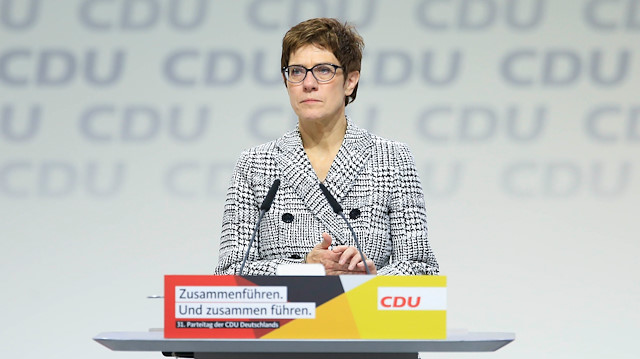
New CDU leader Annegret Kramp-Karrenbauer
Annegret Kramp-Karrenbauer, the new leader of Chancellor Angela Merkel's Christian Democrats, sought to bind the party together after a divisive leadership battle by promoting a rival's ally to a key post on Saturday.
Delegates from the Christian Democratic Union (CDU) elected Kramp-Karrenbauer, 56, on Friday to replace Merkel as party leader, a decision that moves her into pole position to succeed Europe's most influential leader as chancellor.
Kramp-Karrenbauer, the continuity candidate favoured by the party elite, won a narrow victory over the more conservative Friedrich Merz in a run-off. Health Minister Jens Spahn, also a more conservative candidate, was knocked out in a first round.
On Saturday, Kramp-Karrenbauer proposed Paul Ziemiak, head of the Junge Union, the conservatives' youth wing, to replace her as CDU secretary general - a role in which he will organise the party, election campaigns and congresses, and support her.
Chancellor Angela Merkel’s preferred candidate Annegret Kramp-Karrenbauer has won the race on for the leadership of the ruling Christian Democratic Union (CDU) party.IIn a knife-edge runoff on Friday, the 56-year-old conservative politician won 517 votes from the CDU delegates, at a party conference in Hamburg.Her main rival Friedrich Merz, an outspoken critic of Merkel’s liberal refugee policy, got 482 votes.Earlier on Friday, Kramp-Karrenbauer called on the CDU delegates to be more courageous and self-confident to address the challenges of 21st century, to strengthen the European Union and defend the “rules-based international order.”Merz, for his part, criticized Merkel’s open door policy for refugees, and called for a “new start” for the CDU, with a new strategy on various political issues.He pledged to win back voters the CDU has lost to the far-right Alternative for Germany, or the AfD.Merkel, who led the Christian Democrats for 18 years, announced in October that she will not run for the chair again amid heavy losses of her party in regional elections.But Merkel underlined that she wanted to remain chancellor until her term ends in 2021.Germany’s CDU set to elect successor to Merkel
Kramp-Karrenbauer elected Merkel’s successor in Germany
Party delegates duly elected Ziemiak, 33, but with just 62.8 percent of the votes cast - a far narrower margin than the overwhelming 98.9 percent support with which Kramp-Karrenbauer was elected to the secretary general post in February.
The tight nature of Ziemiak's victory reflected the divisions in the CDU after a robust campaign for the leadership. Kramp-Karrenbauer's first job as new party leader is to try to unite the CDU ahead of European and regional elections in 2019.
"Paul Ziemiak is from the home region of Friedrich Merz. He's a close friend, from the Junge Union, of Jens Spahn," David McAllister, a member of the CDU's executive committee, told Reuters.
"So this move to choose Paul Ziemiak is a step forward by Annegret Kramp-Karrenbauer, trying to unite the different camps which the endorsed the three different candidates," he added.
Merkel needs Kramp-Karrenbauer to unite the CDU to help steady her ruling coalition with the centre-left Social Democratic Party (SPD) - an awkward alliance that has come close to collapse several times since being formed in March.