

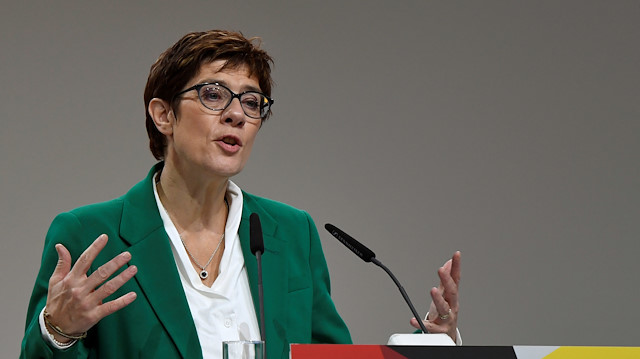
Newly elected CDU leader Annegret Kramp-Karrenbauer announces Paul Ziemiak as a candidate for party's secretary general, during the Christian Democratic Union (CDU) party congress in Hamburg, Germany.
German Chancellor Angela Merkel's conservatives gained support in a poll published on Monday after her Christian Democrats (CDU) chose centrist Annegret Kramp-Karrenbauer as the new party leader.
Kramp-Karrenbauer, often dubbed "mini Merkel", narrowly beat the more conservative Friedrich Merz in a run-off vote of party delegates. Another conservative, Health Minister Jens Spahn, lost out in a first round.
The conservative bloc - made up of the CDU and their Bavarian CSU sister party - has slumped in polls since last year's federal election but picked up 3 percentage points to hit 32 percent in the Forsa poll for broadcasters RTL and n-tv.
The survey of 1,506 people was conducted after Kramp-Karrenbauer's election. The previous Forsa poll was published on Dec. 7, the day of the CDU vote.
The new support appeared to come at the expense of the Greens who dipped 3 percentage points while support for all other parties was unchanged.
Germany's EVG railway workers' union will start strikes on Monday that will hit local, regional and long-distance trains nationwide after wage talks with rail operator Deutsche Bahn broke down, two union sources said on Sunday.One person familiar with the preparations told Reuters the union did not want to limit itself to just a few routes or one form of transport although some regions would be worse hit than others.The union, which represents most railway industry workers and professionals, had said on Saturday that warning strikes would be unavoidable, raising fears that Christmas travel could be disrupted.The EVG wants a 7.5 percent wage increase and has also made demands on working hours and holidays.Deutsche Bahn, also in talks with the smaller train drivers' union GDL, said it had offered a 5.1 percent wage rise in two stages and a one-off payment of 500 euros ($568.80). Overall, the package is equivalent to a 7 percent rise, it said. It has said the EVG decision to break off talks were causing a "completely unnecessary escalation" which will unsettle travellers over the Christmas period.No one at the EVG union was available to comment. ($1 = 0.8790 euros) France's Macron to give speech in coming week amid further violent protests
German railworkers to go on strike from Monday
Germany does not envision EU sanctions against Russia over its conflict with Ukraine as long as de-escalation efforts continue, Foreign Minister Heiko Maas said on Friday."At this time I believe it would be wrong to talk about new sanctions, because efforts are being made to reduce tensions," he told a briefing after meeting his counterpart in Lisbon."From the German side, there will be no proposal for new sanctions," he added. "I don't see a consensus in the EU for new sanctions." 
Germany sees no new EU sanctions on Russia for now
The poll found half of voters (46 percent) thought the choice of Kramp-Karrenbauer was "a good solution" while around a quarter (24 percent) would have preferred Merz.
Almost two-thirds (62 percent) of CDU supporters thought Kramp-Karrenbauer was a good choice while 55 percent of those who back the Social Democrats (SPD) - Merkel's junior coalition partner - were pleased.
Merkel needs Kramp-Karrenbauer to unite the CDU to help steady her awkward alliance with the SPD that has come close to collapse several times since being formed in March.
The poll showed almost two-thirds (63 percent) of Germans wanted Merkel to remain chancellor until the legislative period ends in 2021 while around a third think she should leave office early.
Merkel has said she is prepared to remain chancellor until 2021.
The poll showed the SPD on 14 percent while both the pro-business Free Democrats and the hardline Left were unchanged at 8 percent. The far-right Alternative for Germany was on 13 percent.
German President Frank-Walter Steinmeier told Chinese students on Friday that "havoc" was wrought in the name of Karl Marx in Germany and eastern Europe, but that Marx also stood for things like freedom of the press.Marx is lauded in China, and in May President Xi Jinping said the decision of the ruling Communist Party to stick with his political theories remained "totally correct", in a speech to coincide with the 200th anniversary of the German philosopher's birth.Xi's speech came near the end of a week-long propaganda blitz by state media, with chat shows saying "Marx was Right" and cartoons of his wild youth aiming to show his theories remain relevant to modern China and the next generation.Speaking to students at Sichuan University in southwestern China, Steinmeier noted that China had this year donated a big statue of the founding father of communism to his German birthplace of Trier - controversial at the time due to German concerns at China's poor human rights record.Slow train to China: India's trade ties with Beijing taking time to ripen"In this anniversary year, it seems to me that Germans and Chinese can have very different views not only of current issues, but also of the same historical and intellectual ideas," Steinmeier said, according to a copy of the speech provided by the German embassy in Beijing.There was no doubt Marx was a great German intellectual, an influential philosopher, economist, historian and sociologist, and a "rather less successful educator and workers' leader", the president said."However, there is also no doubt that Marx was a passionate humanist. He demanded freedom of the press, humane working conditions, universal education, political rights for women and environmental protection," he said.But Marx's ideas did not remain theoretical, Steinmeier said.China hails Trump-Xi summit, says 'very confident' in trade deal"We Germans cannot talk about Marx without also thinking of the havoc wrought in his name in eastern Germany and Europe – the depressing time of the Iron Curtain."During that time, Marxism was everything and the individual counted for nothing, families were torn apart, neighbours pitted against each other, and "people confined behind walls and people who attempted to flee murdered", he said.Steinmeier did make any specific criticisms of China, where attention most recently has focused on widespread concern in Western capitals about re-education camps for ethnic Uighurs and other Muslim peoples in China's Xinjiang region.China to stick to 'mutual respect' in dealings with world: XiGermany's history, he said, was for many years marked by "dictatorship and repression"."This makes us particularly sensitive to and aware of what happens to those who do not share the prevailing opinion, belong to an ethnic minority, want to practise their religion or campaign non-violently and peacefully for their ideas and beliefs," Steinmeier said."That is why we are worried and alarmed whenever personal freedoms are curtailed."
German president reminds young Chinese of 'havoc' caused by Marxism
Germany's Christian Democrats (CDU) are set to vote on Friday to choose Chancellor Angela Merkel’s successor as party leader in a knife-edge election.Recent surveys showed around 48 percent of the CDU voters backed Merkel loyalist Annegret Kramp-Karrenbauer for the leadership, while 35 percent supported Friedrich Merz, an outspoken critic of Merkel’s refugee policy.It was not clear how the electorate’s choice would be reflected in the decision of 1,001 delegates, who will gather in Hamburg to elect the new party chair.Parliament speaker Wolfgang Schaeuble, one of Germany's most powerful politicians, announced his support for Merz, in an interview with Frankfurter Allgemeine Zeitung on Wednesday.Several other key figures of the CDU, including EU Commissioner Guenther Oettinger, also backed Merz for the CDU leadership.The 62-year-old candidate, branded by critics as “Trump light,” had challenged Merkel in 2002, but lost the power struggle, and later withdrew from politics in 2009.Merkel’s right-hand man, Economy Minister Peter Altmaier said on Thursday that he would support Kramp-Karrenbauer, as she would be the best candidate to lead the CDU.56-year-old Kramp-Karrenbauer was the premier of the southwestern German state of Saarland from 2011 ahd 2018, and in February this year she was promoted to CDU secretary-general.Merkel, who led the Christian Democrats for 18 years, announced in October that she will not run for the chair again amid heavy losses of her party in regional elections.But Merkel underlined that she wanted to remain chancellor until her term ends in 2021.
Germany’s CDU set to elect successor to Merkel