

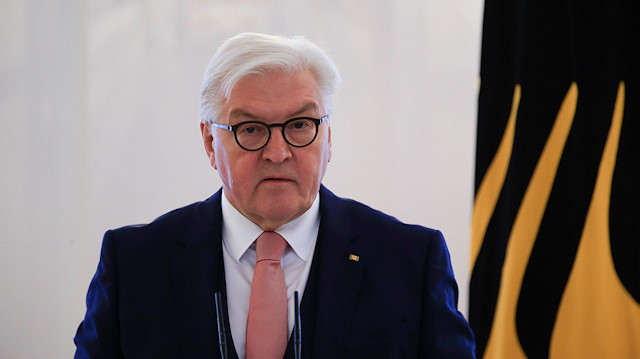
German President Frank-Walter Steinmeier
German President Frank-Walter Steinmeier told Chinese students on Friday that "havoc" was wrought in the name of Karl Marx in Germany and eastern Europe, but that Marx also stood for things like freedom of the press.
Marx is lauded in China, and in May President Xi Jinping said the decision of the ruling Communist Party to stick with his political theories remained "totally correct", in a speech to coincide with the 200th anniversary of the German philosopher's birth.
Xi's speech came near the end of a week-long propaganda blitz by state media, with chat shows saying "Marx was Right" and cartoons of his wild youth aiming to show his theories remain relevant to modern China and the next generation.
Speaking to students at Sichuan University in southwestern China, Steinmeier noted that China had this year donated a big statue of the founding father of communism to his German birthplace of Trier - controversial at the time due to German concerns at China's poor human rights record.
China and India may be talking about improving their trade relationship but there is little action to go with the words.According to Indian government officials and representatives of various Indian trade bodies, progress is very slow - and may even be getting slower after last weekend's truce between the United States and China in their trade war.Both India and China have sought to rebuild trust after a armed standoff over a stretch of the Himalayan border last year.Indian Prime Minister Narendra Modi and Chinese President Xi Jinping have met a number of times this year to give impetus to the trade discussions. The latest was last week, when they met on the sidelines of the G20 meeting in Argentina.China hails Trump-Xi summit, says 'very confident' in trade dealIndian and Chinese officials said after that meeting there was talk of Beijing increasing its soymeal, rapeseed meal, rice and sugar imports from India, while China would push for more Chinese exports of dairy products, apples and pears to India.India is also keen to increase its exports of drugs to China.In reality, though, getting such exchanges turned into deals is going to be a laborious process."When we say the Chinese are receptive, it means the talks are happening, but it's going slow," said one senior Indian government official with direct knowledge of the discussions. "It can be termed as progress because just a few months ago, we weren't even talking," said the official, who did not wish to be named because he is not authorised to talk to media.The Chinese commerce ministry did not respond to a faxed request for comment for this article.China commerce ministry says goal in trade talks with US is to remove all tariffsBilateral trade between China and India touched $89.71 billion in the year ending March 2018, with the trade deficit widening to $63.05 billion in China's favour, more than a nine-fold increase over the past decade.The Indian government is very keen to reduce that gap. A recent study commissioned by India's trade ministry and reviewed by Reuters, said: "There is no bilateral trade relationship of greater economic and political significance for India than with China."The reduction in trade tensions between Washington and Beijing, which has led to a delay in the imposition of larger punitive tariffs by the United States pending further trade talks over a 90-day period, means that the Chinese government may not feel the need to speed up its discussions with New Delhi, Indian officials said.The government has received calls from jittery exporters who want to know whether the improvement in the relationship between China and the United States would make India's position weaker, said the senior Indian government official.Security tightened in north India on eve of mosque demolitionROADBLOCK FOR INDIAAjay Sahai, director general of the Federation of Indian Export Organisations, also said China's truce with the United States may be a roadblock to improved trade with Beijing."As it is, the China-U.S. tariff tension was a temporary opportunity and it is not correct for companies to base their long-term strategies on it," said Sahai.One longer term impediment to improved trade is product quality, and trade, industry and government officials in India said both Beijing and New Delhi could take time to iron out their differences.Last week, India and China signed an agreement allowing Beijing to inspect imports of Indian fish meal and fish oil.A Chinese trade delegation is coming to India on Dec. 10 to inspect soymeal plants, said D.N. Pathak, executive director of the Soybean Processors Association of India.India wants China to drop a years-long ban on soymeal imports from the South Asian nation. China was a leading buyer of Indian soymeal, a key ingredient in animal feed, until Beijing banned the purchases in late 2011 over quality concerns.In November, India's trade ministry said the country could export up to 2 million tonnes of sugar, but trade officials said the target was too steep because China has already exhausted its import quota for this year.Although India has contracted to sell some tiny shipments of rice to China, officials said New Delhi would find it difficult to boost volumes as Beijing has traditionally been importing the staple from Vietnam and Thailand and the Chinese would take time to develop a taste for Indian rice. 
Slow train to China: India's trade ties with Beijing taking time to ripen
"In this anniversary year, it seems to me that Germans and Chinese can have very different views not only of current issues, but also of the same historical and intellectual ideas," Steinmeier said, according to a copy of the speech provided by the German embassy in Beijing.
There was no doubt Marx was a great German intellectual, an influential philosopher, economist, historian and sociologist, and a "rather less successful educator and workers' leader", the president said.
"However, there is also no doubt that Marx was a passionate humanist. He demanded freedom of the press, humane working conditions, universal education, political rights for women and environmental protection," he said.
But Marx's ideas did not remain theoretical, Steinmeier said.
China on Thursday expressed confidence in striking a trade deal with the United States within their 90-day ceasefire period, praising the recent meeting between U.S. President Donald Trump and Chinese President Xi Jinping as highly successful.In Argentina last weekend, Trump and Xi agreed to a truce that delayed the planned Jan. 1 U.S. hike of tariffs to 25 percent from 10 percent on $200 billion of Chinese goods while they negotiate a trade deal."We are very confident in reaching an agreement (with the United States) within the next 90 days," China's commerce ministry spokesman Gao Feng said in a weekly briefing, adding both sides have been communicating and cooperating "smoothly" since the leaders met in Argentina.China's ultimate goal during the 90-day trade talks is to remove all U.S. tariffs imposed on Chinese goods, Gao said.China commerce ministry says goal in trade talks with US is to remove all tariffsHis comments come as the arrest of a top executive of Chinese tech giant Huawei by Canadian authorities, on Washington's request, threatens to spark a flare-up in tensions between the world's two economic powerhouses once again.The two countries have hit each other with tit-for-tariffs on goods worth hundreds of billions of dollars in sectors from automobiles to agriculture and energy, stymying trade and redrawing global supply chains.Gao confirmed for the first time since the high-stakes meeting that China had agreed to implement consensus reached by both sides on agriculture, energy and cars, although he did not give details on any specific measures."We will start with agricultural products, energy, automobiles to immediately implement the issues that the two sides have reached consensus," Gao said, when asked about what is on the negotiation agenda.China telecoms giant Huawei CFO arrested in Canada"Then, in the next 90 days, we will follow a clear timetable and roadmap to negotiate on issues such as intellectual property right protection, tech cooperation, market access and trade balance," he said, stressing the consultations should be based on meeting the interests of both parties.The White House has said China had committed to start buying more American products and lifting tariff and non-tariff barriers immediately, while beginning talks on structural changes with respect to forced technology transfers and intellectual property protection.The United States has levied additional duties of between 10 percent and 25 percent on $250 billion of Chinese goods this year as punishment for what it calls China's unfair trade practices. China has responded with its own tariffs.Huawei founder's daughter arrested on US request, puts trade war truce in doubt"China and United States have reached very important consensus as both sides' interests overlap," Gao said. His comments echoed earlier remarks made by senior Chinese diplomat Wang Yi, who said the meeting was "friendly and candid" and would help to avoid further trade tensions."All of these help to safeguard China's legitimate interests, and are also in the interests of the United States, and even more are in line with the expectations of the international community," he added in a statement carried on the foreign ministry's website.But global markets have been nervous about the prospects of a Sino-U.S. trade dispute spilling over to growing rivalry between both sides in areas such as technology, and many economists have remained cautious about being too optimistic on a temporary truce.The daughter of Huawei's founder is facing extradition to the United States, dealing a blow to hopes of an easing of Sino-U.S. trade tensions and rocking global stock markets.Trump also warned this week of more tariffs if the two sides could not resolve their differences.
China hails Trump-Xi summit, says 'very confident' in trade deal
"We Germans cannot talk about Marx without also thinking of the havoc wrought in his name in eastern Germany and Europe – the depressing time of the Iron Curtain."
During that time, Marxism was everything and the individual counted for nothing, families were torn apart, neighbours pitted against each other, and "people confined behind walls and people who attempted to flee murdered", he said.
Steinmeier did make any specific criticisms of China, where attention most recently has focused on widespread concern in Western capitals about re-education camps for ethnic Uighurs and other Muslim peoples in China's Xinjiang region.
Chinese President Xi Jinping said on Wednesday that China will always stick to "mutual respect" in its efforts to deal with global challenges.Xi made the comment during a visit to Portugal, the last stop on a trip that included a meeting of G20 leaders in Buenos Aires, where China and the United States agreed to negotiate a solution to their trade war."Even though the world is facing many challenges, China will always adhere to mutual respect and peaceful development, promote peace and stability," Xi said in a short speech.He added that during his trip he had felt people's aspirations for "peace, stability, prosperity and a better life".During Xi's two-day visit to Lisbon, Portugal and China signed a memorandum of understanding on cooperation on Beijing's belt and road initiative - which promotes expanding land and sea links between Asia, Africa and Europe, with billions of dollars pledged for infrastructure development.His visit reinforced China's strong presence in the Iberian country, particularly as an investor in sectors from energy to banking.The memorandum covers a wide range of sectors, especially digital connectivity and electric mobility, according to a statement from the Portuguese prime minister's office. China implements homestay program to monitor ethnic minoritiesTrump says he believes China's Xi is sincere on trade
China to stick to 'mutual respect' in dealings with world: Xi
Germany's history, he said, was for many years marked by "dictatorship and repression".
"This makes us particularly sensitive to and aware of what happens to those who do not share the prevailing opinion, belong to an ethnic minority, want to practise their religion or campaign non-violently and peacefully for their ideas and beliefs," Steinmeier said.
"That is why we are worried and alarmed whenever personal freedoms are curtailed."