

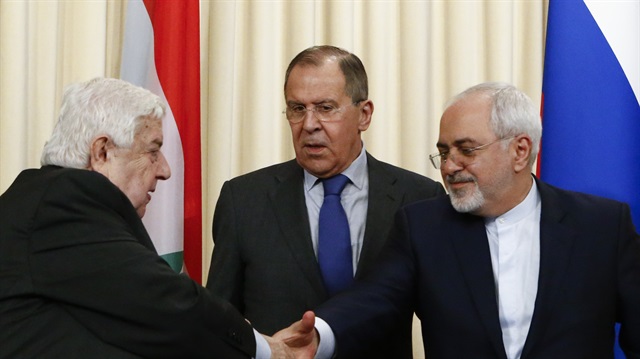
File photo: Foreign Ministers, Sergei Lavrov (C) of Russia, Walid al-Muallem (L) of Syria and Mohammad Javad Zarif of Iran, attend a news conference in Moscow
Syrian Foreign Minister Walid al-Muallem will visit Moscow on Thursday ahead of Syrian peace talks in Geneva, according to the Russian Foreign Ministry on Wednesday.
Al-Muallem would discuss with Russian Foreign Minister Sergey Lavrov the Geneva peace talks scheduled on Sept. 14, repatriation of the Syrian refugees, and "staged” chemical attacks in Idlib, the ministry said in a statement.
Syria has been locked in a vicious civil war since 2011 when the Bashar al-Assad regime cracked down on pro-democracy protests with unexpected ferocity.
Since then, hundreds of thousands of people have been killed and millions displaced in the conflict, according to the UN.
Russia has deployed several frigates to the Mediterranean via the Bosphorus, an analysis of shipping traffic showed, part of what a Russian newspaper on Tuesday called Moscow's largest naval buildup since it entered the Syrian conflict in 2015.The reinforcement comes as Russia's ally, Syrian President Bashar al-Assad, is believed to be considering an assault on the last big opposition-held enclave, Idlib in the north.Russia has accused the United States of building up its own forces in the Middle East in preparation for a possible strike on Syrian government forces.UN invites US and allies for Syria talks next monthOn Saturday, the Admiral Grigorovich and Admiral Essen frigates sailed through Istanbul's Bosphorus towards the Mediterranean, Reuters pictures showed.The day before, the Pytlivy frigate and landing ship Nikolai Filchenkov were pictured sailing through the Turkish straits that connect the Black Sea with the Mediterranean. The Vishny Volochek missile corvette passed through earlier this month.The Izvestia newspaper said Russia had gathered its largest naval presence in the Mediterranean Sea since it intervened in Syria in 2015 turning the tide in Assad's favour.The force included 10 vessels, most of them armed with long-range Kalibr cruise missiles, Izvestia wrote, adding that more were on the way, and that two submarines had also been deployed. Ties to Russia no alternative to US, EU: Turkish FMRussia to hold biggest war games in nearly four decades
Russia reinforces naval forces in Mediterranean off Syrian coast
Iran will maintain its military presence in Syria despite U.S. pressure for its withdrawal, a senior Iranian official said on Tuesday, revealing more details about a military cooperation deal that Tehran and Damascus signed this week.Iranian Defence Minister Amir Hatami visited Damascus on Saturday for talks with Syrian President Bashar al-Assad and senior military officials. He signed a deal for military cooperation in a meeting with his Syrian counterpart, but details of the accord were not revealed."The continued presence of Iranian (military) advisers in Syria was part of this military cooperation agreement between Tehran and Damascus," the state news agency IRNA quoted Tehran's military attache to Damascus, Abolqassem Alinejad, as saying.Iran president defends economic performance before MPsThe accord also emphasised the importance of Syria's territorial integrity and sovereignty, he said, adding that it came into effect on the day of its signing."Iran will help Syria in clearing minefields in different parts of the country... Iran will help Syria to rebuild the military factories that were damaged in the war," Alinejad said.Iran’s Revolutionary Guards have sent weapons and thousands of soldiers to Syria to help shore up Assad during the seven-year-long civil war there.Iran shuts down scores of military-run companiesU.S. National Security Adviser John Bolton reiterated last week Washington's call for Iran to remove all its forces from Syria.The United States has reimposed economic sanctions against Iran partly over its involvement in conflicts in Syria, Iraq and Yemen as well as over its nuclear and missile programmes.Israel has accused Tehran of seeking a permanent military presence in Syria. Iran has repeatedly said its military presence in Syria is at the invitation of the Assad government and that it has no immediate plans to withdraw.Iran and Syria sign deal for military cooperationMore than 1,000 Iranians, including senior members of the elite Revolutionary Guards, have been killed in Syria since 2012.The Guards initially kept quiet about their role in the Syria conflict. But in recent years, as casualties have mounted, they have been more outspoken about their engagement, framing it as an existential struggle against Daesh.
Iran says to maintain military presence in Syria despite US pressure
U.N. Syria envoy Staffan de Mistura has invited the United States and six other countries for talks in Geneva next month, a U.N. spokeswoman said on Tuesday, as the United Nations continues its push for a new Syrian constitution.He plans to meet senior representatives from the United States, Britain, Saudi Arabia, Jordan, Germany, France and Egypt on Sept. 14, two days after he meets officials from Russia, Turkey and Iran on Sept 11-12 for previously announced talks."This is going to be an opportunity to discuss the way ahead on the political process," U.N. spokeswoman Alessandra Vellucci said.US: Iran misusing World Court with suit aimed at lifting sanctionsDe Mistura is tasked with forming a committee of Syrian citizens to draw up the new constitution, after receiving nominations from the Syrian government and the opposition.The planned meetings follow a similar set of talks with both groups of countries in June, although Egypt was not involved in that round.The discussions about setting up a constitutional committee have made slow progress and represent a big downgrade in the United Nations' ambitions for Syrian peace talks.‘US seeks to strengthen presence in Syria by setting up missile defense shield’For two years the warring sides repeatedly came to Geneva, in a futile search for agreement on political reforms, a new constitution and new elections.But this year, with little U.S. political involvement and major gains on the battlefield by Syrian President Bashar al-Assad and his Russian and Iranian allies, the U.N. political process has largely evaporated. 
UN invites US and allies for Syria talks next month
The Washington administration, which intends to maintain a permanent presence in Syria, has completed the construction of three advanced radar systems in Syria’s Hasakah-Tal Baidar countryside along with the Ayn al-Arab and Sarrin regions, and has set up 13 portable and fixed observation-intelligence radar systems.Speaking to Yeni Şafak daily, former Commander of Syria's Deir Ezzor Military Assembly Fayez al-Esmer evaluated the U.S.’s latest moves in Syria and said that in an addition to all attempts to protect Kurdistan Workers’ Party (PKK) terrorists in the region, Pentagon is in preparation to set up a missile defense shield in Syria’s Hasakah and Rmeilan.“The U.S.’s next step is to build a missile defense shield in the region which must be considered as a part of Washington’s long-term plan for chaos in the region,” he said.The U.S. has already begun to create a new no-fly-zone in northern Syria, the same tactic used in the 1991 occupation of Iraq, and started to install advanced radar systems in a 26,000 square kilometer area occupied by the Syrian affiliate of the Kurdistan Workers’ Party (PKK), the PYD, east of the Euphrates. US sets up radars in northern Syria to ‘protect PKK terrorists’Alternatives to Incirlik Air Base Additionally, the U.S administration is looking for alternatives to Incirlik Air Base because of its current strained relationship with Turkey.Incirlik Air base was used during the defeated 15 July coup attempt to aid terrorists of the Fetullah Terrorist Organization (FETÖ) as well as to provide logistics support to Kurdistan Workers’ Party (PKK) in Syria.U.S. warplanes at Incirlik Air Base were moved to other bases, and only cargo planes, refueling aircraft, and scout planes remain.Lately, the U.S. is converting its bases into aerial operation centers in Iraq’s Al Asad, Ayn al-Asad, Qayyarah, as well as those in Rimeylan, Ayn el Arab, Tal Baidar and Sarrin in Syria.Turkey and the U.S. are currently experiencing rocky relations following Washington’s imposition of sanctions on Interior Minister Süleyman Soylu and Justice Minister Abdülhamit Gül for not releasing American Pastor Andrew Brunson, who faces terrorism charges in Turkey.U.S. President Donald Trump ramped up his attack on Turkey by doubling U.S. tariffs on Turkish aluminum and steel imports to 20 percent and 50 percent, respectively. They will monitor Turkey from the border Stressing Pentagon’s lengthy plan for chaos in the region, al-Esmer said that all these steps indicate that the U.S. administration intends to strengthen its presence in Syria while providing support to PKK terrorists.The advanced radar systems will especially be used to monitor Turkey’s air and ground operations at the border, he added.Esmer also said that U.S. warplanes will be more active in the regions of Hasakah, Raqqa and Deir ez-zor and that information received from these points will be transferred to the air forces to create a protection shield.He stressed that all these initiatives must be considered as moves to “intimidate” Turkey, Russia and Iran.Russia and Turkey, along with Iran are sponsoring the Astana peace talks, which focuses on a cease-fire and ending the seven-year civil war in Syria.“The Washington administration has realized that the PKK is insufficient regarding its plans related to east of the Euphrates. Therefore, it will further fortify its military presence in the region. On the other hand, U.S. activities carried out in Syria and Iraq is due to its determination to exploit underground resources,” Esmer added.The U.S has supplied the PYD terror organization and its armed wing, the YPG, with more than 5,000 truckloads of weapons to allegedly use in the fight against Daesh, despite Ankara’s warnings that the fact they are the Syrian offshoots of the PKK terror organization.Russia says sees signs US preparing for possible strike on Syria836 detainees die in Syrian regime prisons: NGODriven from home, White Helmet rescuers start over in north SyriaIran and Syria sign deal for military cooperation
‘US seeks to strengthen presence in Syria by setting up missile defense shield’
Chancellor Angela Merkel discussed recent developments in Syria with U.S. President Donald Trump over the phone on Monday, her spokesman said. “The chancellor and the president share concerns about developments in Syria, especially the humanitarian situation in Idlib region,” Steffen Seibert said in a statement.“Russia is called upon to use its moderating influence on the Syrian regime and prevent a further escalation,” he added.Russia says sees signs US preparing for possible strike on SyriaThe phone call between Merkel and Trump came amid growing worries over Syrian regime’s possible military offensive on the Idlib region, which is controlled by opposition forces.The two leaders also discussed international trade issues, the situation in Ukraine and developments in Western Balkans, according to Merkel’s spokesman.
German chancellor, US president discuss Syria