

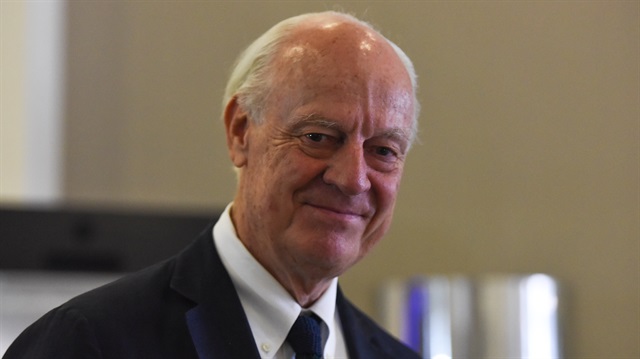
Staffan de Mistura
U.N. Syria envoy Staffan de Mistura has invited the United States and six other countries for talks in Geneva next month, a U.N. spokeswoman said on Tuesday, as the United Nations continues its push for a new Syrian constitution.
He plans to meet senior representatives from the United States, Britain, Saudi Arabia, Jordan, Germany, France and Egypt on Sept. 14, two days after he meets officials from Russia, Turkey and Iran on Sept 11-12 for previously announced talks.
"This is going to be an opportunity to discuss the way ahead on the political process," U.N. spokeswoman Alessandra Vellucci said.
U.S. lawyers urged the International Court of Justice (ICJ) on Tuesday to dismiss an Iranian lawsuit calling for a lifting of U.S. sanctions against Tehran, saying its real aim was to restore a 2015 nuclear pact rejected by President Donald Trump.The ICJ is the United Nations' highest court for resolving disputes between nations. Its rulings are binding, but it has no power to enforce them, and the United States and Iran are both among a handful of countries that has ignored its decisions.Iran argues that the reimposed U.S. sanctions, which are undermining its already weak economy, violate a 1955 friendship treaty between the two countries - signed before Iran's 1979 Islamic revolution and the sharp deterioration in bilateral ties that has endured until today.Video: World Court hears Iran suit to have US sanctions liftedBut U.S. State Department Legal Adviser Jennifer Newstead said on the second day of oral arguments in the case that Iran's appeal based on the 1955 Treaty of Amity was a legal dodge."Iran is endeavouring to use the procedures of the Treaty of Amity to enforce rights that it claims under an entirely different (agreement) that specifically excludes judicial remedies," she said.Newstead said U.S.-Iranian disagreements should be resolved through diplomacy and not by the court.Iran oil exports set to drop in August ahead of US sanctionsTrump pulled out of what he described as a flawed 2015 pact between Iran and major world powers under which sanctions were lifted in return for Tehran accepting curbs on its nuclear programme. The Trump administration then announced unilateral plans to restore sanctions against Tehran.BUSINESS CONCERNSAlthough Washington’s European allies protested against the move, most Western companies intend to adhere to the sanctions, preferring to lose business in Iran than be punished by the United States or barred from doing business there."This case is entirely about an attempt to compel the U.S. by order of this court to resume" the 2015 nuclear deal, Newstead said.Iran’s parliament blames Rouhani for economic troubles, refers him to judiciaryThe Trump administration has said its decision to quit the 2015 deal were prompted by U.S. national security concerns, including the threat it says is posed by Iran's nuclear programme and Tehran's involvement in conflicts in Syria, Iraq and Yemen.Iran asked the ICJ, which is also known as the World Court, on Monday to order Washington to suspend the sanctions temporarily while it hears Iran's case in full, a process that could take years. Washington says that request must be rejected.A provisional ruling is expected within a month, though no date has been set. Rouhani vows to defeat 'anti-Iranian' officials in the White House
US: Iran misusing World Court with suit aimed at lifting sanctions
De Mistura is tasked with forming a committee of Syrian citizens to draw up the new constitution, after receiving nominations from the Syrian government and the opposition.
The planned meetings follow a similar set of talks with both groups of countries in June, although Egypt was not involved in that round.
The discussions about setting up a constitutional committee have made slow progress and represent a big downgrade in the United Nations' ambitions for Syrian peace talks.
The Washington administration, which intends to maintain a permanent presence in Syria, has completed the construction of three advanced radar systems in Syria’s Hasakah-Tal Baidar countryside along with the Ayn al-Arab and Sarrin regions, and has set up 13 portable and fixed observation-intelligence radar systems.Speaking to Yeni Şafak daily, former Commander of Syria's Deir Ezzor Military Assembly Fayez al-Esmer evaluated the U.S.’s latest moves in Syria and said that in an addition to all attempts to protect Kurdistan Workers’ Party (PKK) terrorists in the region, Pentagon is in preparation to set up a missile defense shield in Syria’s Hasakah and Rmeilan.“The U.S.’s next step is to build a missile defense shield in the region which must be considered as a part of Washington’s long-term plan for chaos in the region,” he said.The U.S. has already begun to create a new no-fly-zone in northern Syria, the same tactic used in the 1991 occupation of Iraq, and started to install advanced radar systems in a 26,000 square kilometer area occupied by the Syrian affiliate of the Kurdistan Workers’ Party (PKK), the PYD, east of the Euphrates. US sets up radars in northern Syria to ‘protect PKK terrorists’Alternatives to Incirlik Air Base Additionally, the U.S administration is looking for alternatives to Incirlik Air Base because of its current strained relationship with Turkey.Incirlik Air base was used during the defeated 15 July coup attempt to aid terrorists of the Fetullah Terrorist Organization (FETÖ) as well as to provide logistics support to Kurdistan Workers’ Party (PKK) in Syria.U.S. warplanes at Incirlik Air Base were moved to other bases, and only cargo planes, refueling aircraft, and scout planes remain.Lately, the U.S. is converting its bases into aerial operation centers in Iraq’s Al Asad, Ayn al-Asad, Qayyarah, as well as those in Rimeylan, Ayn el Arab, Tal Baidar and Sarrin in Syria.Turkey and the U.S. are currently experiencing rocky relations following Washington’s imposition of sanctions on Interior Minister Süleyman Soylu and Justice Minister Abdülhamit Gül for not releasing American Pastor Andrew Brunson, who faces terrorism charges in Turkey.U.S. President Donald Trump ramped up his attack on Turkey by doubling U.S. tariffs on Turkish aluminum and steel imports to 20 percent and 50 percent, respectively. They will monitor Turkey from the border Stressing Pentagon’s lengthy plan for chaos in the region, al-Esmer said that all these steps indicate that the U.S. administration intends to strengthen its presence in Syria while providing support to PKK terrorists.The advanced radar systems will especially be used to monitor Turkey’s air and ground operations at the border, he added.Esmer also said that U.S. warplanes will be more active in the regions of Hasakah, Raqqa and Deir ez-zor and that information received from these points will be transferred to the air forces to create a protection shield.He stressed that all these initiatives must be considered as moves to “intimidate” Turkey, Russia and Iran.Russia and Turkey, along with Iran are sponsoring the Astana peace talks, which focuses on a cease-fire and ending the seven-year civil war in Syria.“The Washington administration has realized that the PKK is insufficient regarding its plans related to east of the Euphrates. Therefore, it will further fortify its military presence in the region. On the other hand, U.S. activities carried out in Syria and Iraq is due to its determination to exploit underground resources,” Esmer added.The U.S has supplied the PYD terror organization and its armed wing, the YPG, with more than 5,000 truckloads of weapons to allegedly use in the fight against Daesh, despite Ankara’s warnings that the fact they are the Syrian offshoots of the PKK terror organization.Russia says sees signs US preparing for possible strike on Syria836 detainees die in Syrian regime prisons: NGODriven from home, White Helmet rescuers start over in north SyriaIran and Syria sign deal for military cooperation
‘US seeks to strengthen presence in Syria by setting up missile defense shield’
For two years the warring sides repeatedly came to Geneva, in a futile search for agreement on political reforms, a new constitution and new elections.
But this year, with little U.S. political involvement and major gains on the battlefield by Syrian President Bashar al-Assad and his Russian and Iranian allies, the U.N. political process has largely evaporated.