

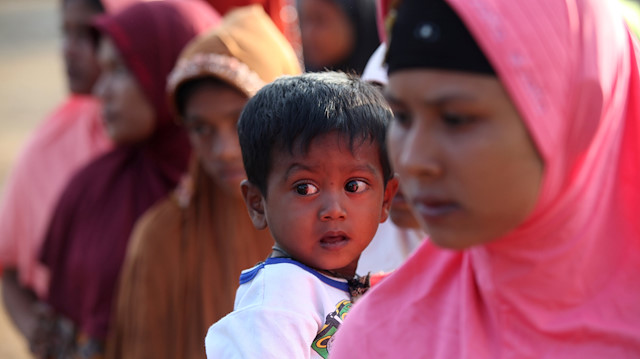
Rohingya Muslims who landed in northwest Indonesia by boat wait in line for breakfast at the makeshift shelter in Bireuen, Aceh province, Sumatra, Indonesia April 21, 2018.
Outspoken Burmese activist Ro Nay San Lwin sheds light on Saudi Arabia’s infamous al-Shumaisi Detention Center in Jeddah, where thousands of Rohingya Muslims, who fled from violence and persecution in their homeland of Myanmar’s Rakhine state to the kingdom, are held because Riyadh claims they entered illegally. Lwin is a coordinator of the Free Rohingya Coalition and has been living abroad since 2001 because of the restrictions of his home country.
Since Aug. 25, 2017, nearly 24,000 Rohingya Muslims have been killed by Myanmar’s state forces, according to a report by the Ontario International Development Agency (OIDA).
More than 34,000 Rohingya were also thrown into fires, while over 114,000 others were beaten, said the OIDA report, titled "Forced Migration of Rohingya: The Untold Experience."
Some 18,000 Rohingya women and girls were raped by Myanmar’s army and police and over 115,000 Rohingya homes were burned down and 113,000 others vandalized, it added.
A UN human rights official has implored Bangladesh to shelve its plans to start the repatriation of Rohingya Muslims to Myanmar this month, fearing they may face violence or abuse."I have not seen any evidence of the Government of Myanmar taking concrete and visible measures to create an environment where the Rohingya can return to their place of origin and live there safely with their fundamental rights guaranteed," Yanghee Lee, the special rapporteur on human rights in Myanmar, said in a statement on the UN website on Tuesday.Lee said she fears the Rohingya may face suffering, violence, or abuse as Myanmar has failed to take any tangible measures for the Rohingya's return to the border state of Rakhine in November.Facebook says human rights report shows it should do more in Myanmar"Not only did the Rohingya face horrific violence at the hands of security forces in 2016 and 2017 with no accountability, they have been subjected to decades-long systematic discrimination and persecution in Myanmar," Lee said, urging both Bangladesh and Myanmar to call off the repatriation."I urge the Governments of Bangladesh and Myanmar to halt these rushed plans for repatriation, to ensure the protection of the Rohingya refugees and to adhere to their international human rights and refugee law obligations to ensure any returns are safe, sustainable, voluntary and dignified," she added.Persecution of RohingyaThe Rohingya, described by the UN as the world's most persecuted people, have faced heightened fears of attack since dozens were killed in communal violence in 2012.Since Aug. 25, 2017, nearly 24,000 Rohingya Muslims have been killed by Myanmar’s state forces, according to a report by the Ontario International Development Agency (OIDA).Bangladesh court sentences two to death for war crimesMore than 34,000 Rohingya were also thrown into fires, while over 114,000 others were beaten, said the OIDA report, titled "Forced Migration of Rohingya: The Untold Experience."Some 18,000 Rohingya women and girls were raped by Myanmar’s army and police and over 115,000 Rohingya homes were burned down and 113,000 others vandalized, it added.According to Amnesty International, more than 750,000 Rohingya refugees, mostly children, and women, fled Myanmar and crossed into neighboring Bangladesh after Myanmar forces launched a crackdown on the minority Muslim community in August 2017.The UN has documented mass gang rapes, killings -- including of infants and young children -- brutal beatings, and disappearances committed by Myanmar state forces. In a report, UN investigators said such violations may have constituted crimes against humanity.
UN official urges Bangladesh to halt Rohingya returns
Many Rohingya Muslims have had to leave their homelands over the past few years, just like you. Some of them also traveled to Saudi Arabia. But there seems to be a problem here. What is it?
First of all, it is necessary to note that there are approximately 300,000 Rohingya Muslims in Saudi Arabia. Most of these people entered with the passports of Bangladesh and surrounding countries. Unfortunately, unjust treatment of these passports were fake and they became illegal. There have been two cases of victimization. People who were forced to leave their lands under the pressure of the Myanmar state were defrauded by human traffickers. Before 2010, this situation was relatively tolerable because the introduction of fingerprinting in Saudi Arabia had not started yet. In this case, even if you entered the country illegally, you could stay for many years without being pursued. With the implementation of fingerprint scanning, this has been eliminated. The state can easily find you wherever you go. Rohingya Muslims do not want to live illegally. They want to live a normal life, earn money and take care of their families. Unfortunately, they have to pay the price of being stateless wherever they go.
What kind of price is Saudi Arabia making Rohingya Muslims pay?
There is al-Shumaisi Detention Center in Jeddah. Of course, we cannot know the exact figure [of detained Rohingya] because there is no official number. However, I believe there are two to three thousand Rohingya Muslims held there. The camp is quite large, and I believe it has the capacity to host 30,000 people. It is possible to say that the conditions are not very different to a concentration camp.
What kind of place is this? Isn’t is possible for humane living conditions to be established?
We are talking about a place where communication facilities are very limited: there is no newspaper and television, and even mobile phones can only be provided by illegal means. It is essentially the life of a prisoner: your freedom is taken away. Some people can't get out of there for years. There are even those who cannot stand the conditions, lose hope for the future and commit suicide. The administration of Saudi Arabia has to provide refugee status to these victims and get them out of that camp immediately.
Facebook Inc on Monday said a human rights report it commissioned on its presence in Myanmar showed it had not done enough to prevent its social network from being used to incite violence.The report by San Francisco-based nonprofit Business for Social Responsibility (BSR) recommended that Facebook more strictly enforce its content policies, increase engagement with both Myanmar officials and civil society groups and regularly release additional data about its progress in the country."The report concludes that, prior to this year, we weren't doing enough to help prevent our platform from being used to foment division and incite offline violence. We agree that we can and should do more," Alex Warofka, a Facebook product policy manager, said in a blog post.Myanmar officials try to convince Rohingya to return, accept ID cardsBSR also warned that Facebook must be prepared to handle a likely onslaught of misinformation during Myanmar's 2020 elections, and new problems as use of its WhatsApp grows in Myanmar, according to the report, which Facebook released.A Reuters special report https://www.reuters.com/invest... in August found that Facebook failed to promptly heed numerous warnings from organizations in Myanmar about social media posts fueling attacks on minority groups such as the Rohingya.In August 2017 the military led a crackdown in Myanmar’s Rakhine State in response to attacks by Rohingya insurgents, pushing more than 700,000 Muslims to neighboring Bangladesh, according to U.N. agencies.Bangladesh says Rohingya repatriation to start mid Nov.The social media website in August removed several Myanmar military officials from the platform to prevent the spread of "hate and misinformation," for the first time banning a country's military or political leaders.It also removed dozens of accounts for engaging in a campaign that "used seemingly independent news and opinion pages to covertly push the messages of the Myanmar military."The move came hours after United Nations investigators said the army carried out mass killings and gang rapes of Muslim Rohingya with “genocidal intent.”Facebook said it has begun correcting shortcomings.Rohingya genocide continues in Myanmar: Rights groupFacebook said that it now has 99 Myanmar language specialists reviewing potentially questionable content. In addition, it has expanded use of automated tools to reduce distribution of violent and dehumanizing posts while they undergo review.In the third quarter, the company said it "took action" on about 64,000 pieces of content that violated its hate speech policies. About 63 percent were identified by automated software, up from 52 percent in the prior quarter.Human Rights Watch (HRW) in Asia said the report showed Facebook is working hard to address the issues and should step up its efforts, especially in combating hate speech ahead of the general election in 2020."It’s often said that in Myanmar, for all intents and purposes Facebook really is the Internet because of its widespread use among online users -- so Facebook needs to act accordingly to head off what will likely be a tsunami of hate speech and attacks in the 2020 election," said Phil Roberston, HRW deputy director.Facebook has roughly 20 million users in Myanmar, according to BSR, which warned Facebook faces several unresolved challenges in Myanmar.BSR said locating staff there, for example, could aid in Facebook's understanding of how its services are used locally but said its workers could be targeted by the country's military, which has been accused by the U.N. of ethnic cleansing of the Rohingya.
Facebook says human rights report shows it should do more in Myanmar
Is it correct that there is a circulation in place?
Yes, they are sending people back to the countries they came from. Those who enter Saudi Arabia via Bangladesh are relatively lucky, because there is an agreement between the two countries. Bangladesh has to take back refugees from Saudi Arabia. However the situation is dire for those who entered Saudi Arabia from India, Pakistan and Nepal, because these countries do not want to take back the Rohingya. Many of those who stayed at Shumaisi for extended periods and went mad and committed suicide, are from these countries.
These peoples aren’t thieves or murderers. They came to a Muslim country because they thought they would find comfort there as they could not take shelter in their own countries. Is this situation not under the umbrella of human rights?
These people are not involved in any crime. Just like everybody else, they are normal people. There are some who have been held in the camp for five to six years. Besides, they have come there after already being victims. And they have had to suffer further. This is a human tragedy. There is, of course, a violation of human rights. However, as you will appreciate, there is no point in raising any issue in Saudi Arabia in the context of human rights. It's not ready for such a concept yet. It is unthinkable for anyone to go out on the street and make an ordinary, simple action regarding human rights. It's a geography where security concerns are overwhelming. Even its own citizens cannot raise their voices about freedoms, and I do not think that foreigners have such a luxury.
What do you see in the future of Rohingya Muslims? Are you hopeful about tomorrow?
Everything depends on the international community's response. It is clear that the Myanmar government committed genocide and a crime against humanity. If there is serious pressure on the administration of Myanmar, at least some fundamental rights will come to the agenda. Otherwise, it appears that there will be no possible improvement in the current situation. However, regardless of what is done or not done, we will continue to put up our own fight. We will continue to protect the dignity and rights of our people. We will raise our voice through every platform that we can find, because this is our cause of existence.
Myanmar is not safe enough for the return of hundreds of thousands of Rohingya in camps in Bangladesh, said Asian parliamentarians on Friday, urging both governments to halt plans for repatriation scheduled to begin this month.More than 700,000 Rohingya people crossed into Bangladesh in the four months after deadly attacks by Rohingya insurgents on security forces in August, 2017, which were followed by military operations that the United Nations said targeted civilians.Myanmar has denied most of the allegations.Bangladesh and Myanmar first reached a deal a year ago to begin repatriation, but the process has been delayed. Officials from both countries met this week and announced that it would begin in mid-November.Myanmar officials try to convince Rohingya to return, accept ID cards"This is a poorly thought-out plan," said Charles Santiago, head of ASEAN Parliamentarians for Human Rights, which is comprised of elected representatives from countries that are members of the Association of Southeast Asian Nations (ASEAN).He said Myanmar must first put in place plans for the protection and livelihoods of Rohingya who live under an apartheid-like system, facing restrictions on their movements, as well as access to healthcare, employment and education.Almost all Rohingya lack citizenship, and many of their villages were burned down during the military operations."They were still licking their wounds, they are still living in fear," said Santiago, a Malaysian lawmaker who led a fact-finding mission early this year to refugee camps in Bangladesh's Cox's Bazar district.Bangladesh says Rohingya repatriation to start mid Nov."We're not expecting them to go back to live in barracks and as squatters," he told the Thomson Reuters Foundation.Myint Thu, a senior Myanmar foreign ministry official, has said measures are in place to ensure "a secure environment" for the returnees.Human Rights Watch (HRW) said it had interviewed hundreds of Rohingya refugees and asylums seekers, many of whom said they would only go home if Myanmar guaranteed "security, access to land and livelihoods, freedom of movement, citizenship rights."Rohingya genocide continues in Myanmar: Rights groupDonors should not support the repatriation plan, the New York-based group said."Myanmar's government keeps talking about returns, but it has done nothing to allay the Rohingya's fears of being returned to the same violence and oppression they fled," said Bill Frelick, the group's refugee rights director, in a statement. The United Nations in August recommended that Myanmar military leaders be investigated and prosecuted for "genocide, crimes against humanity and war crimes" against the Rohingya.Stéphane Dujarric, a U.N. spokesman, told reporters this week that conditions "are not yet conducive for a return", and that refugees continue to flee across the border into Bangladesh.
Asian MPs urge halt to Rohingya repatriation plan amid safety fears
You must have discussed the matter with officials. The headquarters of the Organization of Islamic Cooperation (OIC), which was established to defend the rights of Muslims, is in Jeddah where Rohingya Muslims are being subjected to a great tragedy. Have you shared the situation with them?
I have elaborated on the matter in writing to both the Saudi authorities and the OIC. I asked them to help with the solution. To this day, I have not received a reply from either of them.
Did the OIC really not deal with the issue?
Unfortunately, they preferred to ignore the tragedy in their immediate vicinity. They know very well that the Rohingya are stateless people. In this world, there is a place where every community, all peoples can feel safe. Even the OIC did not back my people. This is a great shame. Can they say that they were not aware of the situation? We are a community that has been on the agenda of the world for years. Is there anyone who does not know of the pain we suffered? Moreover, we also informed them. We said: “There is a tragedy, please help.” We said this many times, but nobody cares. My people are treated like common criminals in the detention camp. What hurts the most is that the situation is pawned off as if it were supposed to be this way.
Myanmar officials visited camps for Rohingya Muslim refugees in Bangladesh on Wednesday in an effort to kickstart a process to repatriate hundreds of thousands who fled an army crackdown last year.More than 700,000 Rohingya refugees crossed into Bangladesh from western Myanmar, U.N. agencies say, after Rohingya insurgent attacks on Myanmar security forces in August 2017 triggered a sweeping military response.Officials said after meetings in Dhaka on Tuesday returns would begin next month, but the U.N. refugee agency said conditions in Rakhine state were “not yet conducive for returns".The agency had completed the second phase of assessment in Rakhine, but its access remained "limited", UNHCR spokesman Andrej Mahecic said in Geneva on Wednesday.Rohingya and other Muslims in three townships suffer hardship and economic vulnerability due to restrictions on their movement and the prevailing sentiment is "fear and mistrust", he said.A group of about 60 Rohingya community leaders met a delegation of about a dozen Myanmar officials in the Kutupalong camp, the largest refugee settlement in the world in Bangladesh's Cox's Bazaar district, said two Rohingya men who were present.Myanmar says it has been ready to accept back the refugees since January, and has built camps near the border to receive them."They told us we don't have to stay (in a camp) for long, but when we asked for how many days they could not say," said Mohib Ullah, an influential organiser in the camps, reflecting what the officials said.Bangladesh says Rohingya repatriation to start mid Nov.Reuters was unable to reach the Myanmar delegation for comment and government spokesman Zaw Htay did not pick up a call seeking comment.Mohib Ullah said Rohingya leaders wanted Myanmar to recognise them as an ethnic group with the right to Myanmar citizenship before they return.Myanmar does not consider the Rohingya a native ethnic group. Many in the Buddhist-majority country call the Rohingya "Bengalis", suggesting they belong in Bangladesh.A pamphlet given to refugees by Myanmar officials on Wednesday, seen by Reuters, encourages them to accept new identity cards as a "first step" to citizenship. Many Rohingya reject the cards, which they say treat them as foreigners.Those with "national verifications cards" - known as NVCs - would be guaranteed "socio-economic development", but those without will be "stateless", the pamphlet says."When we asked about our citizenship there was no answer," said Abdur Rahim, another Rohingya at the meeting. "They told us to accept NVCs. We are not accepting NVCs. We are not Bengali."Rohingya genocide continues in Myanmar: Rights groupThe Rohingya leaders handed over a letter to Myanmar leader Aung San Suu Kyi setting out their demands, including "compensation and reparations" for violence committed against Rohingya.U.N. rights investigators said in August that Myanmar’s military acted with “genocidal intent” in the crackdown last year.The administration of Nobel laureate Suu Kyi has denied most of the allegations, arguing it was a legitimate response to quell "terrorism".China, which has provided diplomatic cover to Myanmar over the exodus, has brokered talks with Bangladesh aimed at speeding up repatriation.Western countries and the United Nations, while calling for accountability for abuses committed by the military, have stressed that any returns must be voluntary.The repatriation faces resistance from Rakhine Buddhists who make up the majority in western Myanmar's Rakhine state, which the Rohingya also consider their homeland.Than Tun, a Rakhine community leader, said those who return should be confined to a part of the Maungdaw area close to the border and not allowed to resettle some formerly Muslim-majority areas."We Rakhine don’t want them to come back at all, but we understand there's international pressure," he said, adding anyone who does return should be placed in "certain secure locations".
Myanmar officials try to convince Rohingya to return, accept ID cards
Some states hinder our work in raising awareness about the Rohingya genocide in Myanmar, head of a rights groups said Sunday.Kyaw Win, director of Burma Human Rights Network (BHRN), said: “Some countries in the UN Security Council seem to prefer their interests over humanity. Some superpowers put obstacles in front of us on the Myanmar issue.”Speaking on the sidelines of a session on Myanmar at the UN Security Council, he said: “This is very important: genocide against Rohingya Muslims continues in Myanmar, it’s not over yet. I am surprised that some countries still downplay this issue.Muslims living in Myanmar face many persecutions. There are 76 regions where Muslims are forbidden to enter. Muslims are not given jobs in many places. "Since the beginning of 2018, 20 mosques have been closed all over the country and some churches have been locked down. Religious freedom is under threat in Myanmar."Praising efforts by Turkey on the issue, he said: "I want to thank the leaders and people of Turkey. You are a great example in the Muslim world and you have been the first to respond to this crisis. We admire your efforts. I would also like to call the Organization of Islamic Cooperation (OIC) to put more pressure on Myanmar government to solve this problem as soon as possible. Please help us on this issue."The Rohingya, described by the UN as the world's most persecuted people, have faced heightened fears of attack since dozens were killed in communal violence in 2012.Myanmar court frees journalists on bail in incitement caseSince Aug. 25, 2017, nearly 24,000 Rohingya Muslims have been killed by Myanmar’s state forces, according to a report by the Ontario International Development Agency (OIDA).More than 34,000 Rohingya were also thrown into fires, while over 114,000 others were beaten, said the OIDA report, titled "Forced Migration of Rohingya: The Untold Experience".Some 18,000 Rohingya women and girls were raped by Myanmar’s army and police and over 115,000 Rohingya homes were burned down and 113,000 others vandalized, it added.According to Amnesty International, more than 750,000 Rohingya refugees, mostly children, and women, fled Myanmar and crossed into Bangladesh after Myanmar forces launched a crackdown on the minority Muslim community in August 2017.The UN has documented mass gang rapes, killings -- including of infants and young children -- brutal beatings, and disappearances committed by Myanmar state forces. In a report, UN investigators said such violations may have constituted crimes against humanity.
Rohingya genocide continues in Myanmar: Rights group
China, backed by Russia, failed on Wednesday to stop a United Nations Security Council briefing by the chair of a U.N. inquiry that accused Myanmar’s military of genocide against Rohingya Muslims and urged the 15-member council to push for justice.“Atrocities continue to take place today,” Marzuki Darusman, chair of the U.N. Fact Finding Mission on Myanmar, told reporters ahead of the council briefing. “It is an ongoing genocide that is taking place.”Global pressure is mounting on Myanmar to act on accountability after a Myanmar military crackdown in the western state of Rakhine last year drove some 700,000 of the largely stateless minority over the border into Bangladesh.Darusman told the Security Council that remaining Rohingya in Rakhine were “at grave risk” and returning those who have fled “in this context is tantamount to condemning them to life as sub-humans and further mass killing.”Genocide ongoing in Myanmar, says UN investigatorMyanmar has rejected the findings of the U.N. report.“We are willing and able to take on the accountability issues for any alleged human rights violation where there is sufficient evidence,” Myanmar’s U.N. Ambassador Hau Do Suan told the Security Council.The military crackdown followed attacks by Rohingya militants on security posts. Myanmar has denied committing atrocities against the Rohingya, saying its military carried out justifiable actions against militants.“The crimes we have heard echo those committed in Rwanda and Srebrenica some twenty years ago. The Security Council acted in those two situations. It acted too late to prevent them which is all to our lasting shame but it did act to ensure accountability,” British U.N. Ambassador Karen Pierce told the council.Australia slaps sanctions on Myanmar army top brassBritain coordinates council action on Myanmar and Pierce said she would push for “accountability that genuinely ends the Burmese military’s impunity.”The U.N. inquiry’s report, released in August, called for the Security Council to impose an arms embargo on Myanmar, targeted sanctions and set up an ad hoc tribunal to try suspects or refer them to the International Criminal Court (ICC).“National sovereignty is not a license to commit crimes against humanity or genocide,” Darusman told the council. “The Rohingya and all of Myanmar’s people, in fact the entire world, is looking at you to take action.”However, diplomats say council veto powers China and Russia are likely to protect Myanmar from any action. Myanmar’s U.N. ambassador said the country would never accept an ICC referral.Malaysian deputy PM criticizes Myanmar leaderBritain, France, the United States and six other members requested Wednesday’s briefing, but China called a vote to try to stop it. Nine countries voted in favor of the briefing - the minimum needed - while China, Russia and Bolivia voted against and Ethiopia, Equatorial Guinea and Kazakhstan abstained.China’s U.N. Ambassador Ma Zhaoxu told the council “it should not get involved in country-specific human rights issues” and that the briefing would be counterproductive to efforts to solve the situation.In Beijing, Chinese foreign ministry spokeswoman Hua Chunying said China had always maintained that the international community should allow a compromise and cooperation between Myanmar and Bangladesh.“The Security Council is not the appropriate place to discuss human rights issues,” she told a regular news briefing, adding that the briefing interfered with the talks between Myanmar and Bangladesh and was not beneficial to an appropriate resolution of the issue.Russian U.N. Ambassador Vassily Nebenzia accused the nine members who called the meeting of “intentionally torpedoing” council consensus on the issue.
China fails to stop UN Security Council Myanmar briefing