

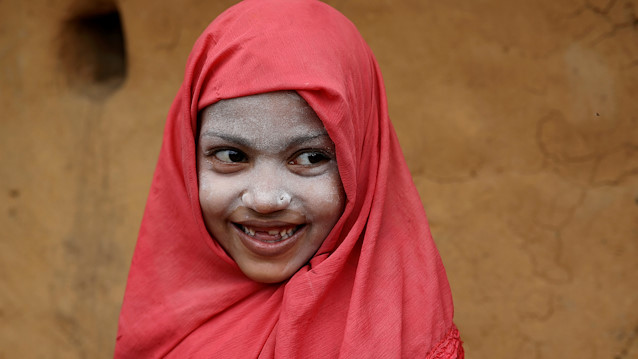
A Rohingya refugee girl smiles as she applies Thanaka paste in the Kutupalong camp in Cox's Bazar
Myanmar officials visited camps for Rohingya Muslim refugees in Bangladesh on Wednesday in an effort to kickstart a process to repatriate hundreds of thousands who fled an army crackdown last year.
More than 700,000 Rohingya refugees crossed into Bangladesh from western Myanmar, U.N. agencies say, after Rohingya insurgent attacks on Myanmar security forces in August 2017 triggered a sweeping military response.
Officials said after meetings in Dhaka on Tuesday returns would begin next month, but the U.N. refugee agency said conditions in Rakhine state were “not yet conducive for returns".
The agency had completed the second phase of assessment in Rakhine, but its access remained "limited", UNHCR spokesman Andrej Mahecic said in Geneva on Wednesday.
Rohingya and other Muslims in three townships suffer hardship and economic vulnerability due to restrictions on their movement and the prevailing sentiment is "fear and mistrust", he said.
A group of about 60 Rohingya community leaders met a delegation of about a dozen Myanmar officials in the Kutupalong camp, the largest refugee settlement in the world in Bangladesh's Cox's Bazaar district, said two Rohingya men who were present.
Myanmar says it has been ready to accept back the refugees since January, and has built camps near the border to receive them.
"They told us we don't have to stay (in a camp) for long, but when we asked for how many days they could not say," said Mohib Ullah, an influential organiser in the camps, reflecting what the officials said.
The first group of Rohingya will be sent to Myanmar in mid-November, a Bangladeshi official said Tuesday following a meeting with Myanmar officials in Dhaka.The announcement came amid international concern and criticism of the repatriation process of the most persecuted community which fled military brutality in the western Rakhine state of Myanmar.Bangladeshi Foreign Secretary Shahidul Haque told reporters following the Bangladesh-Myanmar joint working group meeting that both countries are planning to send the first group of Rohingya to Rakhine in mid-November, without providing any specific date, Bengali daily Prothom Alo reported.The meeting was held to discuss the development regarding the repatriation process, which was inked by top diplomats of both countries last December.The repatriation was scheduled to start earlier this year, as part of the agreement, but Bangladesh blamed Myanmar for unusual delay.In February, Bangladesh handed over a list of 8,032 Rohingya to Myanmar as the first group to be repatriated, according to Haque. However, the Yangon authority only evaluated around 6,000 Rohingya for alleged terror links last month, he added.Following the evaluation Myanmar agreed to accept only 4,600 Rohingya while they claimed 52 Rohingya were terrorists and showed reluctance to accept around 1,500 refugees.Rohingya genocide continues in Myanmar: Rights groupSafety concernsTuesday’s meeting was the third of its kind, said Haque, without providing further details about the repatriation process such as which area in Rakhine the Rohingya will be settled or how their safety will be monitored.Rights organizations have repeatedly expressed their concern over the repatriation process as the killing of Rohingya is still ongoing in western Myanmar.Marzuki Darusman, the chair of the UN's fact-finding mission in Myanmar, told reporters at the UN headquarters in New York on Oct. 24 that atrocities tantamount to genocide against Myanmar's Rohingya Muslim minority continue to take place."This is an ongoing genocide," he said, while calling on the international community to act to stop the abuses.Human Rights Watch, Amnesty International, Burma Human Rights Network, Free Rohingya Coalition and European Rohingya Council are among several organizations which objected to repatriation claiming it was unsafe to return.Despite repeated assurance by Bangladesh that repatriation will not take place until humanitarian situation and basic rights are improved, they have failed to convince the Rohingya community and rights groups.Last year's agreement also says the repatriation will be voluntary.Neither Bangladesh nor Myanmar have disclosed whether the listed 8,000 Rohingya are willing to return to their country without getting any kind of international protection.Genocide ongoing in Myanmar, says UN investigatorPersecutionThe Rohingya, described by the UN as the world's most persecuted people, have faced heightened fears of attack since dozens were killed in communal violence in 2012.Since Aug. 25, 2017, nearly 24,000 Rohingya Muslims have been killed by Myanmar’s state forces, according to a report by the Ontario International Development Agency (OIDA).More than 34,000 Rohingya were also thrown into fires, while over 114,000 others were beaten, said the OIDA report, titled "Forced Migration of Rohingya: The Untold Experience".Some 18,000 Rohingya women and girls were raped by Myanmar’s army and police and over 115,000 Rohingya homes were burned down and 113,000 others vandalized, it added.According to Amnesty International, more than 750,000 Rohingya refugees, mostly children, and women, fled Myanmar and crossed into Bangladesh after Myanmar forces launched a crackdown on the minority Muslim community in August 2017.The UN has documented mass gang rapes, killings -- including of infants and young children -- brutal beatings, and disappearances committed by Myanmar state forces. In a report, UN investigators said such violations may have constituted crimes against humanity.
Bangladesh says Rohingya repatriation to start mid Nov.
Reuters was unable to reach the Myanmar delegation for comment and government spokesman Zaw Htay did not pick up a call seeking comment.
Mohib Ullah said Rohingya leaders wanted Myanmar to recognise them as an ethnic group with the right to Myanmar citizenship before they return.
Myanmar does not consider the Rohingya a native ethnic group. Many in the Buddhist-majority country call the Rohingya "Bengalis", suggesting they belong in Bangladesh.
A pamphlet given to refugees by Myanmar officials on Wednesday, seen by Reuters, encourages them to accept new identity cards as a "first step" to citizenship. Many Rohingya reject the cards, which they say treat them as foreigners.
Those with "national verifications cards" - known as NVCs - would be guaranteed "socio-economic development", but those without will be "stateless", the pamphlet says.
"When we asked about our citizenship there was no answer," said Abdur Rahim, another Rohingya at the meeting. "They told us to accept NVCs. We are not accepting NVCs. We are not Bengali."
Some states hinder our work in raising awareness about the Rohingya genocide in Myanmar, head of a rights groups said Sunday.Kyaw Win, director of Burma Human Rights Network (BHRN), said: “Some countries in the UN Security Council seem to prefer their interests over humanity. Some superpowers put obstacles in front of us on the Myanmar issue.”Speaking on the sidelines of a session on Myanmar at the UN Security Council, he said: “This is very important: genocide against Rohingya Muslims continues in Myanmar, it’s not over yet. I am surprised that some countries still downplay this issue.Muslims living in Myanmar face many persecutions. There are 76 regions where Muslims are forbidden to enter. Muslims are not given jobs in many places. "Since the beginning of 2018, 20 mosques have been closed all over the country and some churches have been locked down. Religious freedom is under threat in Myanmar."Praising efforts by Turkey on the issue, he said: "I want to thank the leaders and people of Turkey. You are a great example in the Muslim world and you have been the first to respond to this crisis. We admire your efforts. I would also like to call the Organization of Islamic Cooperation (OIC) to put more pressure on Myanmar government to solve this problem as soon as possible. Please help us on this issue."The Rohingya, described by the UN as the world's most persecuted people, have faced heightened fears of attack since dozens were killed in communal violence in 2012.Myanmar court frees journalists on bail in incitement caseSince Aug. 25, 2017, nearly 24,000 Rohingya Muslims have been killed by Myanmar’s state forces, according to a report by the Ontario International Development Agency (OIDA).More than 34,000 Rohingya were also thrown into fires, while over 114,000 others were beaten, said the OIDA report, titled "Forced Migration of Rohingya: The Untold Experience".Some 18,000 Rohingya women and girls were raped by Myanmar’s army and police and over 115,000 Rohingya homes were burned down and 113,000 others vandalized, it added.According to Amnesty International, more than 750,000 Rohingya refugees, mostly children, and women, fled Myanmar and crossed into Bangladesh after Myanmar forces launched a crackdown on the minority Muslim community in August 2017.The UN has documented mass gang rapes, killings -- including of infants and young children -- brutal beatings, and disappearances committed by Myanmar state forces. In a report, UN investigators said such violations may have constituted crimes against humanity.
Rohingya genocide continues in Myanmar: Rights group
The Rohingya leaders handed over a letter to Myanmar leader Aung San Suu Kyi setting out their demands, including "compensation and reparations" for violence committed against Rohingya.
U.N. rights investigators said in August that Myanmar’s military acted with “genocidal intent” in the crackdown last year.
The administration of Nobel laureate Suu Kyi has denied most of the allegations, arguing it was a legitimate response to quell "terrorism".
China, which has provided diplomatic cover to Myanmar over the exodus, has brokered talks with Bangladesh aimed at speeding up repatriation.
Western countries and the United Nations, while calling for accountability for abuses committed by the military, have stressed that any returns must be voluntary.
The repatriation faces resistance from Rakhine Buddhists who make up the majority in western Myanmar's Rakhine state, which the Rohingya also consider their homeland.
Than Tun, a Rakhine community leader, said those who return should be confined to a part of the Maungdaw area close to the border and not allowed to resettle some formerly Muslim-majority areas.
"We Rakhine don’t want them to come back at all, but we understand there's international pressure," he said, adding anyone who does return should be placed in "certain secure locations".